
One of the major economic ironies afflicting Australia is that while there are more people graduating from university than ever before, productivity growth is hovering near an all-time low and there are persistent “skills shortages.”
The number of students enrolling in domestic universities increased by 43% between 2008 and 2020, oversupplying the labour market with graduates who possess degrees:
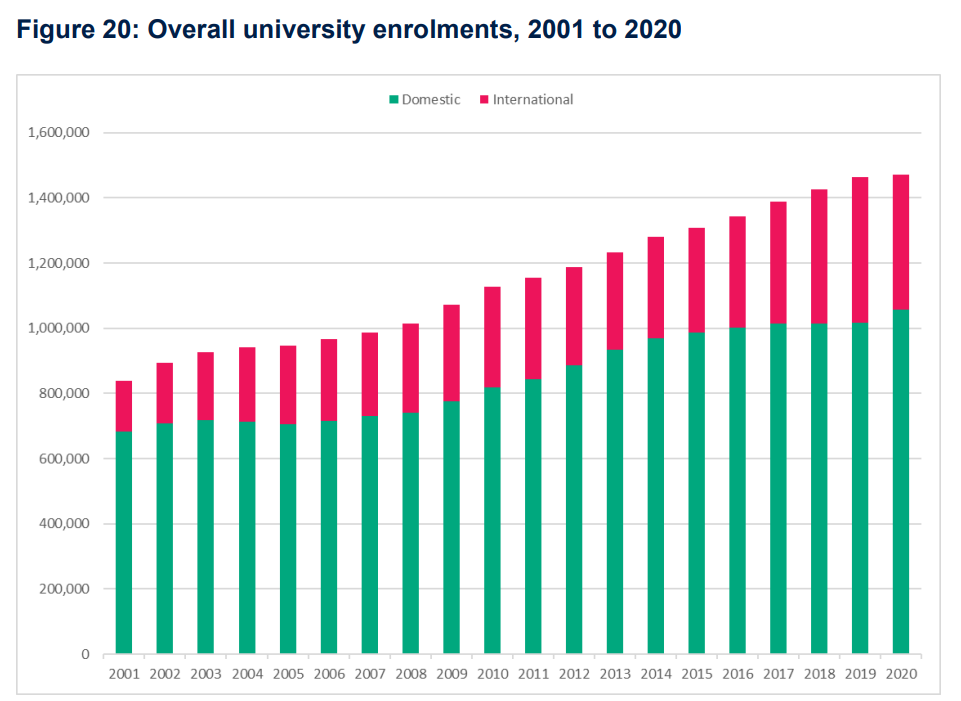
This follows a decade of deliberate government policy encouraging increasing participation in university.
Since 2009, the proportion of young people with a degree has increased from 29% in 2008 to more than 48% nationally in 2021.
By contrast, only 10% of young Australians do an apprenticeship.
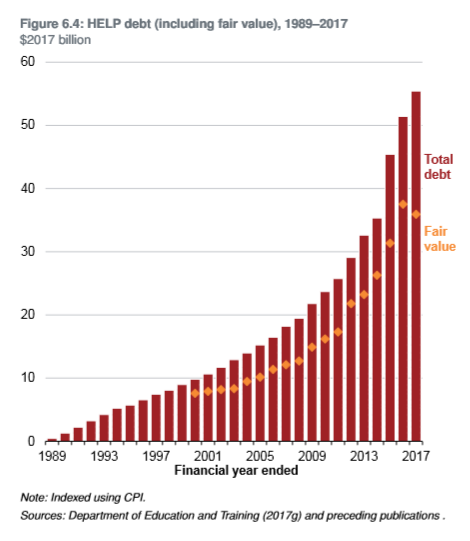
Accordingly, outstanding student loan debt has soared:
Government funding for universities has also risen strongly, while funding for vocational education and TAFE has plunged:
The end result is that Australia is now experiencing chronic skills shortages in areas requiring a vocational education, like the trades.
According to a quarterly Labour Market Update report from Jobs & Skills Australia, seven of the top 10 positions in demand only require for a vocational qualification.
These positions include child and disability carers, mechanics, and retail managers.
This is due to the fact that 60% of the employment increase over the past 12 months came from positions requiring a vocational qualification, whereas just 36% of jobs growth came from professions requiring a university degree.
A survey by the Ai Group’s Centre for Education and Training of 3,000 people over a 10-year period to the age of 25 has likewise found that trades people and people with postgraduate degrees are the most satisfied with their jobs, while they also earn the most money.
The results of the survey suggest a level of dissatisfaction with bachelor’s degrees, despite ongoing government efforts to increase the number of people with them.
“The study shows that some people with a bachelor’s degree are not necessarily making a good transition into the workforce, or they are not getting good alignment between what they have studied and the work they are doing. There is a skill mismatch”, Megan Lilly, head of the Ai Group’s Centre for Education and Training said.
“Happiness, incomes and productivity suffers”, she said.
The above data indicates that there are too many university graduates competing for too few professional jobs in Australia, while there is a persistent scarcity of skilled tradespeople and technicians.
This explains why industry organisations continuously moan about “skills shortages” despite the fact that Australia is producing more university graduates than ever.
The policy focus must be reversed. To start with, admittance requirements for both domestic and international students to universities should be raised.
It has never made sense to prioritise a university education over trade school or vocational training.
