
Goldman is always too hawkish on Australia. It is also too bullish on the US, China, and commodities. So, if you take those away then this call no longer makes any sense.
Nonetheless, it is noteworthy how widespread is the understanding that Alboflation is out of control.
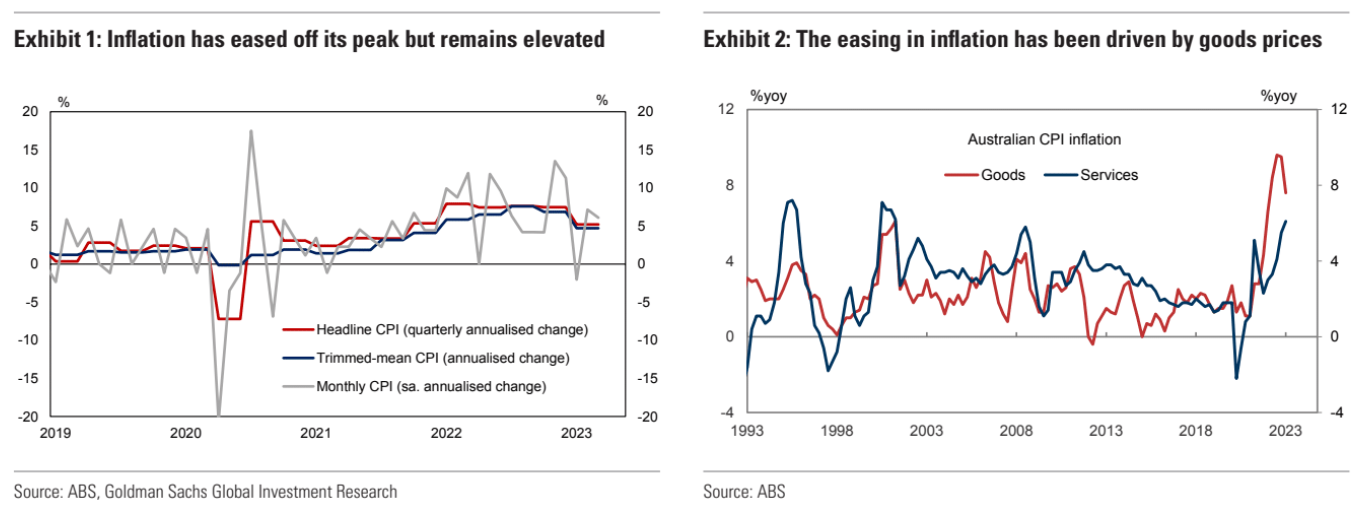
Bottom line: Australia’s 1Q2023 CPI data were broadly in line with our expectations, with inflation easing off its peak in 4Q2022 but remaining very elevated relative to the RBA’s 2-3% target.
The headline CPI rose 1.4%qoq, a bit above expectations (GSe/BBG: 1.3%qoq), with the year-ended rate easing -80bps to 7.0%yoy.
The trimmed-mean measure rose+1.2%qoq, a bit below expectations (GSe: +1.3%qoq; BBG: +1.4%qoq), with the year-ended rate easing -30bps to 6.6%yoy.
Compositionally, the easing in inflation momentum was driven by softer prices for durable goods and fuel, which offset ongoing inflation across services such as education, health, rents and financial services.
Looking ahead, while today’s data supports our view that RBA is likely to keep rates on hold in May/June to further ‘assess’ the impact of prior tightening, we continue to expect the RBA to resume hiking later in the year (GSe: +25bp in July and August) in response to persistently elevated wages growth and services inflation, as well as the impact of rising migration on Australia’s housing market.
Aside from anything else, the deleterious impacts of mass immigration on wages will more than offset rents. But it does all go to the argument that Alboflation is smashing living standards, most especially for the vulnerable.
