The latest monthly inflation gauge from the Australian Bureau of Statistics (ABS) revealed that overall rents across Australia’s capital cities rose by 4.8% in the year to January, “reflecting low vacancy rates and a tight rental market”:
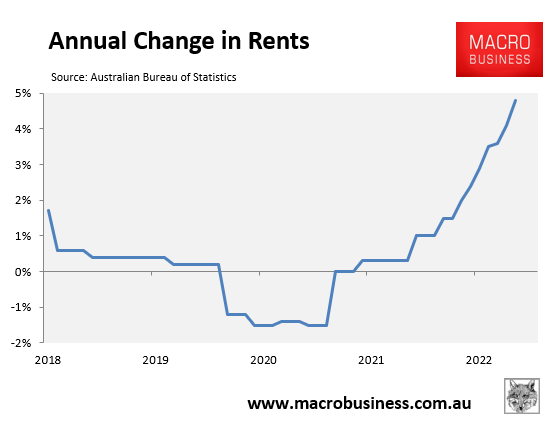
This was up from just 0.3% rental inflation recorded a year earlier.
Residential property rents account for around 6% of the total Consumer Price Index (CPI) basket, meaning the surge in rents is now a major contributor to Australia’s inflation problem.
To make matters worse, the ABS’ measure of rental inflation, which feeds into the CPI, will continue to rise strongly over the foreseeable future.
Private sector measures of asking rents are all posting double-digit increases.
For example, CoreLogic has asking rents growing at 10.9% across the combined capital cities, Domain reports circa 15% growth in asking rents, and SQM Research reports 27% rental growth across the combined capital cities.
The ABS’ recent explainer on rental measurements noted that “price changes observed in advertised rents series are expected to eventually flow through to the CPI Rents series”.
“However, the small share of rental properties leased to new tenants each quarter means that it takes some time for changes in advertised rents to impact price change observed in the CPI Rents series”, the ABS explained.
This means that the ABS’ measure of overall rents will continue to increase aggressively over 2023, which will add directly to Australia’s inflationary troubles.
Rents, alongside soaring utility bills, will become a major thorn in the side of the RBA as it attempts to fight against inflation.
This situation will be made worse by the Albanese Government’s ‘Big Australia’ immigration policy, which will drive record numbers of migrants into the rental market this year and next, putting further upward pressure on rents.