
Proof profits, not wages, are driving Australian inflation
There have been dire warnings that lifting wages in line with the inflation rate would result in a wage-price spiral.
However, ACTU secretary Sally McManus contends that Australia is experiencing a “greed-price spiral” due to the actions of the Reserve Bank and large companies that are keeping their prices much higher than necessary.
“Essentially, we’re seeing a transfer of wealth from working people to the big banks and supermarkets. It’s a greed-price spiral”, Sally McManus said.
Australian Industry Group chief executive Innes Willox countered claiming “compensation of employees, a much broader measure than wage rates, rose strongly over the year with the pace of growth easing in the December quarter”.
As usual, Innes Willox is talking out his backside.
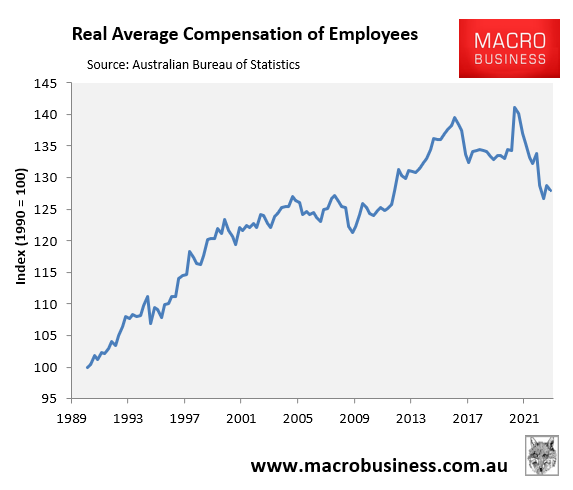
Real average compensation of employees has fallen sharply in real terms, slumping to 2012 levels:
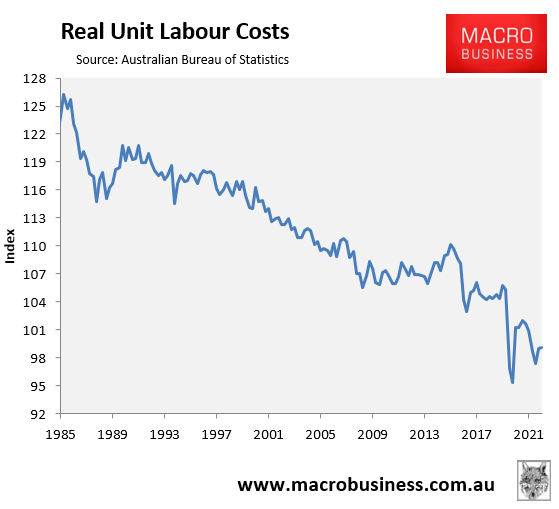
Moreover, the nation’s real unit labour cost (ULC), which “are an indicator of the average cost of labour per unit of output produced in the economy” and “are a measure of the costs associated with the employment of labour, adjusted for labour productivity”, is running 6.1% below its pre-pandemic level and is tracking near record lows:
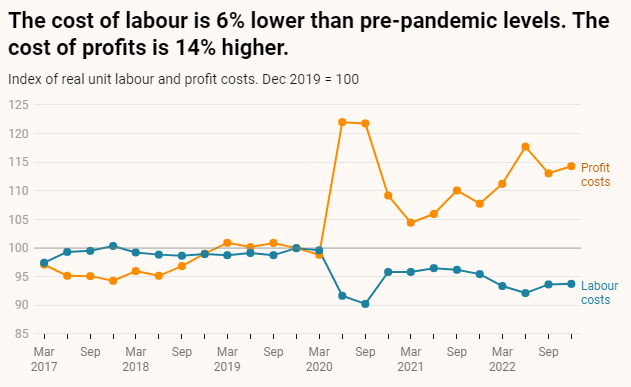
By contrast, the unit cost of profits is 14% above pre-pandemic levels, as illustrated below by Greg Jericho:
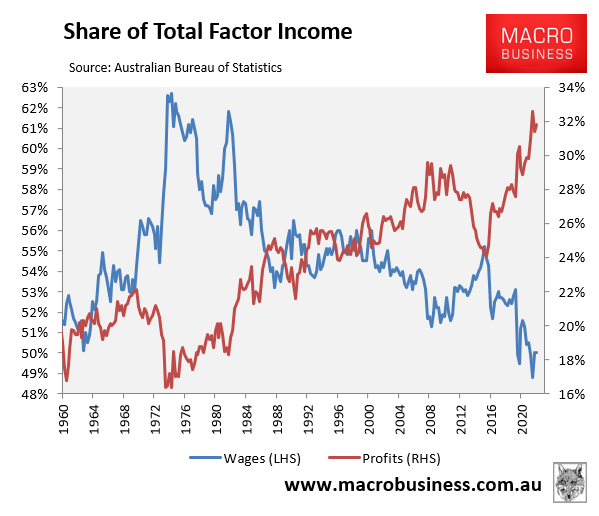
This helps to explain why the share of national income going to profits is running near a record high, while workers’ share is tracking near all-time lows:
Anybody genuinely concerned about Australia’s inflation should point the gun at big business price gouging, starting with the foreign-owned energy cartel.
