
Hard to argue with Michael Wilson at Morgan Stanley.
The speed and size of the SVB wind down was startling to most investors,even those who had been negative on the stock for months on the basis of exactly what transpired-a classic mismatch in assets/liabilities and risk taking beyond what a typical depositor does. Just so we are clear about our view here, we do not think there is a systemic issue plaguing the entire banking system like in 2007-09, particularly with the Fed/FDIC decision to back stop even uninsured deposits. However, last week’s events are likely to have a negative impact on economic growth at a time when growth is already waning in many parts of the economy.
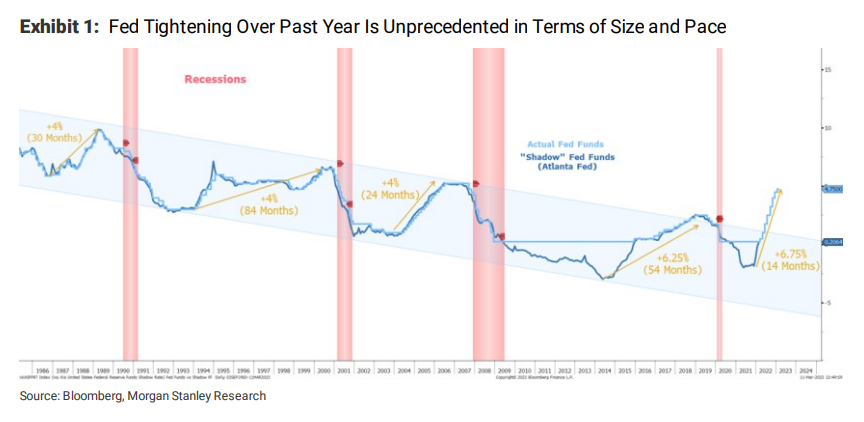
Rather than do a forensic autopsy on what happened at SVB (see our banking analysts’ reports), we will instead focus our attention on what this event may mean for equity prices more broadly.First, we would remind readers that Fed policy works with long and variable lags. Second, the pace of Fed tightening over the past year is unprecedented when one considers that the Fed has been engaged in aggressive quantitative tightening while raising the Fed Funds Rate by almost 500bps.
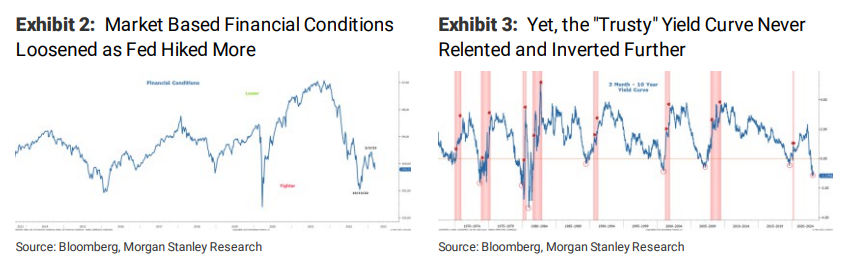
Third, the focus on “market based” measures of Financial Conditions may have lulled both investors and the Fed itself into thinking policy tightening had not yet gone far enough even though more traditional measures like the yield curve have been flashing warnings for the past 6+months. In fact, since mid October of last year, the market based financial conditions measures actually loosened considerably until the upward surprise on January payrolls was released. Since then, financial conditions have tightened again as equities and other risk markets sold off. However,atno point during this time did the trusty yield curve flinch. Instead, ithas steadily inverted further, closing last week near its lowest point of the cycle at -120bps.
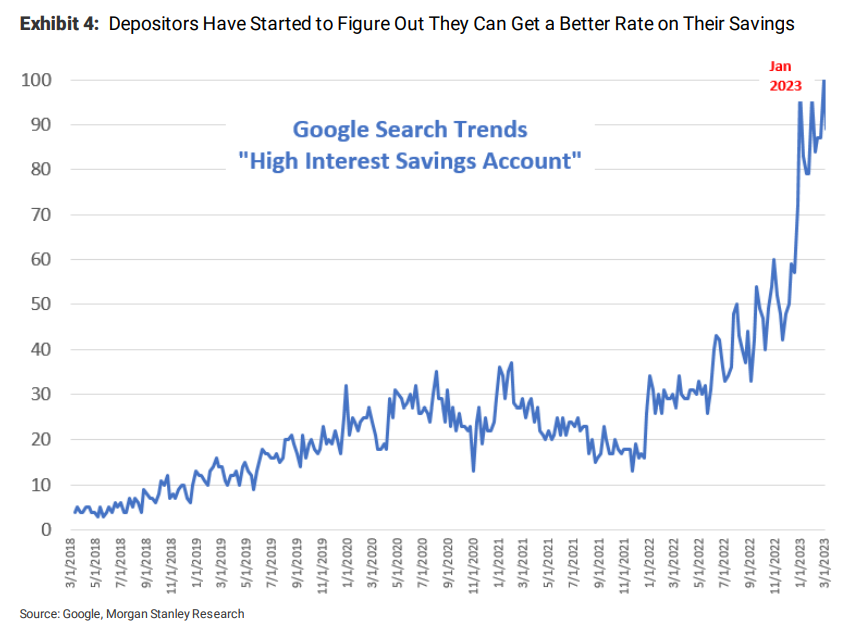
From a bank’s perspective, this has been a more challenging environment for making new profitable loans,and new credit is how money supply expands. However, over the past year, bank funding costs have not kept pace with the higher Fed Funds Rate allowing banks to create credit at profitable NIMs. In short, most banks have been paying well below market rates because depositors have been slow to realize they can get a much better rate elsewhere. But, thathas changed more recently with depositors deciding to pull their money from traditional banks and putting it into higher yielding securities like money markets, T-Bills and the like. We expect that trend to continue unless banks decide to raise the rate they pay depositors. That means lower profits and likely lower loan supply.
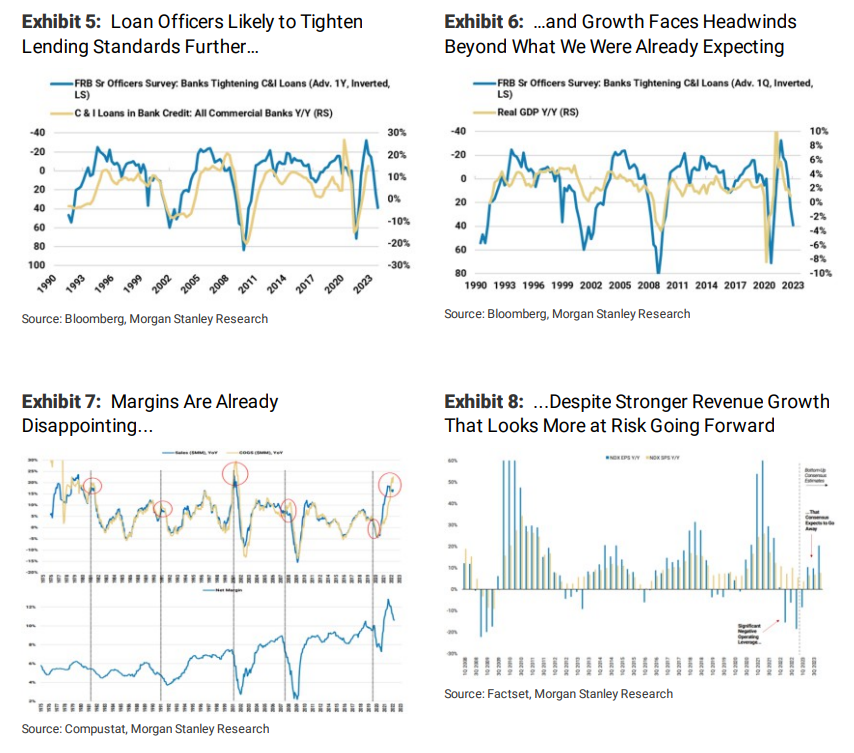
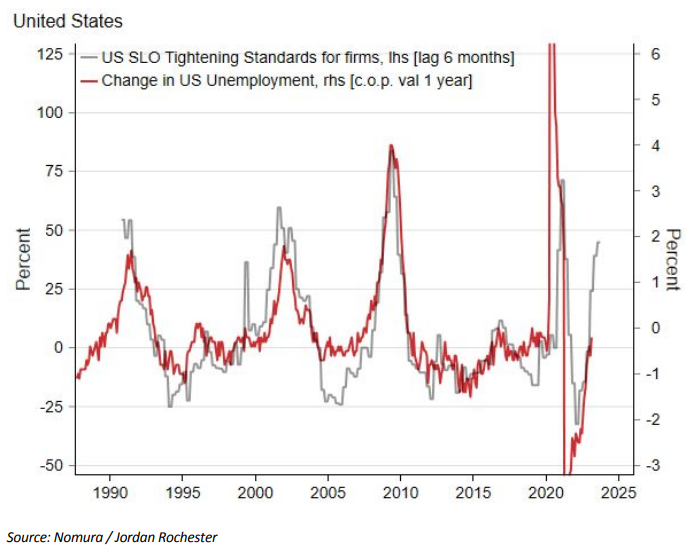
Even before this recent exodus of deposits, loan officers have been tightening their standards (Exhibit 5). In our view, such tightening is likely to become even more prevalent given last week’s events and that poses headwinds for money supply,and consequently,economic and earnings growth. In other words, it’s now harder to hold the view that growth will prove to be ok in the face of the fastest Fed tightening cycle in modern times. Secondarily, the margin deterioration we have been discussing for months is still getting worse. Any top line short fall will only exacerbate this negative operating leverage dynamic, in our view.
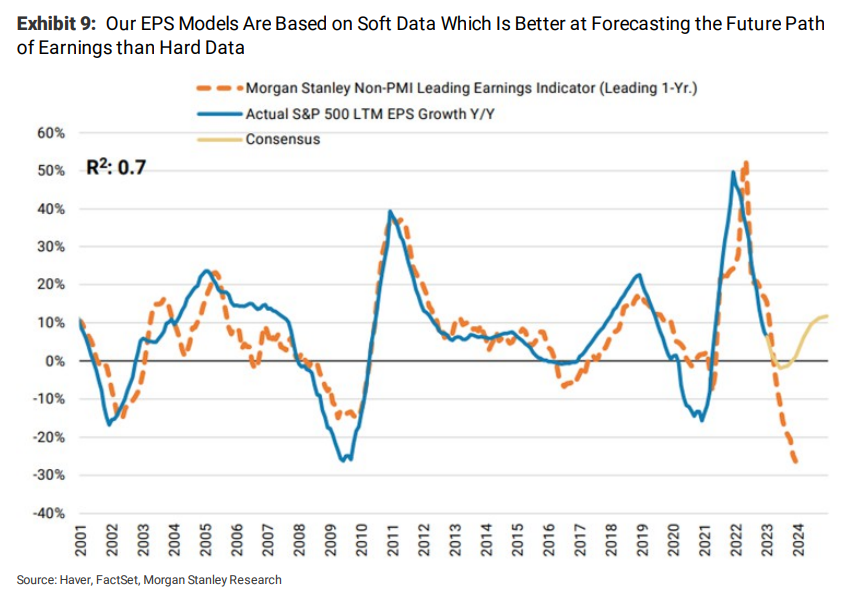
The bottom line is that Fed policy works with long and variable lags. Many of the key variables used by the Fed and investors to judge whether Fed policy changes are having their desired effect are backward looking–i.e.,employment and inflation metrics. Forward looking survey data are often much better at tellingus what to expect rather than what is currently happening. On that score, the picture is pessimistic about where growth is likely headed,especially for earnings. Rather than a random or idiosyncratic shock, we view last week’s events as just one more supporting factor for our negative earnings growth outlook–i.e. it only exacerbates key headwinds like credit/money supply growth. In short,Fed policy is starting to bite,and it’s unlikely to reverse even if the Fed were to pause its rate hikes or quantitative tightening–i.e., the die is cast for further earnings disappointments relative to consensus and company expectations (Exhibit 9).
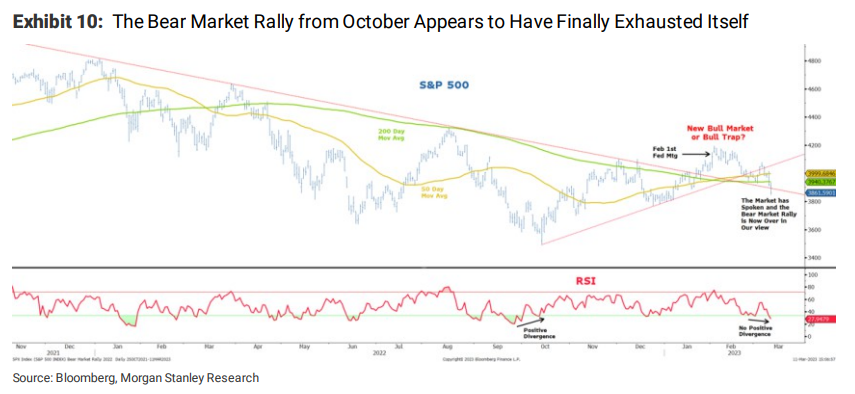
Finally, the market appears to have spoken loudly as well. Over the past few weeks, the S&P 500 and other major indices have been bouncing around key levels of support that have kept trend following strategies,active traders and portfolio managers thatuse technicals interested in the bull case. While the market made an impressive stand at trying to hold the support 2 weeks ago, last week’s event was just too much for it to withstand and support gave way in what we think is now the definitive beginning of the next leg of the bear market. In other words, our view that the rally from October was nothing but a bull trap appears to have been solidified at this point. We suggest selling any bounces on a government intervention to quell the immediate liquidity crisis at SVB and other institutions until we make new bear market lows,at a minimum.Furthermore, we do think that tighter credit availability from banks will weigh on small cap companies more significantly, and last week’s underperformance by the small cap indices supports that view and further throws cold water on the new bull market narrative we have been hearing from others over the past few months.
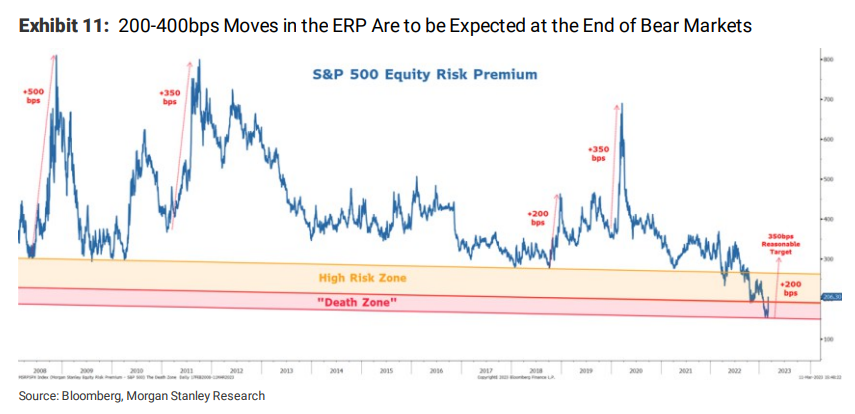
As we have stated all year, we believe that the final stage of this bear market will be driven by the disappointment in earnings that the market may finally start to fully price in advance of the actual revisions to come. We measure the market’s concern about earnings growth via the Equity Risk Premium which has remained extremely well behaved over the past year and especially the past few months. In fact,a few weeks ago, the ERP reached an astoundingly low level of 150bps given the elevated risk to earnings and extremely tight monetary policy conditions (Exhibit 11). We called this the “death zone” because we felt like it couldn’t live there very long and would ultimately rise sharply once the true earnings picture became more obvious.Last week, the ERP rose sharply as P/Es fell in the context of falling rates in a flight to safety. We think this could mark the beginning of a much sharper move in the ERP that takes P/Es to materially lower levels (i.e., 13-15x)– one that will ultimately form the final low in price for this bear market. Generally, such moves happen at the end as the moment of recognition can no longer be denied. It feels like that moment is upon us.
Charlie McEliggott at Nomura is running a similar line.
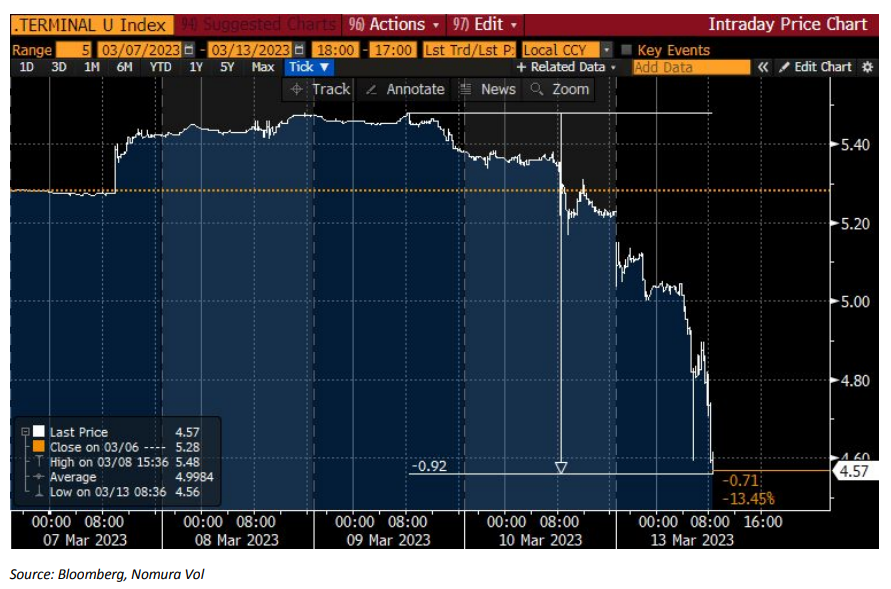
A shock UST curve “bull-steepening” on the reopen following last night’s extraordinary actions from US authorities to intervene in the banking sector—UST 2Y yields set for their largest 2d drop since 1987, while White and Red SOFR futures have exploded higher—indicative of full-blown “stop-outs” in legacy “Short” positions, as Fed terminal projections have collapsed nearly 90bps since Thursday with traders removing forward hikes, while now too only pricing an implied 12bps of Fed hikes next wk, i.e. a coin flip whether they hike at all (pray for your Rates Gamma hedgers, with real delta of everything from hikes to cuts in the coming days).
Equities have swung wildly overnight, bouncing initially on the headline actions, then fading on potential negative impacts across global Banks, before later bouncing on ~$60B of announced M&A this morning, as well as this cautious positive around China’s Xi planned interactions with both Putin and Zelensky separately, next week—however, this Financials –centric beat-down is again dragging risk to fresh lows into the US Cash Equities open.
Banks around the world are appropriately getting starched (Japan / Topix Banks -4.0%, Europe / SX7E -6.8%, US / KBE -6.0% and KRE -7.6%) for a lot of reasons: 1) the unintended consequences of the new US depositor *guarantees, as “deposit flight” risk may actually further grow, while other questions around Banks remain—about 2) the apparent lack of interest in buying-off some of the assets as being indicative of low Bank risk-appetite and further questions around regional bank loan portfolios, around 3) the implications for obvious NIM compression around 4) an almost certain higher cost-of-capital for some Banks due to now a higher “UN-discounted rates” at this BTFP (1Y OIS +10bps!), while 5) the broad industry will likely suffer too under wider credit spreads (Bond holders are in-fact getting appropriately wrecked, after all) and perhaps most critically in the macro sense, 6) a likely further downshift in lending / tighter standards which were already under way anyhow per SLOOS—impacting through ever- “tighter” FCI—and now, with the implications of all these headwinds now 7) likely too seeing Feds force these Bank stocks to have to raise new Capital Taking it back to a question I was asking myself last night: What does last night’s actions -taken (at the core, that the Fed absorbs banks’ unrealized losses on HTM portfolios by instead accepting HQLA as collateral at “par value” for an “advance” with a term up to 1 yr in order to cover deposits) do to change the fact that depositors everywhere are now even more aware that instead of sitting in bank savings account at 0.0%, that they should continue reallocating instead into Money Market Funds and earning ~4.5%?
After the exposure to this story, aren’t small biz / ma & pa even more likely to question their money being anywhere but either at 1) a mega SIFI or 2) collecting actually interest in a Money Fund, after this perpetual existential crisis / regional bank stigma?
Hence, “deposit flight” does not just go away from here, as it’s not solved for from an “incentizes to stick-around” perspective.
So I think the economic growth implications are actually far more nuanced than last night’s first-blush take of this being such a tactical impulse “easing” in financial conditions (with Real Yields and US Dollar collapsing)—as structurally / longer-term, it very likely may in-fact further “gum-up” the banking system as a transmission mechanism—i.e. actually “tightening” financial conditions looking further-out
As this relates to the Fed’s inflation-fighting efforts, however, it may actually then help the FOMC to achieve the “FCI tightening” they’ve needed to crimp demand-side inflation, but have failed at consistently achieving—which is yet another reason that Rates are re-pricing so hard.
From a markets-perspective, that flow I’d been speaking-to over the past two months with regard to there being the first “Short Convexity” risk within the VIX complex witnessed in years did in-fact began to materialize with this “left tail” event last week…”gradually, then suddenly”.
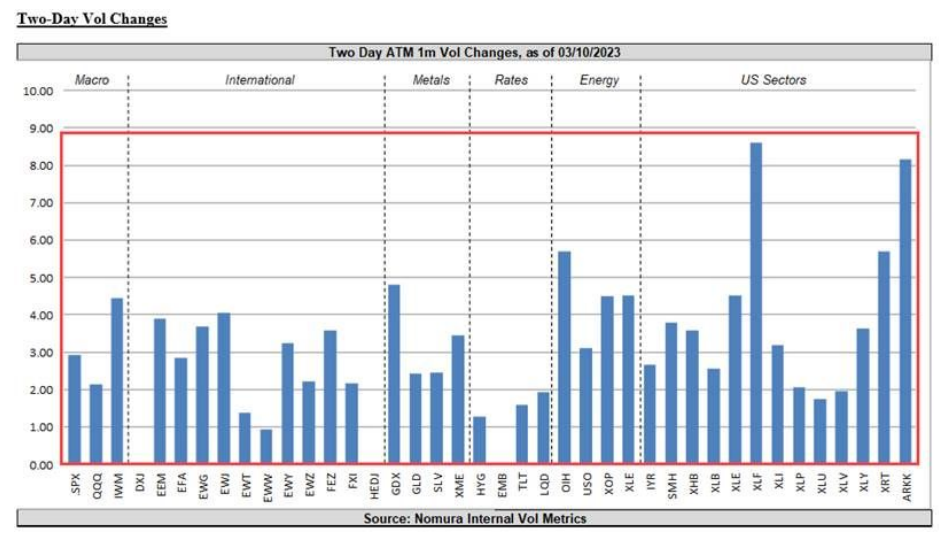
My own view is that the reflexive BTFD on lower rates is one the most stupid trades I have seen in my lifetime. The Market Ear has more on a looming robot panic.
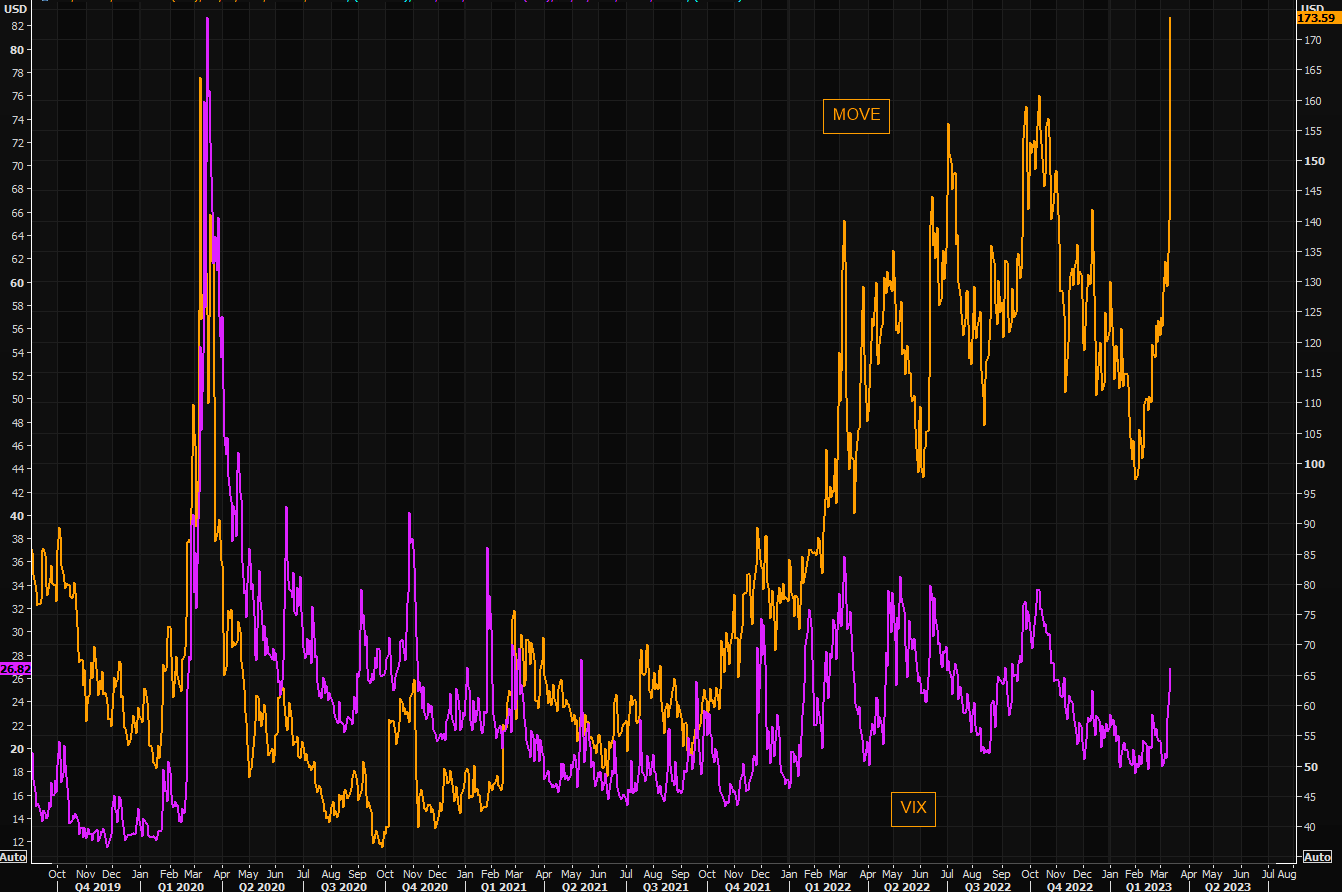
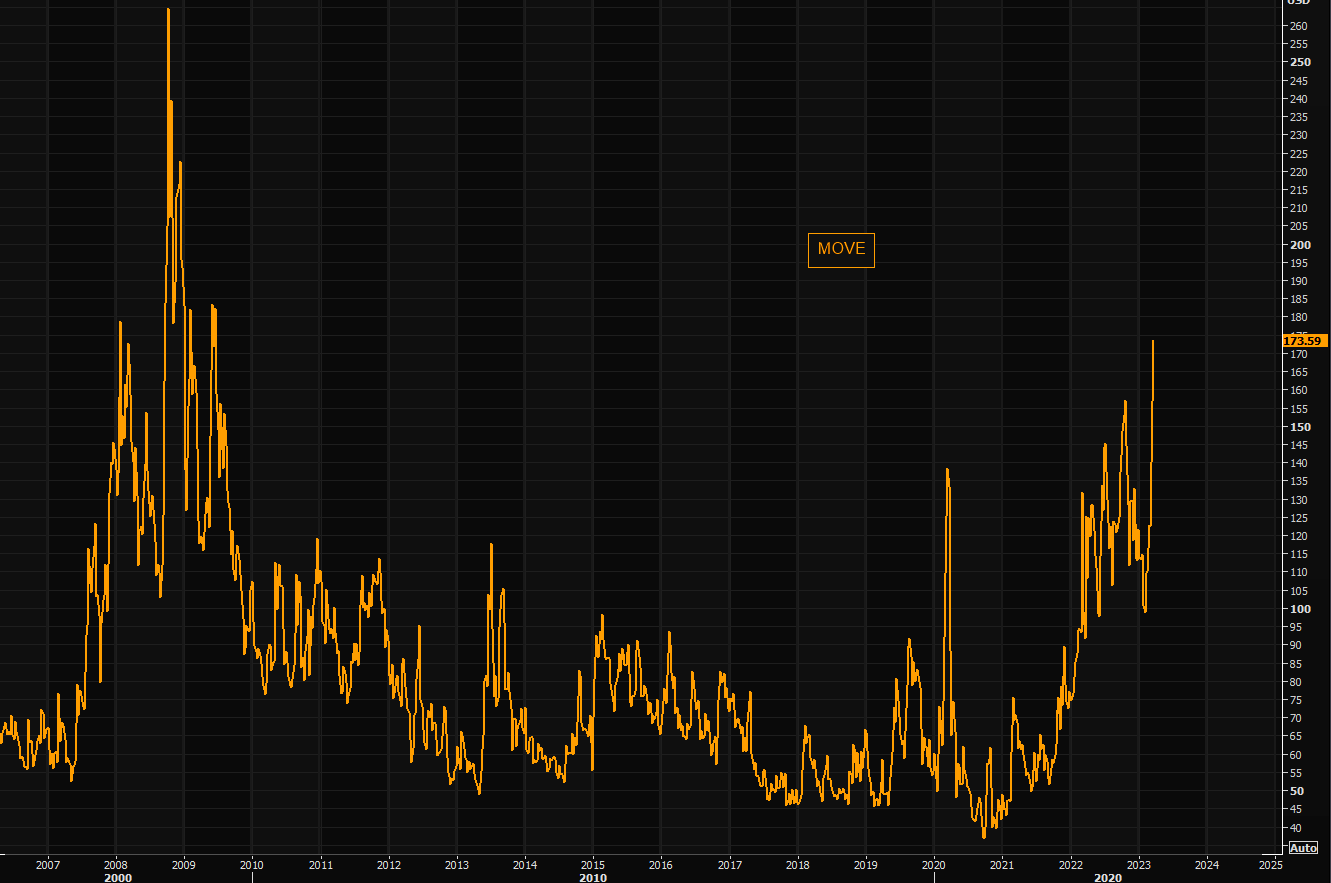
King MOVE
Bond volatility, MOVE, exploded to the upside (today again). The VIX move higher looks tiny in comparison….Note that the MOVE index closed at the highest levels since 2009 (chart 2 weekly).
Refinitiv
Refinitiv
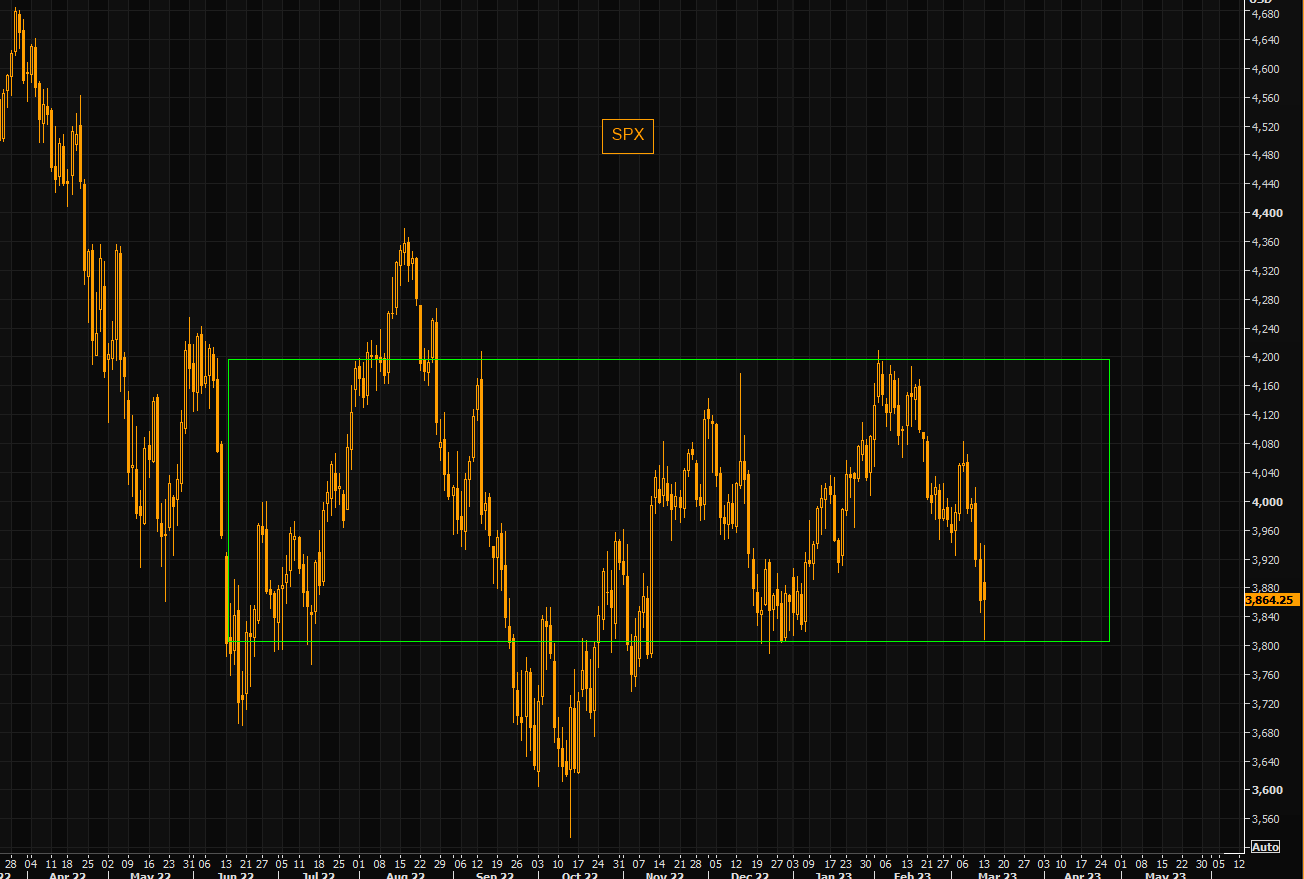
SPX – range mania is alive (still)
SPX has traded inside the 3800/4200 range since last June (with one over and one under shoot).
Refinitiv
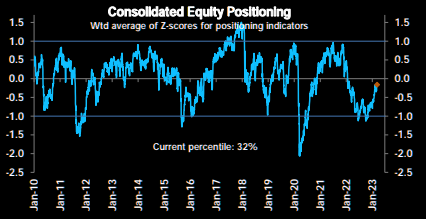
Positioning: Stuck in the middle
Deutsche Bank’s “consolidated equity positioning” indicator. We have come a long way off lows.
Deutsche Bank
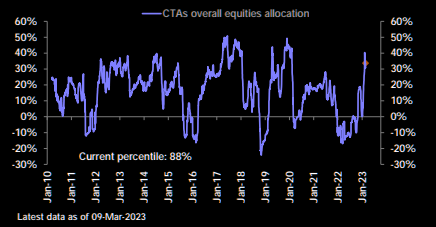
Beware CTAs
Chart shows CTA exposure to equities.
Deutsche Bank
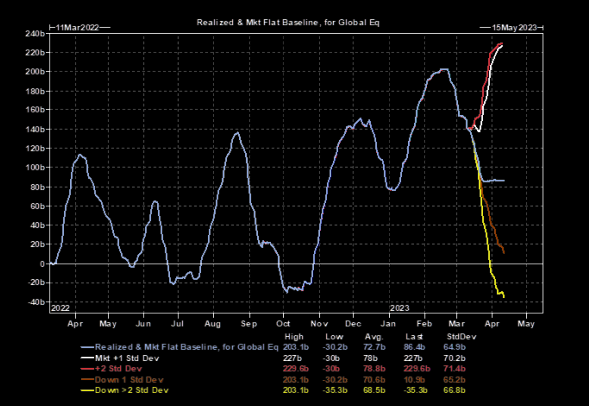
Computers have stuff to sell
CTA downside convexity is back and is rather big…
GS
The bigger picture
TS Lombard reminds us: “…this week will determine whether the Fed is yet done, but the bigger picture story here is that the SVB episode reinforces our conviction of recession and significant rate cuts by the end of the year.”
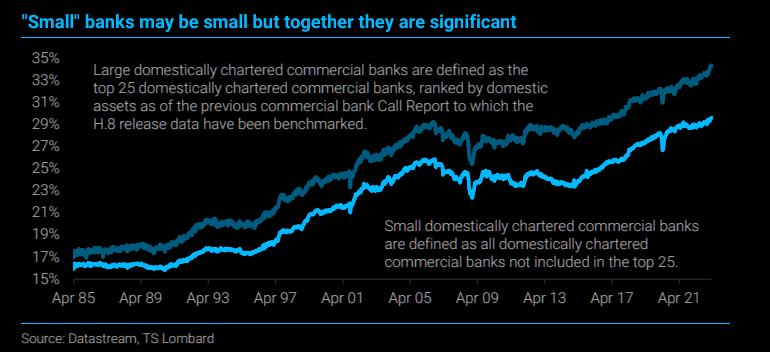
Many small banks…
…are not so small when you put them together. TS Lombard writes: “If enough got into trouble, however, that could be more significant.”
TS Lombard
How confident are you that the FOMC will pause in March?
GS answers: “It is hard to be too confident at this point. If the new measures from the FDIC, Fed, and Treasury are very successful in restoring confidence and reducing pressure on small banks, then the situation could look materially different by later this week. We expect the February CPI report to be firm on Tuesday, with a 45bp increase in the core. While we think a 50bp hike is very unlikely, a 25bp hike is possible at the March meeting if financial stability concerns subside quickly. For now, we see considerable uncertainty about the Fed’s path in March and beyond. In particular, we think the odds of a downside scenario have risen and near-term rate cuts have become more conceivable” (GS)
Do not forget the fundamentals
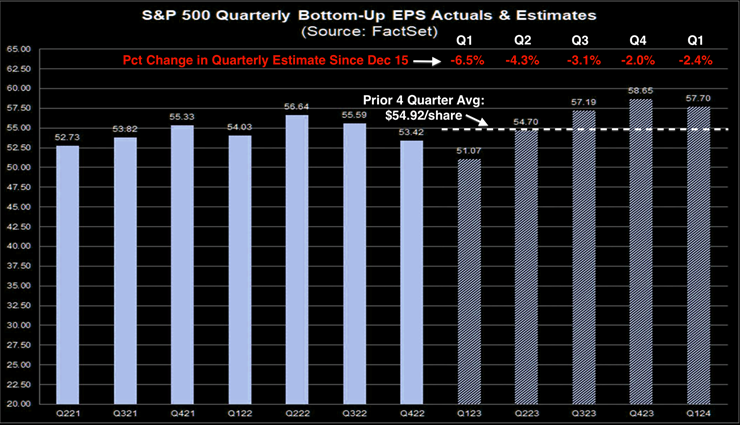
While the Street has taken down its 2023 whole-year earnings estimate by 3.7%, the cuts have mostly come out of Q1 and Q2 estimates. These are 6.5/4.3% lower than 3 months ago. The next 2 quarters have seen less in the way of estimate cuts – just 2.0 to 3.1%. Conclusion? Expectations for 2023 remain too high.
Data Trek
Big earnings forecast writedowns ahead.
