
Nomura was an early hawk on the way up. Now it is the early dove.
We expect a 25bp rate cut and a halt of balance sheet reduction in March while a new lending facility is possible.
On the evening of 12 March, by invoking “systemic risk exception,” the US Treasury, the Federal Deposit Insurance Corporation (FDIC) and the Fed issued a joint statement that all depositors of Silicon Valley Bank (SVB) and Signature Bank will be made whole, while also noting that shareholders and certain unsecured debt holders of those banks will not be protected. Importantly, the Fed introduced a new lending facility for depository institutions, which is named as a Bank Term Funding Program (BTFP). Under the new program, the Fed will offer loans of up to one year in exchange for eligible high-quality assets as collateral, including US Treasuries and agency MBS. These collateral assets will be valued at par and will not be subject to any discount or haircut. Moreover, there are no fees associated with the program and no limit on its size. These above-mentioned policy actions were significantly more aggressive than we had expected. Regulators expanded the scope of the emergency measures to protect the depositors of Signature Bank, which had amounted to much less than SVB. We think this suggested the strong intention of the
Regulators to prevent a similar episode with other banks and contain contagion. In addition, the Fed’s new lending facility will likely mitigate the risk of small banks selling holding assets and incurring capital losses.
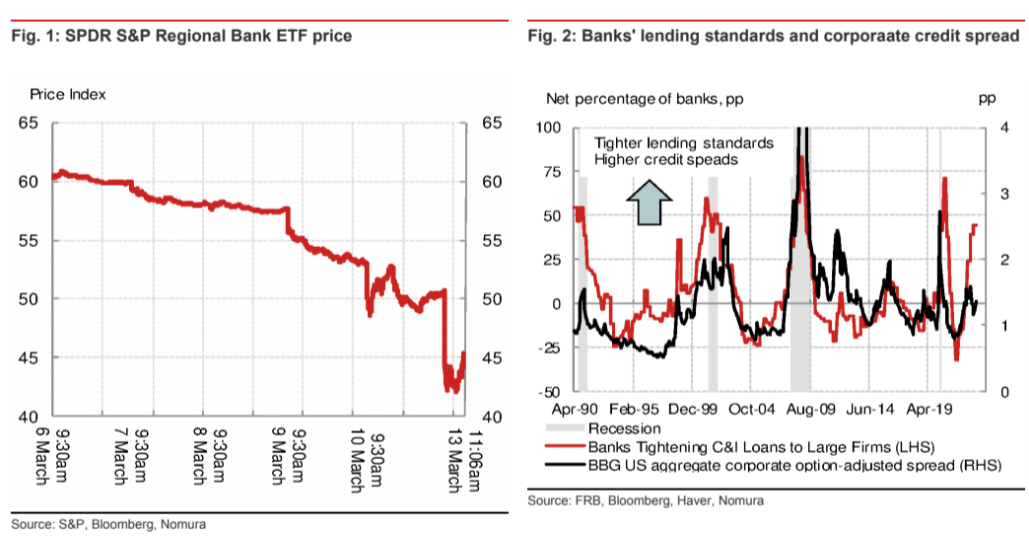
However, judging by the market’s reaction, financial markets seem to view these policy actions as insufficient, as stock prices for the US financial sector continue to decline as of this writing (Fig. 1 ). One market concern is that a deposit flight might not slow anytime soon for a number of reasons. Despite the FDIC’s protection of all depositors of SVB and Signature Bank, corporate depositors are still concerned about a loss, even temporarily, of access to their deposits from the bank(s) going under conservatorship, even if they are made whole later. Second, ironically, the sensitivity of individual depositors to deposit rates might have increased due to the FDIC’s announcement of making all Silicon Valley Banks’ depositors whole. We could see a significant outflow from commercial banks, which may compel banks to liquidate their loan portfolios unless banks raise their deposit rates substantially. Third, on banks’ securities investment, unrealized capital losses in the banks’ held-to-maturity portfolio might not become an imminent issue because of theFed’s new BTFP. However, if the Fed keeps the policy rate “higher for longer”, banks would be averse to liquidating securities holdings for which selling would realize losses in securities any time soon.
In reaction to looming financial stability risks, we now expect the Fed to cut rates in 25bp increments in the March FOMC meeting in comparison to where we had previously expected a 50bp rate hike since 24 February, well before Chair Powell’s testimony last week (see Data Supports More Aggressive Action By The Fed , 24 February 2023). Although a 25bp rate cut seems unlikely to be a panacea for financial institutions, if the Fed shows expected continued rate cuts in the Summary of Economic Projections (“dots”), markets could quickly price in further rate cuts. This could somewhat reduce the risk of further bank runs, as well as reduce unrealized capital losses.
We also expect the Fed to stop quantitative tightening. Although the choice of deposits vs. non-deposit investment vehicles such as Money Market Funds (MMF) matters for banks, ending QT should help keep the amount of reserves more ample than they would be otherwise. Third, it is possible the Fed may create a new lending facility by either offering a wider eligibility of collateral assets or broader access for borrowers through an emergency lending facility. The BTFP generally limits the eligibility of collateral assets to largely US treasuries and other securities backed by government. Note that in the BTFP announcement, the Fed stated that it “is closely monitoring conditions across the financial system and is prepared to use its full range of tools to support households and businesses, and will take additional steps as appropriate.”
Also, the fact that other banks are facing a serious bank run risk suggests an increasing risk of over-tightening by the Fed, which also supports a rate cut in the near term. As we argued, the cumulative rate hikes are disproportionately reducing the supply of credit through bank loans relative to financial market conditions (for more details please refer to Higher Fed Funds Rate May Spur Deeper Recession (Fig. 2). The lagged impact of past rate hikes could now materialize in a draconian way. We believe a tightening of financial conditions through bank loans could potentially steer the economy into a recession starting in H2 2023. However, the process might be accelerating, potentially moving forward a recession and exerting disinflationary pressures with some lag. At this point, the Fed could become more forward-looking in a sense that it might put more weight on the inflation outlook as opposed to waiting for realized inflation to come down materially. In this regard, although we expect a solid 0.4% m-o-m core CPI inflation in the February CPI report on Tuesday 14 March (for more details on our CPI forecast, please refer to our February CPI Preview , 9 March 2023), we think financial stability risks are quickly becoming a dominating factor for monetary policy.
Whatever the Fed does, multiply it 2x for the RBA given Albo has already destroyed wages.
Do buy property now!
