
By Gareth Aird, head of Australian economics at CBA:
Key Points:
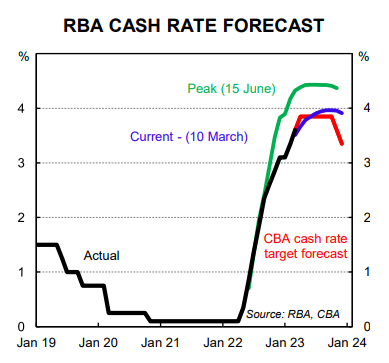
- The April RBA Board meeting is ‘live’ – the case to leave the cash rate on hold or increase it by a further 25bp to 3.85% will be debated.
- Four domestic economic data releases will inform the Board’s decision to either hike the cash rate or leave policy on hold in April.
- The four publications are the February NAB business survey (14/3), February labour force survey (16/3), February retail sales (28/3) and the February monthly CPI indicator (29/3).
- At this stage we marginally favour a 25bp rate hike in April, but that call will be under review as the data prints over the next few weeks.
- The RBA will run their own race from here and we expect the recent divergent tone between the RBA and the US Federal Reserve to persist.
- The RBA has a much more potent policy transmission mechanism than most other central banks as changes in the cash rate directly impact the cash flow of people with variable-rate mortgages.
Governor Lowe tells us what to watch this month
The RBA is willing to pause in their tightening cycle at the April Board meeting. The RBA Governor stated in his speech last week, “with monetary policy now in restrictive territory, we are closer to the point where it will be appropriate to pause interest rate increases to allow more time to assess the state of the economy. At what point it will be appropriate to pause will be determined by the data and our assessment of the outlook.”
The Governor noted in the Q&A session that four key domestic data releases will inform the Board’s decision to either hike the cash rate in April or leave policy on hold. The four releases are monthly data on the labour force, retail sales, inflation and the NAB business survey. All four releases relate to the month of February.
There are limitless configurations of how the collective data may print. A stronger than expected set of numbers across all releases will see the RBA hike the cash rate in April. Conversely, a weaker than anticipated set of outcomes will mean the RBA pauses. The difficulty for market participants and the Board will be assessing a mixed set of results – some stronger and some weaker than expected. The fallout from the collapse of Silicon Valley Bank (SVB) creates an additional layer of uncertainty ahead of the April Board meeting.
We consider the labour force survey and the monthly CPI indicator to be the data of the four aforementioned releases that carries most weight. Retail sales and business conditions will be important. But the chief metrics in February are inflation and the unemployment rate. We preview each of the releases below.
NAB Business Survey (14 March)
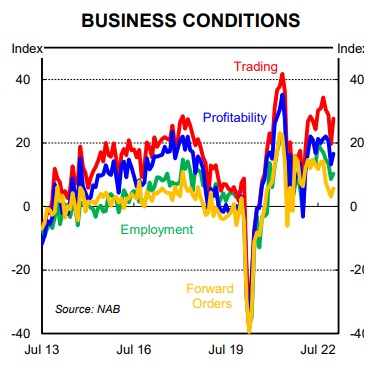
First cab off the data rank is the February NAB business survey. The RBA closely watches this survey for a monthly pulse on conditions and price pressures in the private sector. The measures on business confidence in the survey are less relevant from a policy perspective.
We also like the Markit PMIs for a timely monthly update on business conditions and price changes. But the RBA appears not to place much weight on the PMIs in Australia.
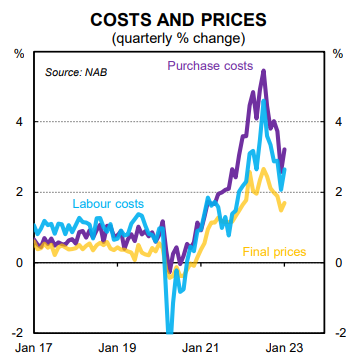
Business conditions were on a softening trend through Q4 22 according to the NAB survey. But the measures on forward orders, employment, profitability and trading all strengthened in January. The prices and labour cost measures followed a similar trajectory to business conditions over Q4 22 and January.
The February survey will clarify if the strengthening in business conditions, prices and labour costs was an anomaly in January. On balance we expect January to be the outlier compared to the trend in Q4 22. We would be surprised to see conditions and the prices gauges in the NAB survey further consolidate this week.
February Labour Force Survey (16 March)
Markets will be firmly fixated on the February labour force survey this week. The January print threw up an unexpected decline in employment of 11.5k (compared to the market median forecast of +20k). But the miss was largely explained by the much greater than usual number of people not considered employed but who had a job to start in February.
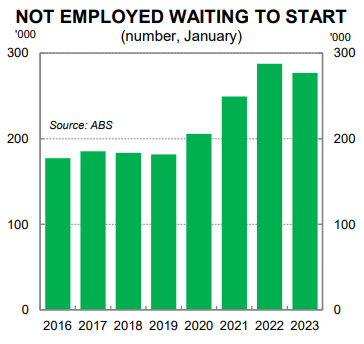
According to the ABS, the proportion of the not employed population who were waiting to start work increased from an average of 2.4% for 2016-2020 to 3.4% in January 2023. Put another way, there were a lot of people not employed in January but about to start work in February (see above chart). These people will show up as employed in the February labour force survey, which means on balance
we should see a solid lift in employment.
We forecast a lift in employment of 45k in February which is similar to the market median forecast of +50k. The RBA also expect to see a solid bounce in employment in February.
Governor Lowe stated in his speech last week that, “it was notable that in early January there were around 100,000 more people than usual indicating that they had a firm offer to start a job within the next four weeks. We expect that many of these people will begin work by February as planned and we will be looking to see evidence of this in the February data.”
Here it should be noted that the economy currently needs to generate growth in employment of ~25k a month to keep the unemployment rate flat on an unchanged participation rate.
The policy relevant statistic is not the change in employment but rather the unemployment rate. On that score, the big expected increase in employment in February will almost certainly be accompanied by an increase in the participation rate. As such, the unemployment rate may not fall (it printed 3.7% in January; up from 3.5% in December).
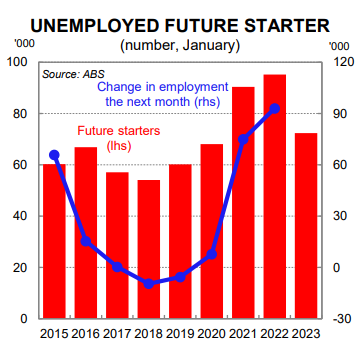
The ABS reported that the number of people unemployed in January but waiting to start work was not too dissimilar to the pre-pandemic trend (see above chart). As a result, the changing seasonal patterns in labour hiring may not impact the jobless rate in February.
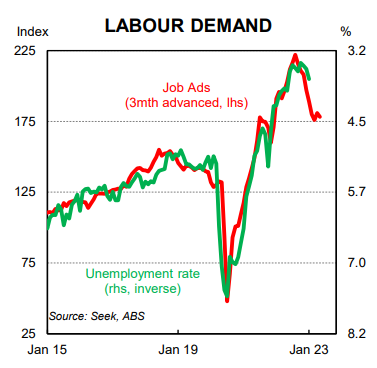
Our point forecast is for the unemployment rate to print at 3.7% in February compared to the market median forecast of 3.6%. Monthly labour force numbers bounce around which means it is hard to have high conviction on where the jobless rate will land on any given month. But job vacancies, the best leading indicator of the unemployment rate in the short run, suggest the unemployment rate will be on an upward trend from here.
February Retail Trade (28 March)
The monthly retail trade figures have been volatile in recent months largely because spending patterns over the festive period have changed. Consumers have in recent years increasingly shifted spending away from December in favour of November to take advantage of Black Friday and Cyber Monday discounting.
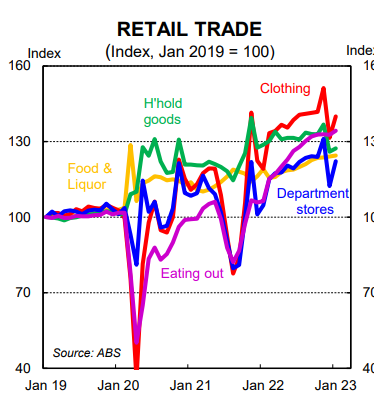
The ABS has had a hard time recalibrating their seasonal factors to pick up this new dynamic. The upshot is that there have been big swings in the monthly flow of spending on retail items (November +1.7%, December –4.0%, and January +1.9%).
Our internal data at CBA points to a contraction in retail sales of 0.3% in February. Of particular interest will be the components of the retail basket. Spending on clothing and on household goods as well as in department stores was sitting below both Q3 22 and Q4 22 levels in January. Cooling demand for key retail items will help to drag the rate of inflation lower over 2023.
February monthly CPI indicator (29 March)
The RBA has elevated the status of the monthly CPI to that of an indicator that they are placing significant weight on when assessing the pulse of inflation. In his Statement accompanying the March Board meeting the Governor noted, “the monthly CPI indicator suggests that inflation has peaked in Australia”. We very much agree.
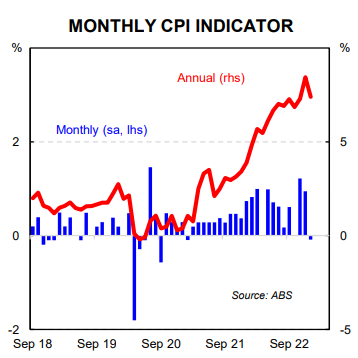
The monthly CPI is a partial read on inflation in any given month. Not all components of the CPI basket are measured each month. Conceptually, the monthly CPI indicator includes all the items of the quarterly CPI basket. But not all items in the basket are updated with new prices each month.
The monthly CPI indicator fell by 0.4% in January and the annual rate dropped from 8.4% to 7.4%. It was the first recorded monthly decline in both the original and seasonally adjusted inflation measure in almost two years. The news was welcome. But the limitations of the monthly CPI indicator mean the February print will be of particular importance. The January monthly CPI only included up to date price information for 62% of the weight of the quarterly CPI. And the updated price information was more heavily skewed towards goods prices.
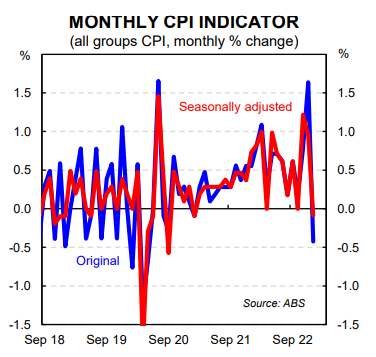
Domestic and household services are only measured in the second month of the quarter. As such, the February monthly CPI indicator will be a timelier barometer of services inflation when compared to the January monthly CPI indicator.
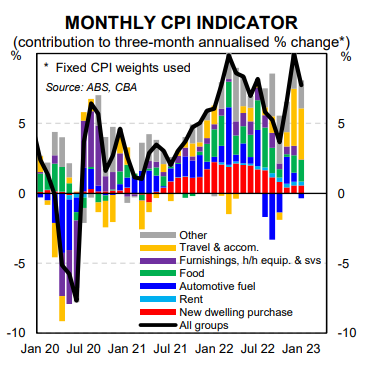
We will publish our point estimate for the February monthly CPI in the week commencing 20 March. The outcome of the February monthly CPI will be the final piece of the domestic economic jigsaw ahead of the April Board meeting.
Our RBA call
At this stage we have one final 25bp rate hike in our profile which would take the cash rate to 3.85%. We have that rate increase pencilled in for the April Board meeting. But we consider it to be a close call at the moment between on hold or a rate rise next month given the shift in tone from the RBA last week.
We believe the Board would like to pause in their tightening cycle. And we think that would be a prudent move given the lags in monetary policy and the massive amount of already delivered tightening. Far more borrowers than usual are on fixed rate mortgages, which blunts the initial impact of rate rises. But fixed rate home borrowers in Australia are not insulated from rate hikes indefinitely. They are
generally on short-dated fixed rate mortgages and half of these loans will expire this year.
That all said, the data mentioned above will have to print in a configuration that gives the Board sufficient confidence that a pause is the appropriate policy response in April.
