
By Gareth Aird, head of Australian economics at CBA:
Key Points:
- The April RBA Board meeting remains ‘live’ –domestic data that prints next week could make or break the case to pause.
- Financial market participants will be focused on retail trade (Tuesday 28/3) and the monthly CPI indicator (Wednesday 29/3).
- We expect a small contraction in February retail trade (CBA (f) -0.3%/mth).
- We forecast the February monthly CPI indicator to increase by 0.4%/mth which would see the annual rate decline from 7.4% to 6.9%.
- Our RBA call for the April Board meeting will be conditional on the outcomes of the data next week(we currently have a 25bp hike in our profile in April for a peak in the cash rate of 3.85%).
- We believe the Board would like to pause in their tightening cycle next month. And we think that is the appropriate policy response given only ~45% of the increase in the cash rate to date had passed through to scheduled mortgage repayments at the end of 2022.
- But the Board may feel the need to put through another 25bp rate hike in April if the domestic data next week prints on the firmer side given the strength in the February labour force data and the latest NAB Business survey.We continue to expect 50bp of rate cuts in late 2023and a further 50bp of easing in H1 24.
Two down and two to go
Earlier this month RBA Governor Lowe flagged four domestic data releases that would largely inform the Board’s policy decision at the April meeting -the February NAB business survey (14/3), February labour force survey (16/3), February retail sales (28/3) and the February monthly CPI indicator (29/3). The April Board Minutes reiterated this point.
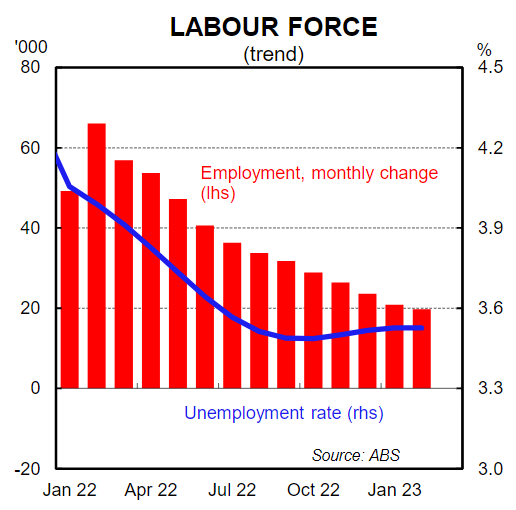
Two of those data releases have already printed. The NAB Business Survey was robust. And the unemployment rate dipped to 3.5% in February from 3.7% in January. Those two pieces of data based on the Board’s reaction function for the April meeting would lend weight to another rate increase.
But we are only halfway through the domestic data releases flagged by the RBA as the ones to watch. February retail trade and the monthly CPI indicator, which are both published next week, could make or break the case to hike or pause.
Forecasting economic data prints is an inexact science. Indeed if we knew with certainty how a release might drop there would be no need to see the actual data! That said, we are not shooting in the dark. At CBA we have access to a lot of internally generated data, which improves the accuracy of the forecasting process. We cover our expectations for the data next week below.
February retail trade (Tuesday 28 March)
Our unadjusted internal data based on CBA credit and debit cards very accurately maps the ABS original retail series (see facing chart). But at times our seasonal adjustment process can generate slightly different seasonal factors than the published ABS factors, which can see our forecast differ from the actual outcome.
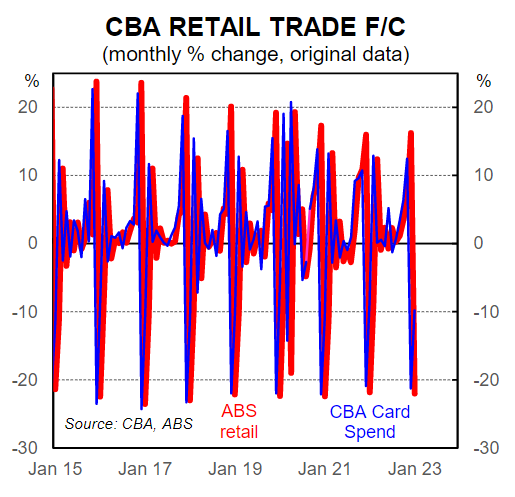
Our internal data based on CBA credit and debit card transactions points to a small contraction in nominal seasonally adjusted retail trade over February. Our point forecast is for a 0.3% decline over the month.
Our seasonally adjusted data suggests eating out is down a touch in February, while spend on food goods (essentially at supermarkets) is up. Our data indicates a small shift between eating out and dining in over the month. Clothing spend on CBA cards was flat in February, while household goods retailing recorded a fall.
February monthly CPI indicator (Wednesday 29 March)
The monthly CPI is a partial read on inflation in any given month. Not all components of the CPI basket are measured each month. Conceptually, the monthly CPI indicator includes all the items of the quarterly CPI basket. But not all items in the basket are updated with new prices each month.
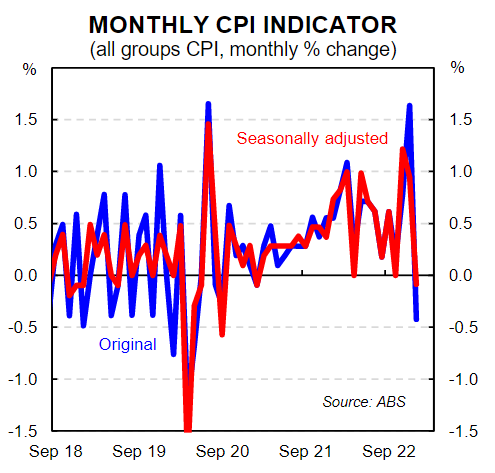
The monthly CPI indicator fell by 0.4% in January and the annual rate dropped from 8.4% to 7.4%. It was the first recorded monthly decline in both the original and seasonally adjusted inflation measure in almost two years. The news was welcome.
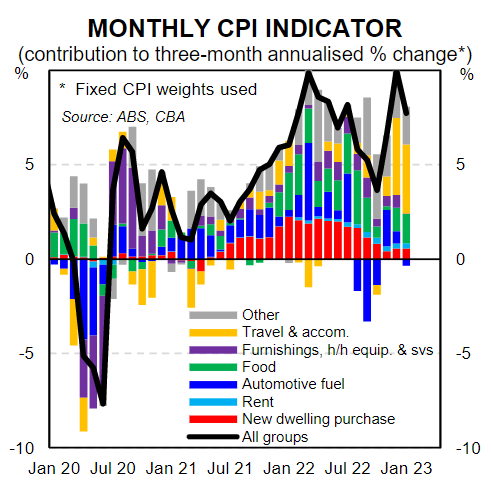
But the limitations of the monthly CPI indicator mean the February print will be of particular importance. The Januarymonthly CPI only included uptodate price information for 55%of the weight of the quarterly CPI. And the updated price information was more heavily skewed towards goods prices.
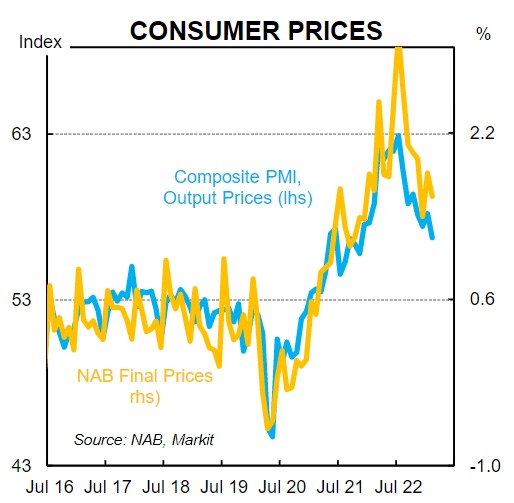
Domestic and household services are predominantly measured in the second month of the quarter. As such, the February monthly CPI indicator to be published next week be a timelier barometer of services inflation when compared to the January monthly CPI indicator.
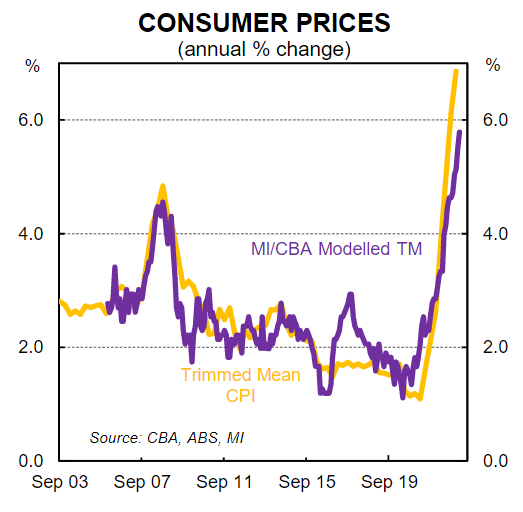
My colleague Stephen Wu has crunched the numbers and tips a 0.4% increase in the monthly CPI over February. Such an outcome would see the annual rate dip to 6.9% (from 7.4%). Table 1 below contains our forecasts by key component.
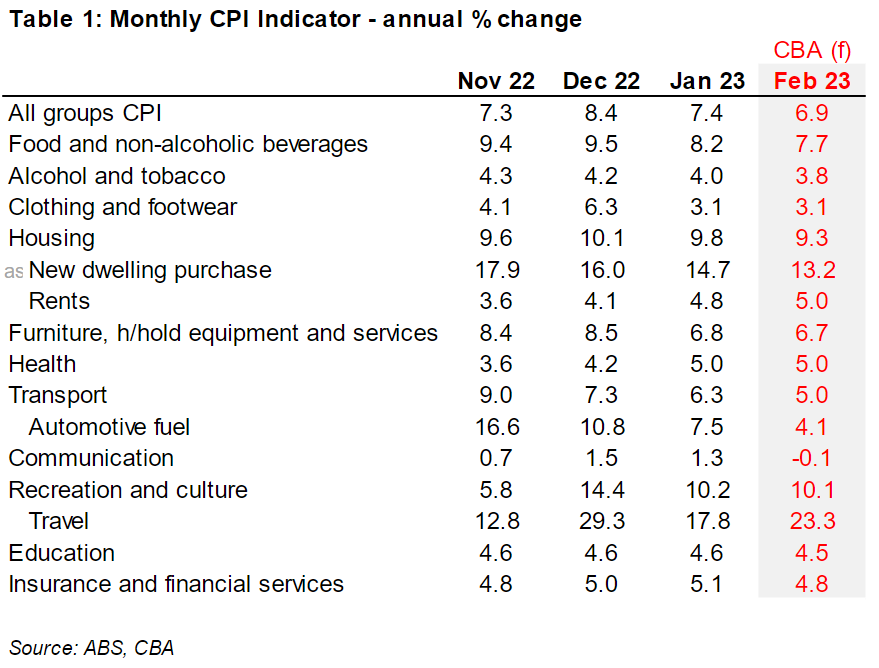
Strong price rises are forecast for education, fuel, rent and takeaway meals. This will be partially offset by the usual seasonal decline in travel prices. Food prices (excluding eating out) are forecast to be largely flat. Utilities prices will not be updated until the Q1 23 CPI is published (the same day as the March monthly CPI indicator prints).
It is not clear what thresholds the RBA has in mind for which the February monthly CPI outcomes move from being welcome to tolerable to concerning.
Indeed it is unlikely to be just the headline change on the month that matters or the change in the annual rate. Rather the RBA will focus on the detail within the updated CPI basket. By extension our analysis of the monthly CPI indicator will do the same. The RBA Board would be more willing to look through an upward shift in fruit and vegetable inflation for example than a strengthening in market services inflation.
