
Australian Housing and Urban Research Institute director, Michael Fotheringham, believes Australia’s rental market is in a state of chaos and the worst in generations.
“It is probably worse than it has been for a number of generations”.
“It is a very tough situation at the moment. There simply isn’t enough rental housing to go around and really intense competition for every property”, Fotheringham said.
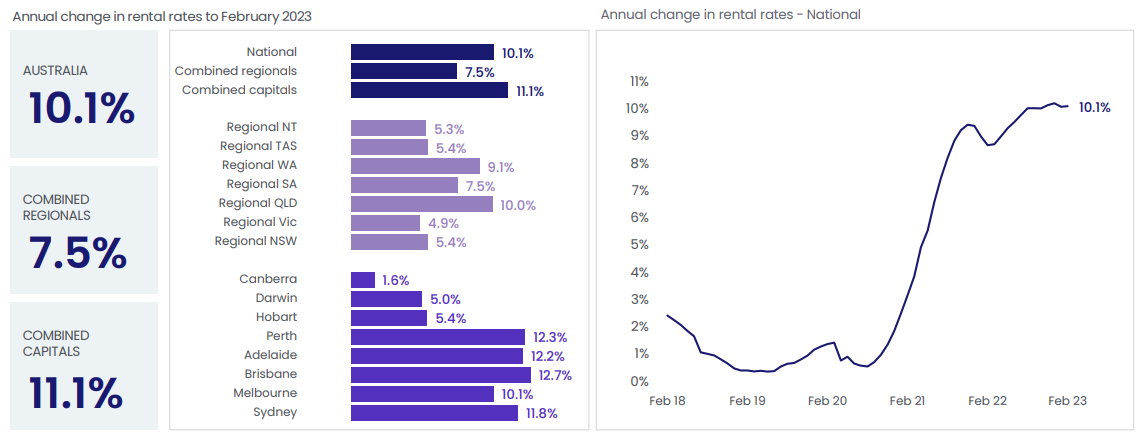
Fotheringham’s remarks follow double-digit rental growth across the nation, on the back of the tightest vacancy rate on record (i.e. just 0.8% across the combined capital cities, down from 1.8% a year earlier):
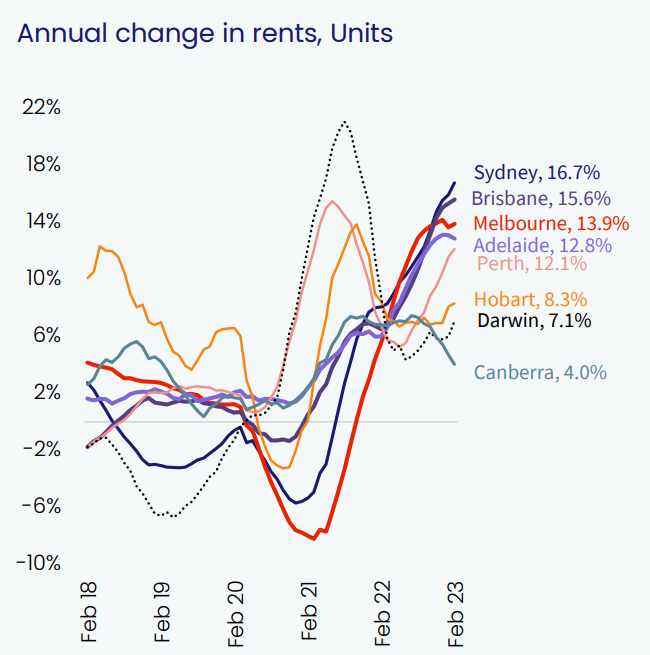
This rental inflation is especially strong across the three major capital cities’ unit markets, which have seen rents soar by between 13.9% and 16.7% in the year to February:
University of Tasmania economics professor, Mala Raghavan, blames the surge in migrants and international students for driving rental demand well ahead of supply – a situation that will only worsen.
“With fewer Australians buying homes, coupled with the inflow of international students and foreign workers, the demand for rental properties will increase, putting significant pressure on landlords to increase rental prices”, Raghavan said,
The Albanese Government’s decision to ramp immigration to record levels is proving to be an unmitigated disaster for Australian tenants.
This month Westpac forecast that net overseas migration into Australia was a record high 400,000 in the 2022 calendar year, which has driven the “sharp escalation in rents”.
“The stronger–than–expected surge in migration helps explain the significant tightening in rental markets and sharp escalation in rents”, Westpac noted.
“Sydney and Melbourne in particular have seen rental vacancy rates drop 1.7ppts and 3.5ppts respectively since late 2021 while asking rents are rising at 15–20%yr across the board (noting that vacancy rates were already at very low levels in other capital cities)”.
Westpac also estimated that the stronger than forecast net overseas migration “adds about 30k a year to the underlying demand for new dwellings taking it to just over 200k a year”.
To add further insult to injury, this increase in rental demand will arrive “at a time when new building is set to fall away, especially once the large backlog of unfinished detached houses rolls off”, according to Westpac.
There is only one outcome from the Albanese Government’s ‘Big Australia’ mass immigration policy: ongoing strong rental inflation, severe financial strain for lower-income Australians, and increasing homelessness.
It is an inequality disaster in the making.
