
Credit Suisse argues that the RBA has succumbed to political pressure. I disagree. It is rapidly collapsing domestic data going into the mortgage cliff that has the RBA backing off. Still, if some of the market views it this way, it adds to the weak AUD story.
Moreover, if the Fed is forced to hike another 3 x 50bps to kill its stupid stock market and get the inflation job done then there is every reason to think that the AUD can collapse into a 5-handle.
Yield spreads will be staggeringly negative.
AUD: Are you GBP in disguise?
The RBA’s decision to walk back its hawkish shift in its 7 Mar decision amid domestic political pressures points to renewed credibility issues, and casts AUD as the new GBP.
We think now markets will be more reluctant to price in a more hawkish outlook, even if data warrant it. We hence drop our bullish AUD bias and target AUDUSD 0.6400 by quarter-end. Our long AUDNZD position was stopped out at entry at 1.0770: we are now neutral the pair and would not look to engage again on the long side until below 1.0600.
The RBA does it again
AUD was dealt a heavy blow this week, undermined on 7 Mar by the reversal in the RBA’s rate decision of the hawkish forward guidance the board itself had introduced just a month earlier, on 7 Feb. The rates market response was to shave 15-18bp off of the priced-in terminal rate to around 4.00%: the divergence vs the US and the euro area, where instead policy rate expectations have continued to climb throughout Q1, could not be starker. In the immediate aftermath of the decision, AUD cratered through key levels such as 0.6700 vs the USD, but also in key crosses such as AUDNZD. The 1.0770 stop loss on our outstanding AUDNZD long recommendation was triggered in the process (we had trailed the stop to entry on 7 Feb, see link).
Last week (link) we widened our AUDUSD target range to the downside, pointing to the risk of further downside as far as 0.6600. Having however reached this level earlier than we anticipated, we are not confident that AUD weakness has exhausted itself in the near term, for the following reasons:
1) No clear signs of capitulation for AUD longs. As shown in Figure 4, front-end AUDUSD risk reversal skews are at fairly benign levels, while still bid for puts over calls. Implied vols are also near the mid-Dec lows, which suggests that a full-blown capitulation of the bullish AUD consensus view has yet to realize.
2) Looming review might limit the RBA’s ability to react to data surprises. As we discussed in last week’s FX Compass, the RBA currently faces a challenging domestic political climate, with forceful criticism of recent rate hikes coming from both sides of the political spectrum and a looming review due by the end of the month. The latter is expected to address a variety of topics, potentially including the bank’s communication of its policy changes and the composition of its rate-setting board. Governor Lowe’s term is also set to end this year (on 17 Sep), which adds to the climate of institutional uncertainty.
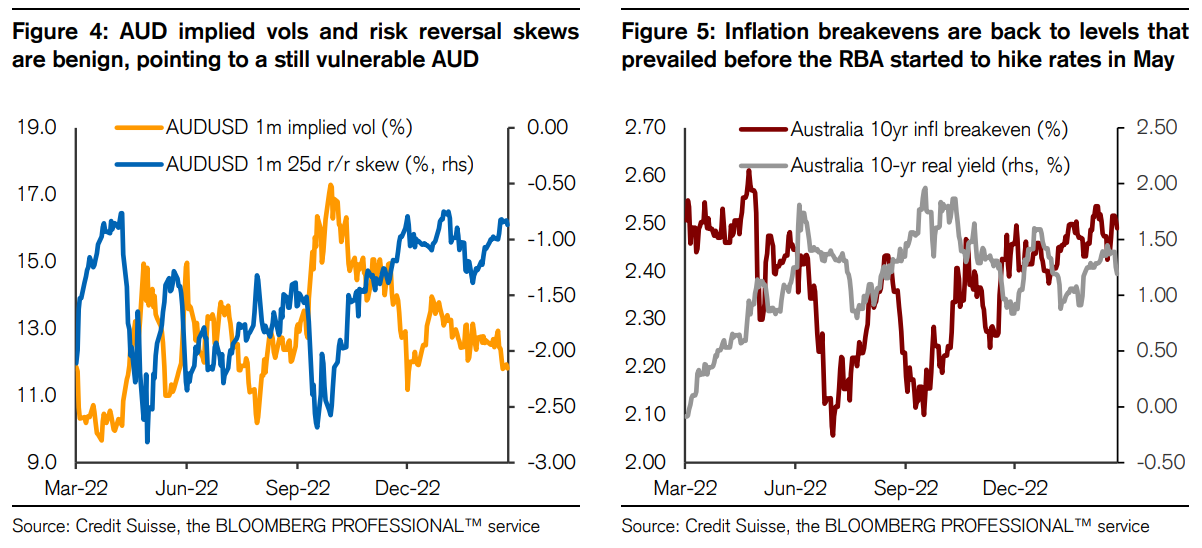
This puts the RBA, and by extension AUD, in a fairly precarious situation. At a fundamental level, we still see reasons to be sceptical of the view, prevalent at home, that the recent disappointment in Australian economic data (Dec and Jan employment data and Jan CPI) will immediately portend to further sharp growth deterioration with firmly disinflationary implications. The ongoing prevalence of news reports pointing to extreme labour shortages across sectors is notably inconsistent with this narrative. In the
meanwhile, inflation breakevens are back to the levels that prevailed before the RBA started hiking rates, in May 2022 (Figure 5), far from clearly suggesting that RBA monetary policy is definitely in restrictive territory.
As such, we are alert to the possibility that the RBA’s decision to dial back its hawkish bias might drive inflation expectations higher from current levels. If this were to realize, perhaps in conjunction with suddenly better activity data, we suspect that markets will be reluctant to price in the possibility of the RBA shifting back to a more vigilant stance, having seen just how quickly it ditched the hawkish policy bias it introduced on 7 Feb. This might change once more clarity around the extent of the RBA review emerges, but for the time being we think the challenges to the board’s credibility will persist. A strong surprise in Feb employment data on 16 Mar or in Feb CPI data on 29 Mar would bring these concerns very quickly into the spotlight.
In terms of the FX outlook, we think this puts AUD in a similar position to the uncomfortable one that GBP has occupied for most of the past year, undermined by central bank credibility issues even amid otherwise constructive circumstances. The key difference, however, is that GBP has long been a consensus short, whereas AUD is still a consensus long, or at least so we glean from front end vols and risk reversal skews. This points to further near-term downside risks in AUD. Expectations that the RBA would maintain a credibly hawkish stance were a key ingredient behind our original bullish 0.7150 AUDUSD target, which we briefly reached in early Feb. With the RBA view however now fundamentally challenged, and against the backdrop of rising Fed tightening pressures, we now forgo our bullish AUD stance, and we see downside risks in AUDUSD as likely to extend as far as 0.6400 between now and quarter-end.
As for AUDNZD, our preference for being long the pair was directly related to our view that monetary policy expectations had space to shift more hawkish in Australia and more dovish in New Zealand. While the latter view has so far been mostly correct, the former clearly has not, and makes taking a directional stance on the FX pair based on relative monetary policy expectations a lot more challenging. Also, the ongoing repricing higher in terminal rates in the US and in the euro area leaves us less confident in positioning for a pullback in RBNZ tightening expectations from current levels, given that the RBNZ and the Fed have been de facto leaders in the policy hiking cycle. The lack of crucial NZ data points between now and the 5 Apr rate decision (+40bp priced in at the time of writing) also further clouds the near-term outlook. All in all, we are now neutral AUDNZD, and given our newly bearish AUDUSD view, we would need to see AUDNZD trade below 1.0600 before thinking of engaging again on the long side.
