
RBA hell-bent on plunging Australia into recession
AMP Capital chief economist, Shane Oliver, now expects the official cash rate (OCR) to peak at 3.6%, although he says it could potentially reach 3.85%.
However, futures traders are pricing in a peak cash rate of 4.2%.
Oliver warns that the Australian economy is likely to go into recession if official interest rates rise to 4% or higher.
He believes that the chance of a recession has now increased from 40% to 45%.
“I’ve long thought that rates at 4 per cent or above would push Australia into recession”, Dr Oliver said.
“It is delicately poised though, and is worsened by the nature of the lag effects [from rate rises] this time around. It’s getting a lot closer”.
George Tharenou of UBS believes the inflation and interest rate outlook means the possibility of a recession is now 25%.
“[Inflation] is forcing the RBA to keep hiking rates, despite the volume of activity that is clearly slowing, and set to weaken further ahead”, Tharenou said.
“This is why we think the risk of recession is increasing materially to a 25% probability”.
The latest rate hike from the RBA has already lifted monthly repayments on a $500,000 variable mortgage by around $1,000:
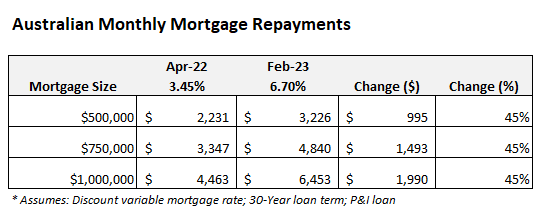
That’s a massive cut to disposable income for those with mortgages. And if the RBA hikes again, as it has indicated it will, mortgage repayments will obviously lift further.
Then there is the fact that around 800,000 mortgages (nearly one quarter of the nation’s mortgage book by value) will this year transfer from cheap pandemic fixed rate mortgages to variable mortgages with rates that are double or triple their current levels.
These households face a hit to their disposable income of around $16,500 a year on average.
Household consumption is by far the biggest driver of the economy, accounting for around 55% of final demand in a typical quarter. Therefore, where household consumption goes, the economy generally follows:
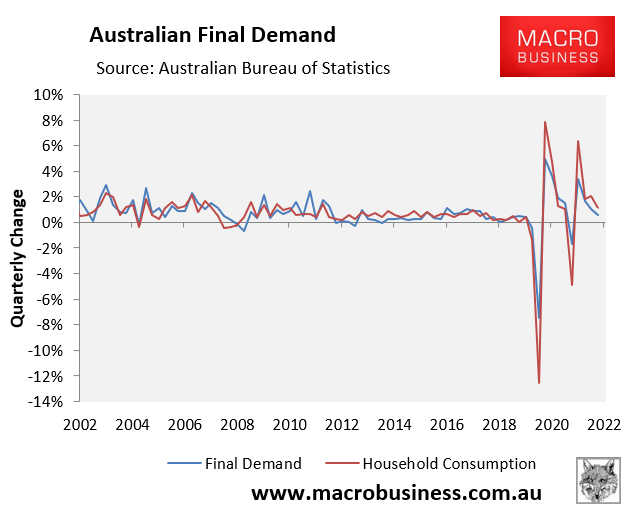
As such, the huge hit to disposable income for the one-third of households with a mortgage could potentially drive the economy into recession if the RBA hikes too far.
Ultimately, the thing that might stop Australian from entering a technical recession – i.e. two consecutive quarters of negative GDP growth – is mass immigration.
Australia is looking at its biggest immigration intake in history this year, which should drive population growth well above 500,000 people.
More inputs in people means more outputs in GDP and makes it much harder for Australia to experience a technical recession.
But it sure will feel like one, with real GDP per capita likely to contract at a solid clip.
