Tone Wheeler, president of the Australian Architecture Association, has penned an article in The Age bemoaning modern day suburbia, which has delivered homes “far from the city centre and water, without public transport, schools or shops; tiny blocks of land with huge, sealed-up two-storey houses; no backyards or gardens, no trees, and 5 degrees hotter than the inner suburbs”.
This is a far cry from Wheeler’s experience of suburbia in the 1960s growing up in Sydney and Melbourne, where “you could walk or cycle to schools and shops; lots of places to explore; modest bungalows on large blocks with backyards for play, and sport with local children; birthday parties under Hills Hoist tents; the beach was close by bus or tram”.
“How did we traduce the great idea of suburbia?”, Wheeler asks?
“Land is so expensive at the edge of the city that subdivisions are half the size of the 1960s quarter-acre (1000 square metres) block, often smaller at 350 to 400 square metres”, Wheeler complains.
“The sites are skinny to minimise the length along the street and sites so small that the houses are oriented to the boundaries, not the sun. The houses are so crowded on the sites that passive solar is not possible, and cross-ventilation breeds a loss of privacy, so air-conditioning is the norm”.
My immediate response to Tone Wheeler is “no shit sherlock”.
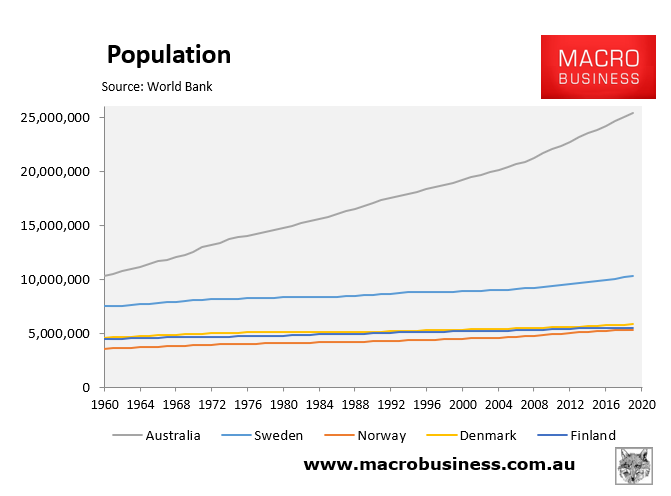
Australia has aggressively grown its population by 150% since the 1960s via immigration:
Melbourne’s population was under 2 million during the 1960s. Today it is above 5 million.
Obviously, such extreme growth means that land will be far more scarce and expensive now than then, and people need to live much further out.
With the land component of new housing now comprising 50% to 70% of the total cost of new houses, compared to around 25% in the 1960s, many buyers are incentivised to ‘upsize’ into larger models.
After all, what’s an extra $50,000 for a few extra rooms when the total cost of a modest home on a small lot already exceeds $600,000?
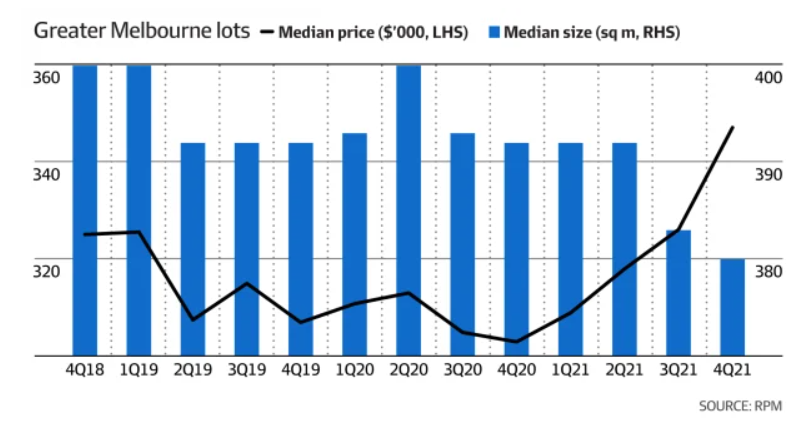
Shrinkflation is a structural trend that will continue so long as the federal government runs a mass immigration policy.
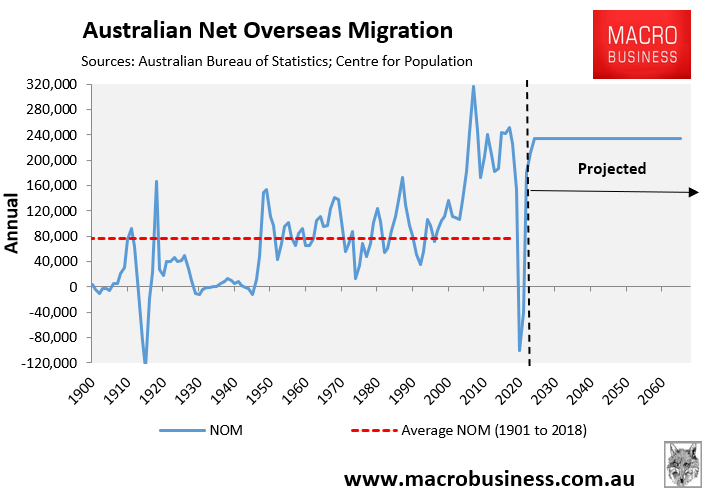
The latest Intergenerational Report (IGR) projects that net overseas migration (NOM) will increase to an average of 235,000 people a year indefinitely, which is 20,000 more than the 15-years of ‘Big Australia’ immigration pre-COVID:
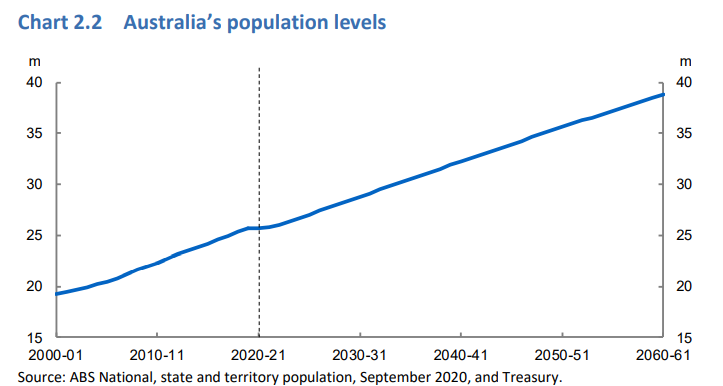
This extreme immigration will grow Australia’s population by 13.1 million people (50%) over the 40 years to 2062, according to the IGR, which is the equivalent to adding a combined Sydney, Melbourne and Brisbane to Australia’s existing population:
Such a population deluge will necessarily bulldoze our suburbs into higher density, as well as shrink outer suburban lot sizes.
If you don’t like this outcome, Tone Wheeler, how about lobbying against ‘Big Australia’ mass immigration?