By Gareth Aird, head of Australian economics at CBA:
Key Points:
- The RBA is widely anticipated to raise the cash rate at the February Board meeting.
- We expect a 25bp hike to 3.35% and ascribe a 65% chance to this outcome.
- We believe there is a non-trivial risk the RBA raise the cash rate by a larger 40bp to 3.50% and also announce an intention to hold the policy rate steady over the period ahead if economic developments evolve broadly in line with their updated forecasts (we ascribe a 25% chance to this outcome; a 10% residual probability is attributed to any other outcome).
- We think that the RBA is close to pausing in their tightening cycle. Markets should be aware of the risk that the RBA restores the cash rate to a conventional metric in February and announces an intention to pause.
- We believe if the RBA delivered an outsized hike of 40bp in February it would be coupled with a stated expectation from the Board to keep the cash rate on hold over the period ahead while it assesses the impact of the cumulative rate increases (this in our view would see the cash rate target peak at 3.50%).
- We expect the RBA to leave their headline and underlying inflation forecasts for end-2023 largely unchanged (the forecast for headline inflation in Q2 23 should be downwardly revised, while trimmed mean inflation in Q2 23 will be nudged up to reflect actual outcomes).
- We expect the RBA to downwardly revise their forecast for GDP growth in 2023 and slightly upwardly revise their forecast for the unemployment rate.
The decision: 25bp rate rise the most likely choice, but a larger hike coupled with a stated intention to pause could be on the table:
The coming week is another big one for Australian financial market participants. The RBA February Board meeting on Tuesday comes in the wake of the very strong Q4 22 CPI. It also follows a very large reported fall in retail trade over December that suggests the lagged impact of rate hikes is starting to gain traction with the consumer.
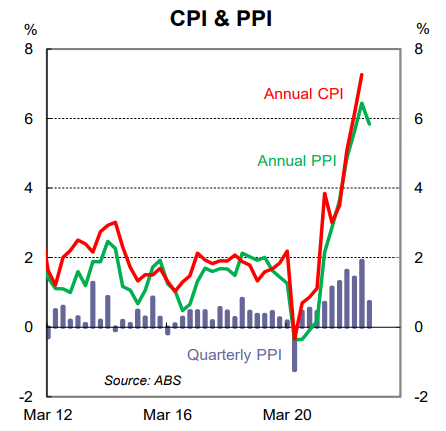
The Q4 22 inflation data contained an upside surprise on the trimmed mean relative to the RBA’s forecast profile. But the headline CPI printed below the RBA’s expectations.
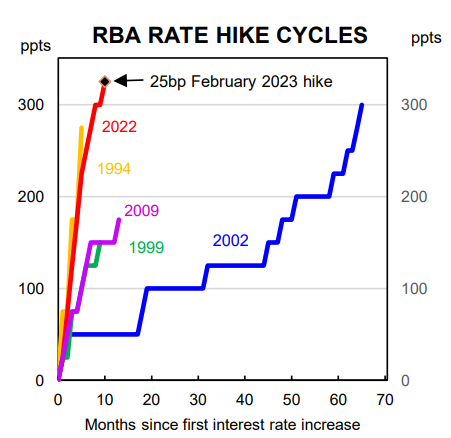
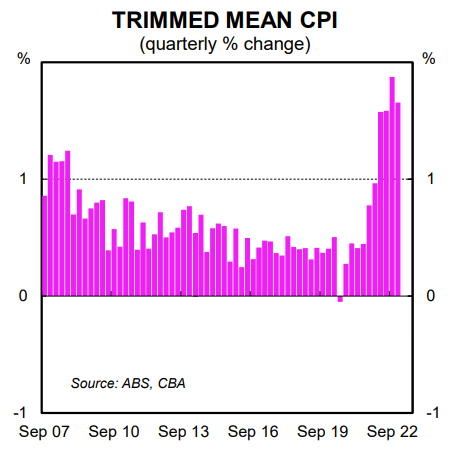
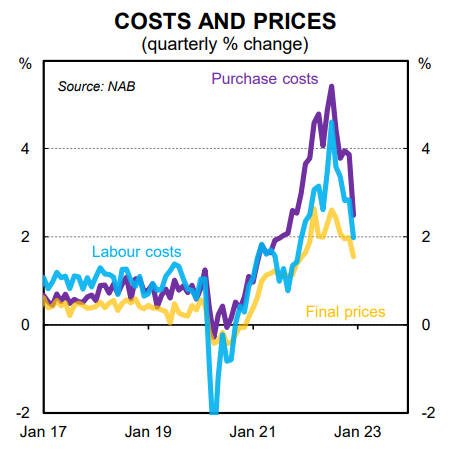
The RBA confirmed post Q4 22 CPI that they expect the peak in inflation was at the end of 2022 and that inflation will begin to ease over the course of this year. We very much agree.
The strength and breadth of price rises in the December quarter means another rate hike is far more likely than not in February. But making a prediction for the meeting is complicated by the radio silence from the RBA on the outlook for monetary policy since the December Board Minutes (note that this is usual over the summer period).
The consensus call across the sell side of economists is for a 25bp rate rise next week. That is also our expectation. But the decision will be ‘live’ and the Board is likely to consider a few different options.
At the December 2022 Board meeting three options for the cash rate decision were considered: (i) a 50bp increase; (ii) a 25 bp increase; or (iii) no change. This was the first time that no change in the cash rate was considered since the tightening cycle commenced in May.
We expect the Board will once again debate the three options they considered in December. And our base case is that they hike the cash rate by 25bp next week.
But we think the case to raise the cash rate by 40bp to a conventional metric of 3.50%, coupled with a stated intention to hold the policy rate steady over the period ahead will be on the table.
Any such intention to keep policy on hold would be conditional on economic developments evolving broadly in line with the RBA’s updated forecasts. These forecasts will be previewed in the Governor’s Statement accompany the Board decision on Tuesday (7/2). And the full suite of updated economic projections will be published in the February Statement on Monetary Policy (SMP) on Friday (10/2).
The Board has not considered the case to raise the cash rate by 40bp since the May 2022 Board meeting (recall the RBA increased the cash rate by 25bp in May). Instead the RBA has preferred to move the cash rate up in either 25bp or 50bp increments. But this has been in the context of an unbroken series of rate hikes at each Board meeting since the tightening cycle started.
If the RBA is willing to pause in their tightening cycle there is merit in restoring the cash rate to a conventional metric prior to doing so. The Board is clearly cognisant that a 40bp rate hike would take the cash rate target to a more orthodox number. There is no other reason to have picked 40bp as an option for the May 2022 rate hike.
In discussing the arguments against no change in the cash rate in December the Board Minutes stated that, “no other central bank had yet paused [in their tightening cycles].” That picture has since changed. The Norges Bank kept monetary policy unchanged in January. And the Bank of Canada (BoC) stated an intention to keep the policy rate at its current level following a 25bp rate rise in January.
Accompanying their 25bp rate hike in January, the BoC noted, “if economic developments evolve broadly in line with the MPR outlook, Governing Council expects to hold the policy rate at its current level while it assesses the impact of the cumulative interest rate increases. Governing Council is prepared to increase the policy rate further if needed to return inflation to the 2% target, and remains resolute in its commitment to restoring price stability for Canadians.”
We believe that such an approach will be considered by the RBA at the February Board meeting. That is, we expect the Board to contemplate the decision to raise the cash rate and accompany the move with a stated intention to keep the policy rate at its new level.
However, we anticipate that a stated intention to leave policy on hold would most likely be accompanied with a rate hike larger than 25bp in February. If the Board wished to announce a pause, a 40bp rate rise seems the logical choice in February as it would take the cash rate to 3.50%. This is a level sufficiently restrictive for the Board to feel comfortable that it is an appropriate time to assess the impact of the already delivered rate rises. Note that a 40bp hike is also not strictly increasing the pace of tightening given the RBA Board did not meeting in January (the only month the RBA Board do not meet each year is January).
If the RBA raise the cash rate by 25bp in February, as per our central scenario, we do not think they will announce a stated intention to pause. Rather they are likely to reiterate that they are not on a pre-set path whist retaining a hiking bias. But this does not preclude a pause at the March Board meeting.
It is worth noting that the RBA started their tightening cycle earlier than a number of other central banks with respect to the trajectory of inflation (see below charts). The annual rate of inflation was significantly higher in the US and Eurozone when the US Fed and ECB started raising their policy rates. Inflation was also higher in Canada when the BoC commenced their tightening cycle.
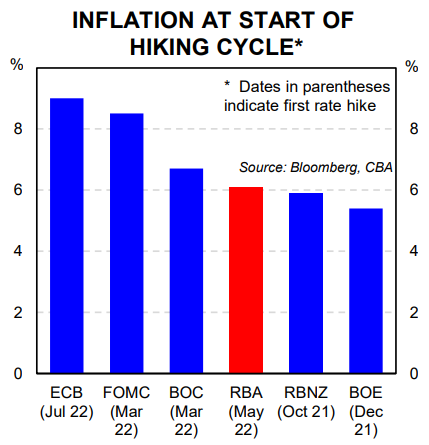
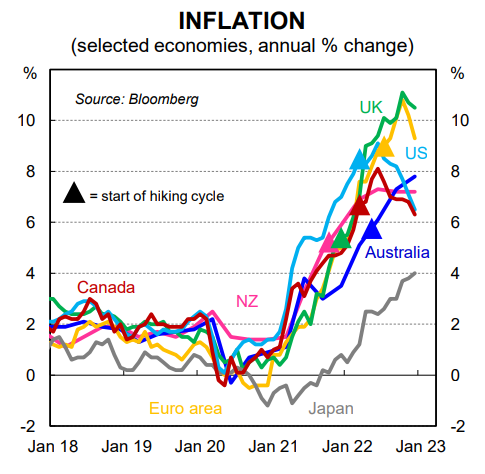
For the RBA, starting the hiking cycle earlier than the US Fed, ECB and BoC meant it was more likely than not that the annual rate of inflation was still on an upward trajectory when the notion of pausing in the tightening cycle was first considered.
The February SMP
Governor Lowe’s Statement accompanying the February Board decision will be important as he will preview the RBA’s updated economic forecasts, which will be published in the February SMP on Friday.
On inflation, the RBA will maintain that they think the annual rate of inflation peaked in Q4 22. We expect the RBA to leave their headline and underlying inflation forecasts for end-2023 largely unchanged. But the forecast for headline inflation in Q2 23 should be downwardly revised given inflation in Q4 22 was 7.8%/yr (versus the RBA’s forecast of 8.0%/yr).
The RBA’s forecast for underlying inflation in Q2 23 will be upwardly revised because the Q4 22 trimmed mean was stronger than their forecast (6.9%/yr actual vs the RBA’s forecast of 6.5%/yr – note that the Q3 22 trimmed mean CPI was upwardly revised from 1.7%/qtr to 1.9%/qtr). We think that the quarterly pace of underlying inflation peaked in Q3 22. And we believe the RBA shares this view.
We expect the RBA will downwardly revise their GDP forecasts. The RBA’s implied profile for the November SMP forecasts GDP growth of 0.9%/qtr in Q4 22. This looks too strong, particularly given the latest retail trade figures point to a 0.8%/qtr contraction in the volume of retail trade over Q4 22.
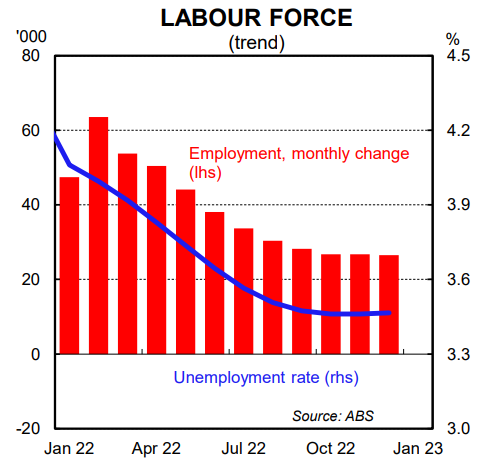
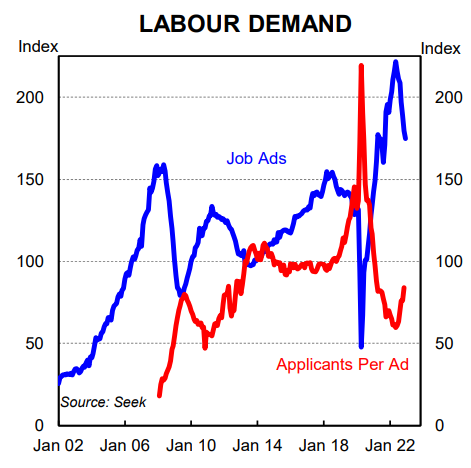
We expect the RBA to very modestly upwardly revise their unemployment rate profile. That said, they will likely continue to forecast the unemployment to gradually edge higher to ~4.0% by mid-2024. We think that forecast is too optimistic. And the Commonwealth Government agrees with us. Recall the Government forecast the unemployment rate to be 4½% by mid-2024 in the October 2022 Budget.
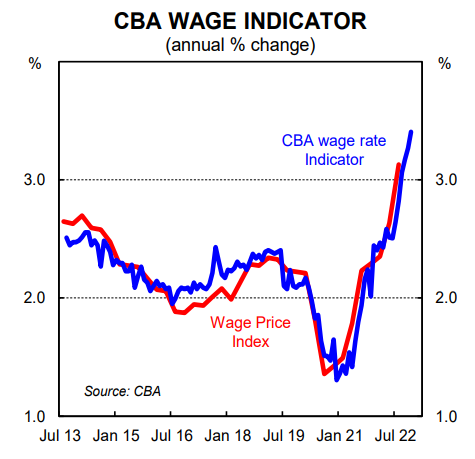
The RBA will likely upwardly revise their near term estimate for the Q4 22 Wage Price Index (WPI) from 3.1%/yr to 3.4%/yr. This is in line with the CBA wage rate indicator (see facing chart). Notwithstanding, we expect the RBA will continue to forecast a peak in the WPI of 3.9%/yr (note that this is consistent with the inflation target).