
Here’s Westpac’s Bill Evans on Australian interest rates. Even hawkish Bill is starting to lose altitude but he maintains that the RBA won’t stop hiking before the FOMC.
This proposition is based upon one error. That Australian wages are going to chase higher from here. That misjudgment arises from another: not including the impact of mass immigration.
Aussie wages are peaking as we speak as waves of cheap foreign labour flood the nation. 2024 will witness powerful wage disinflation as formal and informal wage theft returns en masse.
Anyways, the Aussie political economy is built on the progressive lie that mass immigration lifts living standards, so let’s not be too hard on our Bill.
The central issue for the economies and markets will be the evolution of inflation over 2023.
Westpac forecasts that headline inflation in Australia will peak at 7.4% in 2022 (December quarterly result to be released on January 25).
That read will be an increase from 6.3% in the year to June 2022.
We expect headline inflation in 2023 to slow to 3.7% – well below the Reserve Bank’s current forecast of 4.7%, although it is likely that the RBA will lower its forecast in the February
Statement on Monetary Policy.
While lower than the current official forecast the annual print in 2023 will still be well above the Bank’s 2–3% target range, most likely precluding it from easing policy anytime in 2023.
With inflation running well above the target range it seems it will be reluctant to ease policy during 2023 despite a stagnating economy; a rising unemployment rate and a slowdown in inflation momentum in the second half of 2023.
Figure 1, sets out the forecast contribution to inflation from the key components, highlighting the evolution of those components in 2023.
Key factors to note are:
• The contribution to inflation from dwellings and rent will slow dramatically in 2023. In particular dwelling costs which contributed 1.87 ppt’s to inflation in the year to June 2022 and 1.70 ppt’s to December will slow to 0.29 ppt’s in 2023. Rents themselves that lifted from 0.1 ppt’s in June to 0.25 ppt’s in December are likely to hold at 0.29 ppt’s in 2023. The trend in the slowdown in dwelling costs is already underway with the monthly measure showing that dwelling costs have slowed from 1.5–2.0% per month in the middle of 2022 to only 0.1 % in November following 0.5% in both October and September.
• The services measure used in Figure 1 combines both private sector and public sector (including both health and education) services. The lift in the services contribution between June and December is apparent (1.69 ppt’s up to 2.56 ppt’s). This measure most closely captures the impact on inflation of rising wages. We expect wages growth to lift from the 3.1% recorded for the September quarter 2022 to 4.5% by June before slowing in the second half. Although over the year we have a slowing in the contribution relative to December (2.1 ppt’s) the risks on this component are to the upside. Because these forces most closely capture the “demand” element they are likely to keep the RBA on “inflation alert” during the first half of 2023. The slowing in these pressures is expected in the second half of 2023 and will provide the RBA with some comfort to remain on hold in the second half of 2023 with a view to easing policy in 2024.
• Easing supply chain pressures not only directly lower building cost inflation but direct goods inflation. We expect goods to contribute only 0.17 ppt’s in 2023 down from 0.84 ppt’s in 2022.
• Fuel and food prices are also expected to contribute to the slowdown in inflation in 2023 – food 1.27 ppt’s in 2022 down to 0.14 ppt’s; fuel: 0.76 ppt’s in June and 0.49 ppt’s in December.
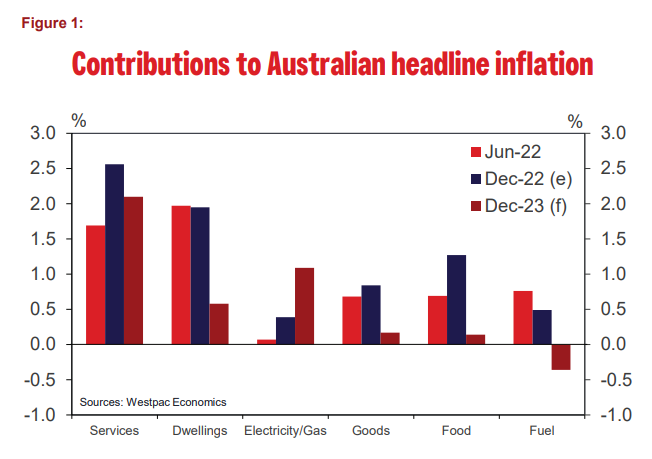
Down to –0.36% in 2023.
• Partially offsetting these positive developments is energy with electricity/gas contributing 1.09 ppt’s in 2023 compared to 0.39 ppt’s in 2022.
So, for Australia the forecast reduction in inflation in 2023 of 3.7 ppt’s (from 7.4% to 3.7%) is driven by dwelling costs (1.38 ppt’s); food (1.13 ppt’s); goods (0.68 ppt’s); and services (0.46 ppt’s).
Markets are currently focussing on the theme that global inflation is falling faster than expected and that should be an encouraging signal for central banks.
We agree that inflation relating to supply chains and other supply shocks is largely a global story. Our forecasts for 2023 certainly incorporate those messages – around building costs; fuel; food and goods.
But the demand factors in Australia, largely captured by services, are likely to intensify in the first half of 2023 before easing in the second half.
Those intensifying demand pressures should keep the RBA in tightening mode in the first half of 2023.
Only if they learned absolutely nothing from the last mass immigration cycle. So, probably.
Here is TSLombard with the truth of it.
- Even as headline inflation abates, structural labour shortages in many advanced economies will make it harder to see the back of the stagflation symptoms that became visible last year.
- Cutting through complex debates about longer-run optimal immigration policies, up-front easing of immigration rules would help economies navigate around the present tricky corner in 2023-24.
- We focus on two cases – the UK and US – where labour supply-related challenges, and the political obstacles to overcoming them, are particularly acute.
- In both cases, incremental immigration easing is underway, but any breakthroughs may only follow from mind-concentrating recessions.
- Near-term immigration boosts would be positive for all asset prices, starting with bonds as central banks would have less work to do against sticky inflation.
- The Biden administration’s latest ‘humanitarian parole’ initiative might result in 0.6-1mn new work permits by next year, possibly enough to move the macro needle – but the picture is precarious.
- The longer-run outlook for the politics of immigration looks fraught as technology (generative AI) shifts labour shortages into the blue-collar camp, while growing climate risks will trigger disorderly mass migration.
