
There is a thesis that would burst the Great Australian Property Bubble once and for all. It is made by Michael Hartnett at BofA:
- super-tight labor market (<200k on initial claims) + renewed rise commodity prices (China reopen + MAD geopolitics in Russia/Ukraine)…only take a couple of higher-than-expected CPI prints to reverse outsized expectations of 200bps of cuts,
- note also China population fell in 2022 to 1.412bn, the 1stdecline since 1961 and China has been the big excess supply of labor in recent decades.
- notable Japan, Turkey, Norway, Malaysia central banks all on hold this week, most of them a surprise“hold”,
- ”rates shock” ending as global central banks >75% through tightening phase,
- but expected end of tightening occurring before policy rates restrictive levels in real terms & hikes ending with all economies at full employment/inflation well above target,
- central banks quietly accepting higher structural inflation, wittingly or unwittingly (maybe they think low rates help to service government debt, higher inflation helps to debase nominal level of debt, inflation cures wealth inequality),
- investment conclusion is super-trend of inflation assets over deflation assets remains in its infancy.
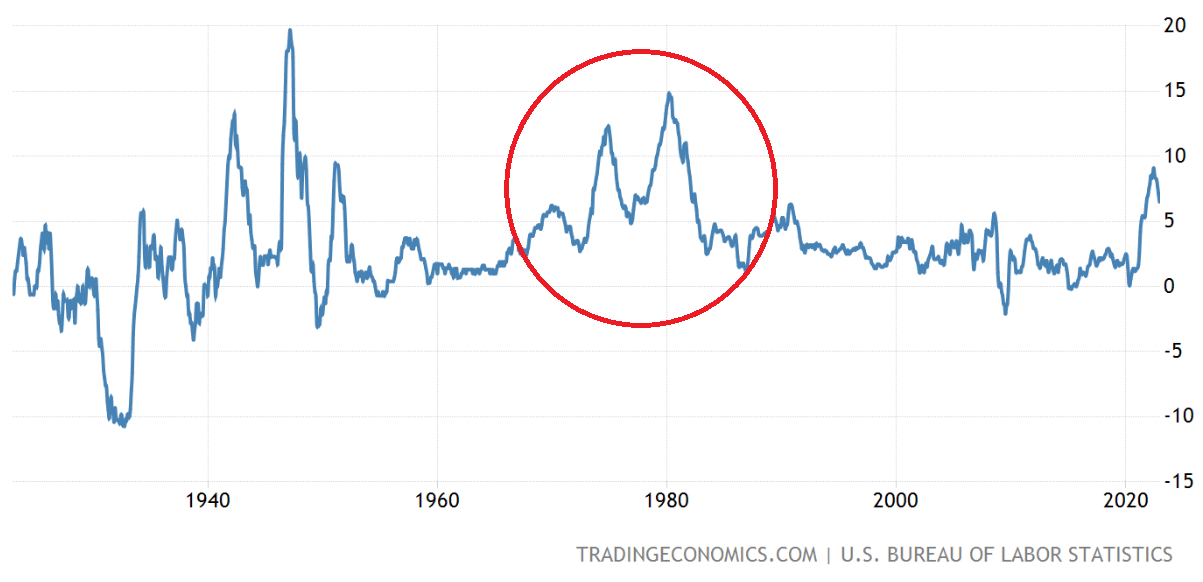
This notion is a rerun of the 1970s in which central banks curtailed monetary tightening too early and another round of global inflation exploded:
The inflation bounce back was not as severe in Australia but it was the same pattern:
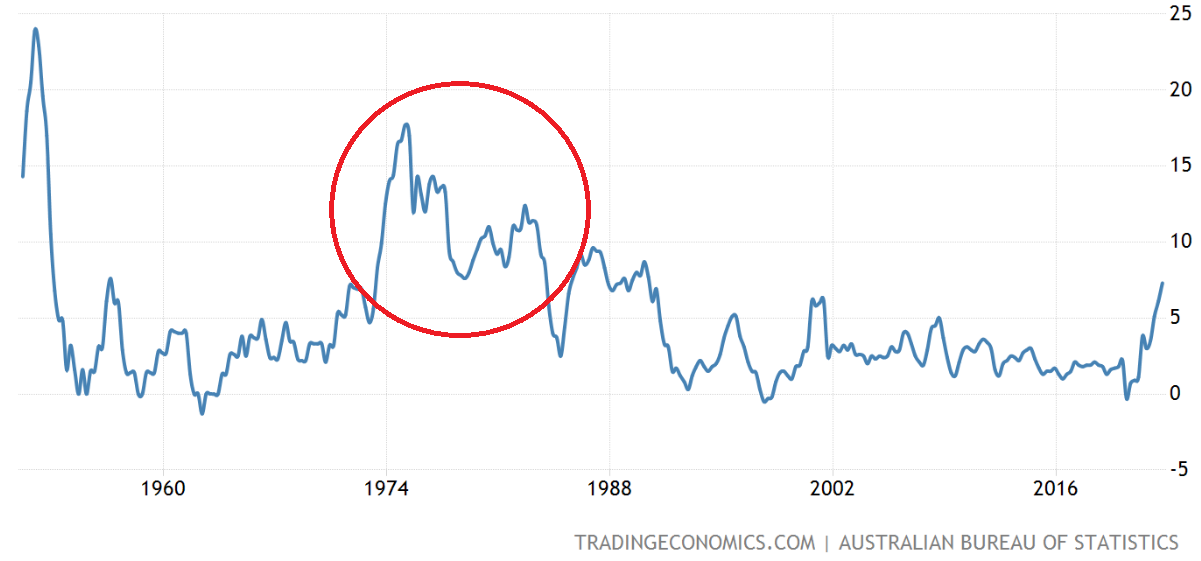
If the same thing happened again then another round of rate hikes would begin before any substantial cuts arrived and property prices would go from pricing 15-20% downside to 30% and more.
The factors that could rebound inflation are well-known:
- oil prices;
- energy cartel bastardry;
- commodity price inflows leading to fiscal spending;
- higher wages under a Labor government;
- higher rents;
- deglobalistion pressures on goods.
But, there are still very strong disinflationary offsets, especially in Australia:
- house prices are falling fast with consumption to weaken;
- energy policy starting to combat cartels;
- commodity price flows are not what they used to be for wider economy;
- China’s structural slowdown and L-shaped property recovery means falling terms of trade by H2, ’23 and for years hence;
- out-of-control mass immigration will crush wages;
- rents will top out with incomes;
- degobalistion pressures combated by higher AUD.
My base case is that this mix of Australian variables will mean local price pressures underperform DM inflation once our business cycle catches up to the current global bust in 2023. Followed by a disinflationary 2024, whereas it may lift elsewhere.
Thus, I still think the odds of a genuine crash in Australian property prices is a tail risk and see rising property prices returning in 2024 as the RBA is forced to cut deeper than other DM central banks.
The fly in the ointment for this outlook is fiscal policy. If Labor spends big then we may join another round of global inflation and property deflate further.
But, at this point, the surplus obsession is probably still in play as a tenet of Australian politics.
