

The Commonwealth Bank is out with its new economic forecast, suggesting a per capita recession dead ahead. Although the pollies will likely be able to again lie that this is not a recession thanks to 3% population growth, to you it will feel exactly the same as one as your living standards crumble on a per capita basis.
■ We forecast GDP growth to be 2.6%/yr at Q4 22 and to slow significantly to 1.1%/yr at Q4 23.
■ A material slowdown in household consumption sits at the heart of our forecasts for the economy to grow well below trend this year.
■ Recession is not our base case, though a quarterly contraction in economic activity in 2023 is a distinct possibility. Indeed we forecast a per capita recession in 2023.
■ We expect the annual rate of inflation to peak at 7.7% in Q4 22 and to decline to 3.4% by late 2023 (our forecast is for underlying inflation to be 3.2%/yr in Q4 23).
■ We expect the unemployment rate to grind higher over 2023 to end the year at 4¼%.
■ We retain our call that the peak to trough fall in national home prices will be 15%. We expect the trough to be reached in Q3 23.
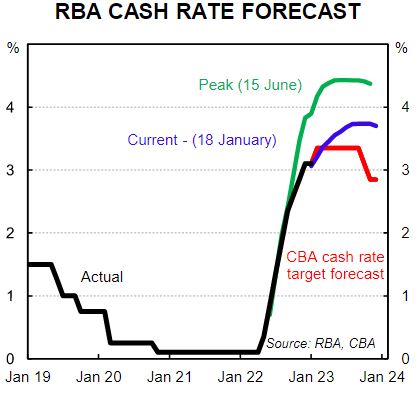
■ Our economic forecasts are conditional on one final 25bp increase in the cash rate in Q1 23 for a peak this cycle of 3.35%. We believe a higher terminal cash rate is inconsistent with a soft landing. We have 50bp of rate cuts in our profile for Q4 23.
■ Monetary and fiscal policy are the key uncertainties – the path of the cash rate from here will play the dominant role in determining economic outcomes in 2023. Fiscal policy also has the capacity to shape the trajectory of the economy.
The Australian economy boomed in 2022. GDP growth was above trend. And labour demand was exceptionally strong as evidenced by a big lift in headcount, a significant fall in the unemployment rate and elevated job vacancies.
There was a lot to like about the performance of the domestic economy in 2022. Output per capita grew solidly and the jobless rate hit a 50‑year low of 3½% mid‑year where it remained over H2 22. Business investment lifted healthily and company profits grew solidly. Workers shared in the spoils and wages growth ‑ as measured by the wage price index (WPI) ‑ increased to a near 10‑year high in the September quarter. A further increase in wages growth is expected.
However, the news was not all positive. Economies running at capacity will almost always experience a lift in inflation. And in 2022 Australia joined most other developed economies in experiencing very high inflation, much stronger than is desired (chart 1).
The RBA responded to the bout of high inflation and embarked on an incredibly aggressive tightening cycle. More specifically, the RBA delivered a whopping 300bps of rate hikes between May and December (chart 2).
The vast majority of households and businesses were caught off guard when the tightening cycle commenced. They were under the impression rates were likely to be on hold until ‘2024 at the earliest’ as they had repeatedly heard this from the RBA through 2021. In contrast CBA called a 2022 RBA rate hike in June 2021. That said, the pace of tightening surprised us. And we made revisions to our RBA forecast profile on a few occasions once the RBA commenced their tightening cycle. Of course we have not been alone and the entire forecasting community at various stages over the tightening cycle has amended their RBA calls.
A dichotomy in the economic data began to open up in late 2022. Backward looking labour market data remained robust. And prices and wages data continued to strengthen. But forward looking data, which includes housing lending, building approvals, the PMIs, home prices and consumer and business sentiment deteriorated (chart 3).
Consumer spending, which is a coincident indicator, remained elevated over the festive period in nominal terms. But we anticipate growth in the volume of spending over recent months has been modest. A further softening will occur in 2023.
The incoming economic data and the outlook for the economy dictates what the RBA does. But the RBA’s decisions influence economic outcomes. As such there is an inherit circularity in calling both the economy and the RBA.
The RBA has focussed a lot on the resilience in consumer spending. And that is understandable given demand for goods and services determines price outcomes (i.e. inflation). But official data on spending to date has only partially captured the impact of rate hikes.
It takes time for rate hikes to impact home borrower cash flow and by extension spending decisions. And far more borrowers than usual are on fixed rate mortgages, which blunts the initial impact of rate rises. But fixed rate home borrowers in Australia are not insulated from rate hikes indefinitely. They are generally on short‑dated fixed rate mortgages and half of these loans will expire this year. As such, a significant amount of tightening lays ahead irrespective of how much higher the RBA takes the cash rate.
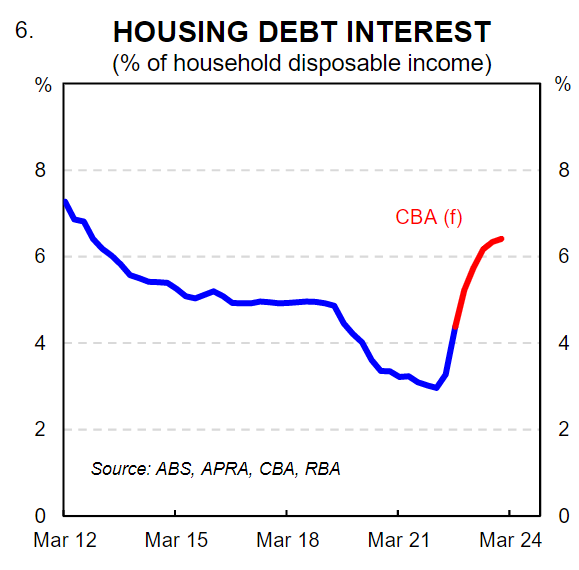
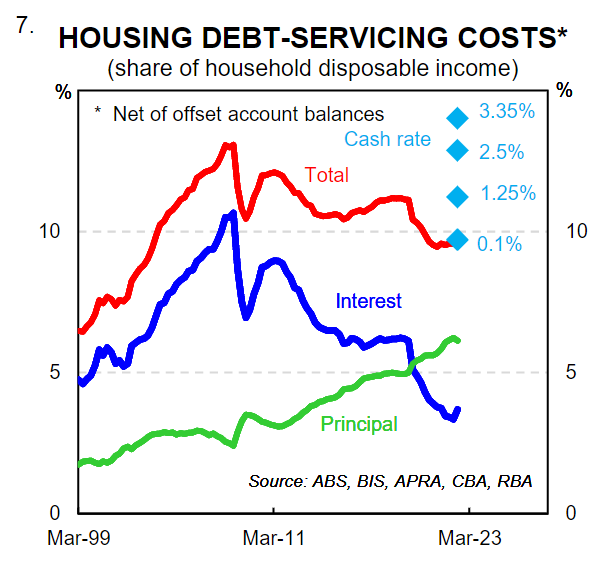
Our base case for the RBA is unchanged from last year. We expect one further 25bp rate hike in Q1 23 that would take the cash rate to 3.35% (we have flagged the February Board meeting for the final 25bp rate hike. But the RBA may pause in February and increase the cash rate by 25bp in March instead following the Q4 22 WPI). We continue to expect rate cuts in late 2023 and have pencilled in 50bp of easing in Q4 23 (chart 5).
RBA policy easing is expected to continue in 2024 and we anticipate a further 50bp of rate cuts in H1 24.