
By Bill Evans, Chief Economist at Westpac:
The recent national accounts for the September quarter were largely in line with our expectations and they further emphasised some of the key developments we see in the Australian economy that will lay the foundations for a modest growth outlook in 2023 and 2024. We continue to forecast a slowdown in the growth profile for the Australian economy from 2.6% in 2022 to 1.0% in 2023 and 2.0% in 2024.
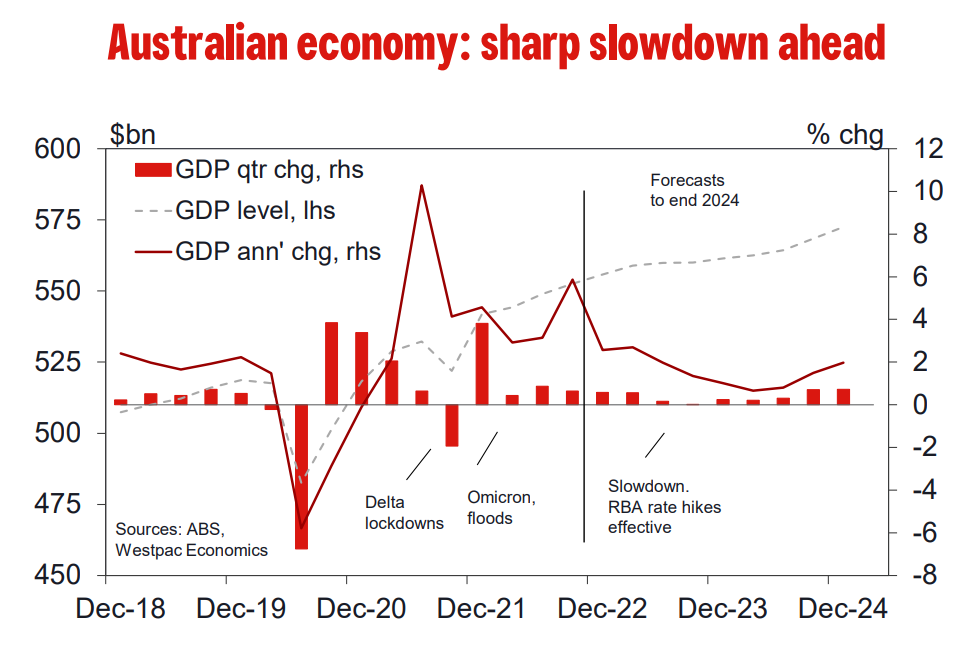
The key to this profile is the consumer. Household consumption is forecast to slow from around 2% (6 month annualised) in the first half of 2023 to near zero in the second half. That would see growth through the year of 1.0%. The first half will benefit from the spill-over of the momentum in the second half of 2022, which is expected to run at around a 4% pace (six month annualised) while the building negative forces of a rising interest rate burden; the fading reopening of the economy; a much more modest fall in the savings rate than we saw in 2021 and 2022; a damaging negative wealth effect from falling house prices and negative real wages growth will weigh heavily on the household sector.
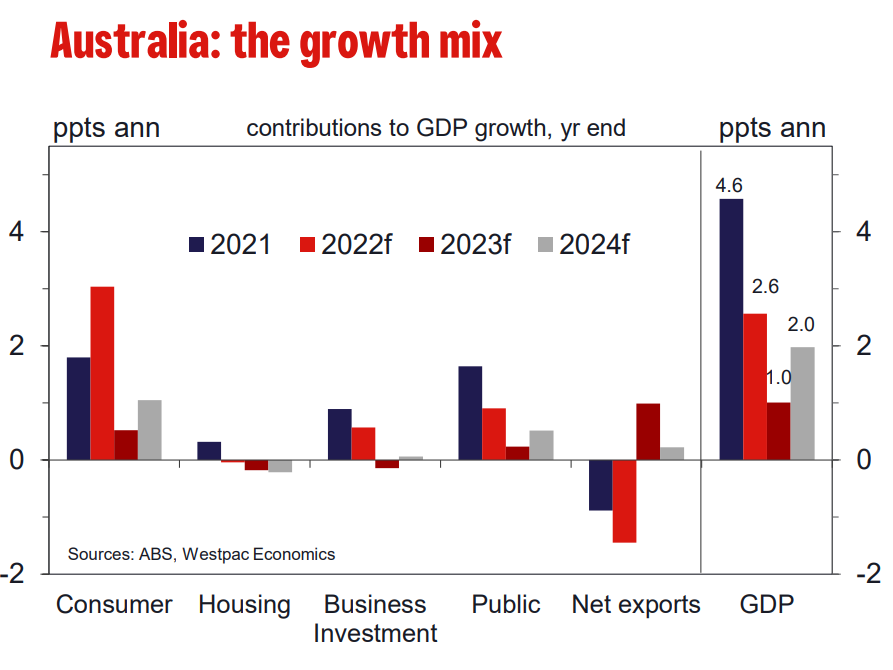
Consistent with a depressing outlook for domestic sales and the expiry of the tax allowances in June, business equipment investment is forecast to contract by around 7% in the second half of 2023. This hit to activity will be compounded by a contraction in new residential investment and in home renovation activity.
A six month period of a stagnant economy and no growth in household spending will alert the RBA to the need to ease policy settings in 2024. Overall output growth in 2024 is forecast to improve to 2%, with the bulk of that expansion (1.5%) coming in the second half of the year.
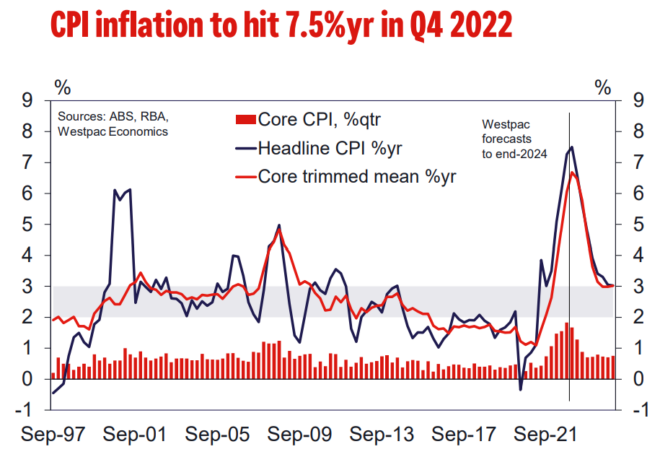
The sharp economic slowdown in 2023 will be partly engineered by the need for the RBA to continue lifting the cash rate in the first half of 2023 as wages growth and inflation remain uncomfortably high and growth holds at a ‘respectable pace’ in the opening quarter. The themes from the September quarter national accounts – discussed below – are expected to extend through 2023. Risks to the profile are evenly balanced. Inflation and wages may fall much more quickly than we envisage, allowing the RBA to bring forward the rate cuts and avoid the last hike (to 3.85%) we are anticipating for May. On the other hand, inflation throughout 2023 may be stickier than we expect. The RBA would be unable to cut rates in 2024, as anticipated, condemning the Australian economy to another very difficult year with weak growth and no prospect of any interest rate relief. Recent evidence on the evolution of the economy are supportive of our assessment.
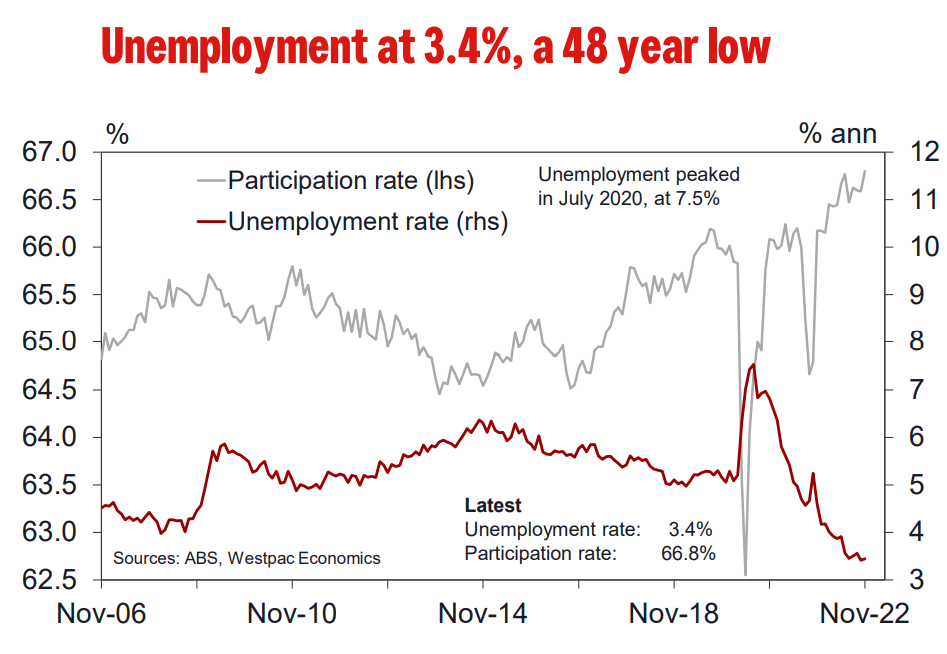
The Australian economy expanded by 0.6% in the September quarter for annual growth of 5.9%. Household spending growth slowed in the quarter, from 2.1% in the June quarter, to 1.1%, although it did still contribute all of the 0.6ppts of overall growth. Motor vehicles sales and operations (0.4ppts); hotels, cafés and restaurants (0.4ppts); and transport services (0.3ppts) contributed most of the 1.1ppt growth in household consumption. While not as strong as in the June quarter, the opening up effect was once again apparent as a key driver of consumer spending.
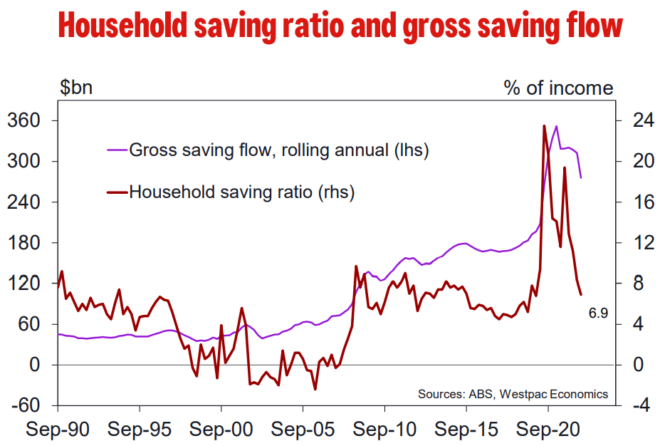
Part of this lift in spending was funded by a further fall in the household savings rate from 8.3%, in June, to 6.9% (which freed up $4.2bn), although the major fall from a peak of 19.4% in September 2021 (associated with the delta lockdowns) has largely worked its way through.
The impacts of high inflation and rising interest rates are becoming increasingly apparent. Households were challenged by a sharp increase (2.0%) in the household consumption deflator up from 1.5% in the June quarter and the fastest quarterly gain since March 1988.
Moreover, while nominal household incomes rose by $8.2bn in the quarter, there was a substantial leakage of $5.1bn in higher interest payments (up from $1.4bn last quarter) as rising interest rates bite.
Prospects for growth in consumer spending are easing as the reopening effect fades and the savings rate settles back at a more normal level. However, given the accumulated $260bn in excess household savings, it is likely that the savings rate will fall below equilibrium (judged to be around 6%) as households draw on these excess balances. We expect that through 2023 that savings rate can drift down to around 3% but our forecasts anticipate that the boost to available spending power will be more than offset by the rising interest cost.
Some specific drag on activity is apparent from the weak real estate market, which subtracted 0.2ppts from growth in the September quarter.
In summary, as we move forward, the reopening effect will fade; property weakness will linger; the savings rate will find a floor; and consumer spending growth will continue to slow. In addition, the drag on incomes from rising interest rates will intensify through 2023.
The economic slowdown will be felt nationally, as consumers across each of the states reign in spending. Here in this Report, we assess current trends across the state economies and consider the prospects for the year ahead as the headwinds intensify.
