

A weaker than expected US inflation print has seen the USD plunge alongside Treasury yields, lifting the risk complex higher that after the usual whipsaw resulted in a solid finish for Wall Street, paving the way for a Santa rally into the year end. The USD moved sharply lower against the majors, although a lot of this was baked in against Euro and Pound Sterling which pushed into new highs while the beleaguered Australian dollar played catchup to soar through the 68 cent level to make a new monthly high. US Treasury yields dropped sharply with the 10 year pushed down to the 3.4% level before recovering to 3.5% while the commodity complex saw oil prices stabilise again, with Brent crude lifting above the $80USD per barrel level as gold soared back above the $1800USD per ounce level alongside the other undollars.
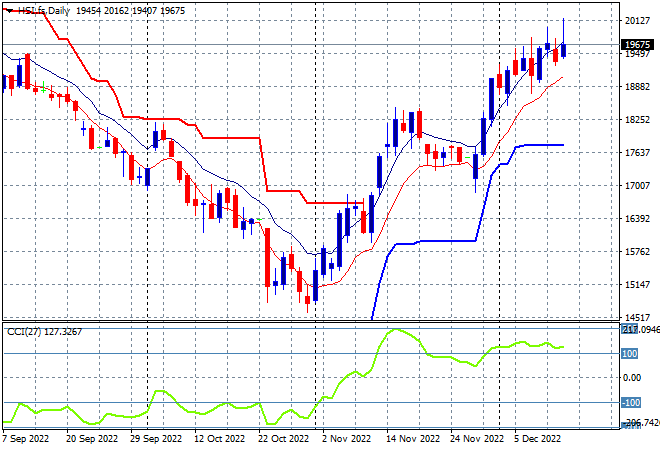
Looking at share markets in Asia from yesterday’s session where Chinese share markets slid going into the close with the Shanghai Composite staying below the 3200 point level, down 0.1% at 3176 points while the Hang Seng Index moved slightly upwards, gaining 0.6% at 19596 points. The daily chart continues to show a lovely breakout here with a big surge up towards the 19000 point level, with more potential upside although price momentum and price action is definitely rounding off. This is a clear case of buying exhaustion so watch support to remain strongly defended at the 17600 area but the low moving average to come under pressure next as overhead resistance – the long tails above – is building:
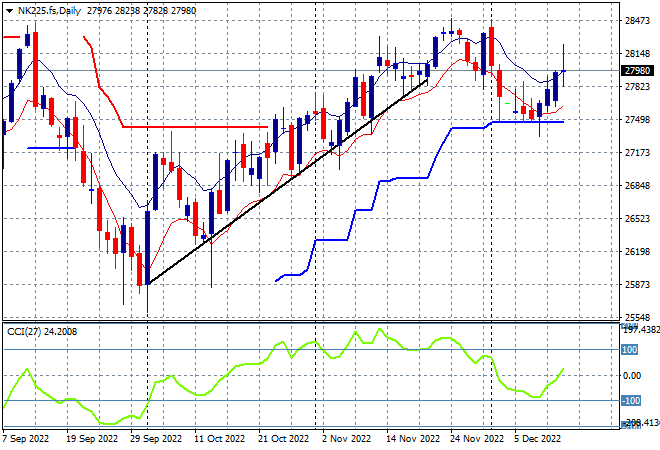
Japanese stock markets initially meandered along then found some buying activity, with the Nikkei 225 up 0.4% at 27942 points. Futures are indicating a better start off today from the clear lead on Wall Street although heavy resistance at the 28400 point level is the key area to beat to get price back on trend. The rollover into short term ATR support at the 27500 point level is trying to convert into a proper rally but momentum is nowhere near overbought yet so watch for a close above the high moving average:
The full text of this article is available to MacroBusiness subscribers