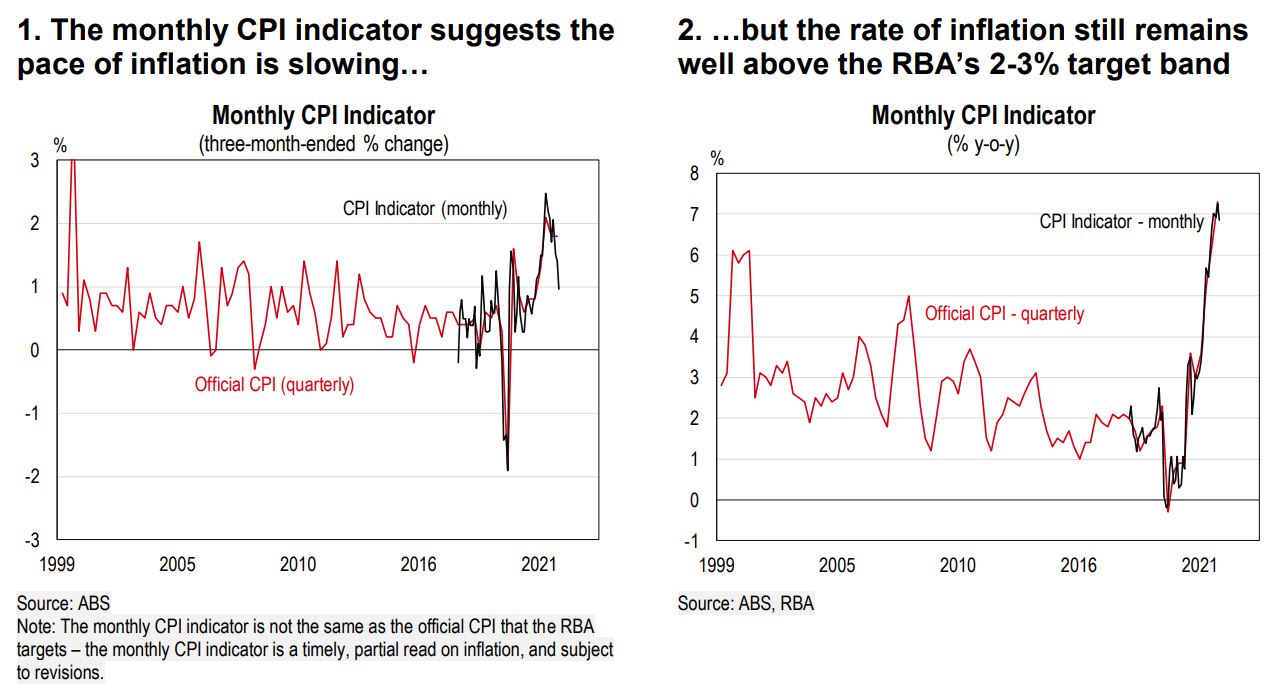
Bloxo making sense. Note that one of the major differences between monthly and quarterly CPIs is that only the latter includes utility bills re energy shock.
- A tight jobs market and inflation that is too high mean we expect the RBA to hike by a further 25bp next week to 3.10%
- After this, we expect a pause, as the lagged impact of its 300bp of hikes feeds through and the global economy slows
- Our central case has the cash rate on hold at 3.10% in 2023 and 2024, with upside risk in 2023 and downside risk in 2024
Another hike likely
The past month has delivered more evidence that inflation is too high and the jobs market is tight. Although the new monthly CPI indicator, published for October, eased a bit and appears to be past its peak, it was still well above the RBA’s 2-3% target band, at 6.9% y-o-y on the headline indicator and 5.3% on the trimmed mean.
With this, we expect that the RBA will remain sufficiently concerned about high inflation that it is likely to hike by a further 25bp in December, taking its cash rate to 3.10% and meaning that 300bp of tightening had been delivered in eight months.
At the same time, the rate hikes the RBA has already delivered are continuing to weaken the housing market. Consumer sentiment has also fallen to its lowest level since the worst depths of the pandemic and before that the 1990s recession. In addition, retail figures fell in October, perhaps an early sign of a broader consumer spending slowdown. Wage price index figures released during the month continued to show that the pick-up in wages growth appears to be gradual.
Our expectation is that local growth will slow further over coming months, pressure in the jobs market will start to ease, the global growth backdrop will worsen, and global disinflation will become clearer. Commodity prices, shipping costs and global goods prices are already falling. Growth already looks pretty challenged in Europe and a US downturn is expected to be more pronounced by early next year. China has significant near-term growth challenges, including managing its “zero COVID-19” strategy, even if things could be a fair bit better by the second half of 2023.
If this is the picture that emerges, then in early February 2023, when the RBA has its next meeting, we expect the RBA to pause.
A key risk to this view is that the RBA feels it needs to hike a bit further in early 2023.
Alternatively, the RBA could choose to pause in early 2023 but still hike again later in 2023, if the inflation problem persists for longer. Working in the other direction, particularly later in 2023 or in 2024, is the possibility of rate cuts. With this set of risks in mind, our central case is that the RBA remains on hold through 2023 and 2024.