
Earlier this week, CBA released card spending data to 16 December, which showed “that a moderation of spending growth is underway”:
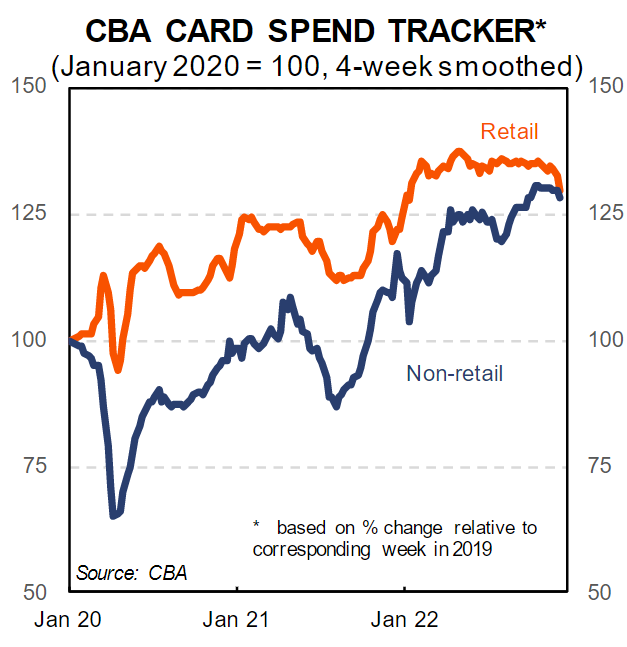
CBA also note that as “the full extent of the rate hikes flow through, and many mortgage holders roll off their fixed rate in 2023, we expect to see a more significant slowing in household consumption”.
Now total ANZ-observed spending data from 20 November to 18 December has been released by ANZ Research, with spending “just 10% higher than in 2019, despite a CPI increase of 10.5% between Dec 2019 and Sep 2022 and population growth of 1.8% from Dec 2019 to Jun 2022”:
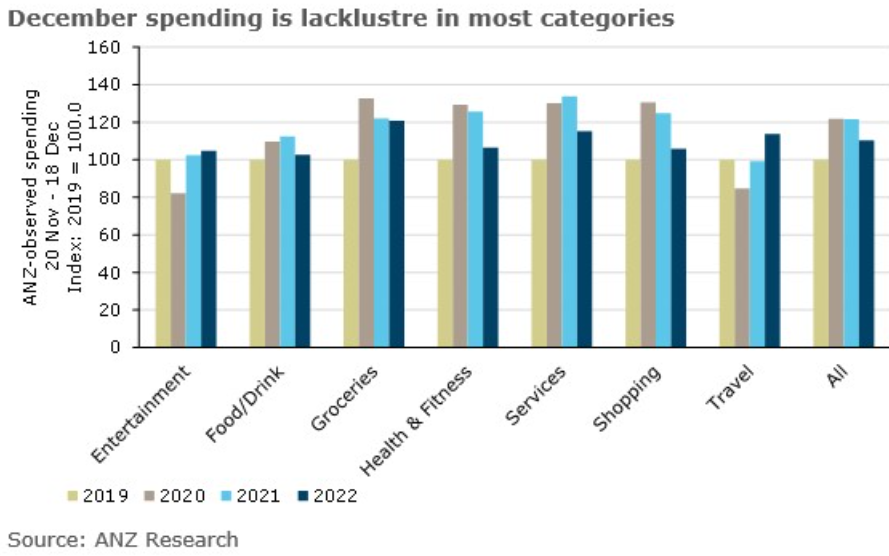
Accordingly, ANZ Research believes “Australia’s spending slowdown has begun”.
To be fair, the decline in spending over December could be in response to the growing popularity of the Black Friday sales period, which may have brought forward purchases to November.
Nevertheless, it is only a matter of time before the RBA’s aggressive rate hikes slash spending.
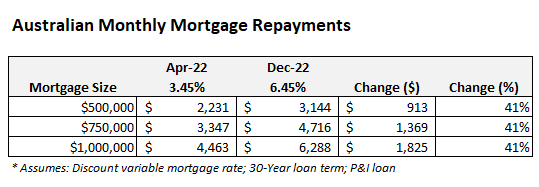
The 3.0% of interest rate tightening already delivered by the RBA will lift variable mortgage repayments by 41% versus their April pre-tightening level once the rate hikes are fully passed on. This will add around $900 in monthly repayments to a typical $500,000 mortgage:
Household budgets will then be hit even harder as the fixed rate mortgage reset takes hold next year.
The share of Australian home buyers that took out fixed rate mortgages surged over the pandemic from a long-term average of around 15% to an all-time high 46% in mid-2021:
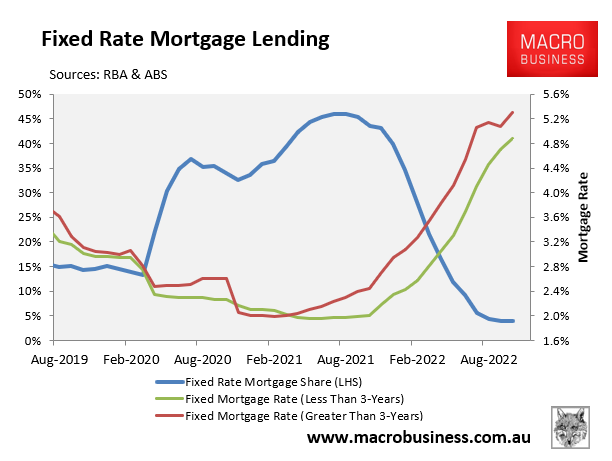
Nearly one-in-four mortgages (by value) will switch in 2023 from ultra-low fixed rates originated at around 2% to rates that are more than double these levels.
Accordingly, the share of household income used to service principal and interest debt repayments will soar next year to its highest level in history.
Tenants are also contending with double-digit rent increases.
The inevitable impact will be that household consumption will crater as more income is diverted away from spending towards debt repayments.
