
“Business” wankers don’t like Albo’s IR bill:
Australia’s major employer associations have joined together to express concern that elements of the Secure Jobs Better Pay Bill being considered by the Federal Parliament would introduce fundamental and highly problematic changes to Australia’s bargaining system that would be detrimental to Australia.
The Australian Chamber of Commerce and Industry; Australian Industry Group; Business Council of Australia; Minerals Council of Australia; the Council of Small Business Organisations of Australia (COSBOA); and National Farmers Federation are united in a call for the Government to either abandon or substantially amend various contentious elements of the Bill relating to bargaining.
The Bill, as currently framed, should not be passed by Parliament.
We jointly call on the Government to permit time for a thorough consideration of the content and implications of the Bill. This deeper consideration should include removing the provisions to allow widespread use of multi-employer bargaining backed by strike action. The Australian Parliament should remain open to making further amendments.
The legislation as drafted does not reflect broad consensus arising out of engagement with industry at the Jobs and Skills Summit or subsequent consultation. It is crucial these proposals are thoroughly examined.
The national employer associations are particularly concerned that the Bill:
- unjustifiably expands the scope for multi-employer bargaining;
- fails to articulate clear parameters around where multi-employer bargaining would be available in either the supported bargaining or single-interest streams; and
- undermines the system of enterprising bargaining that has delivered many significant benefits to Australia over several decades and currently operates effectively in many sectors.
The currently proposed framework for arbitrating bargaining disputes also risks unreasonably subjecting broad sectors of the economy, and community, to the centralised setting of terms and conditions over and above the comprehensive system of modern awards already in place.
So, what is their idea? Because wages have to lift. Otherwise, inequity and, over time, US-style demand deficit will develop as too much wealth and income accumulates in too few hands.
I’m a capitalist and believe fervently in entrepreneurialism, innovation, and productivity gains as the path to higher standards of living for all.
But, if there is not some kind of power balance between capital and labour, how are those gains to be shared?
Post-GFC productivity gains have been muted but they have very much favoured labour. On the other hand, capital efficiency has horribly dragged down multifactor productivity:
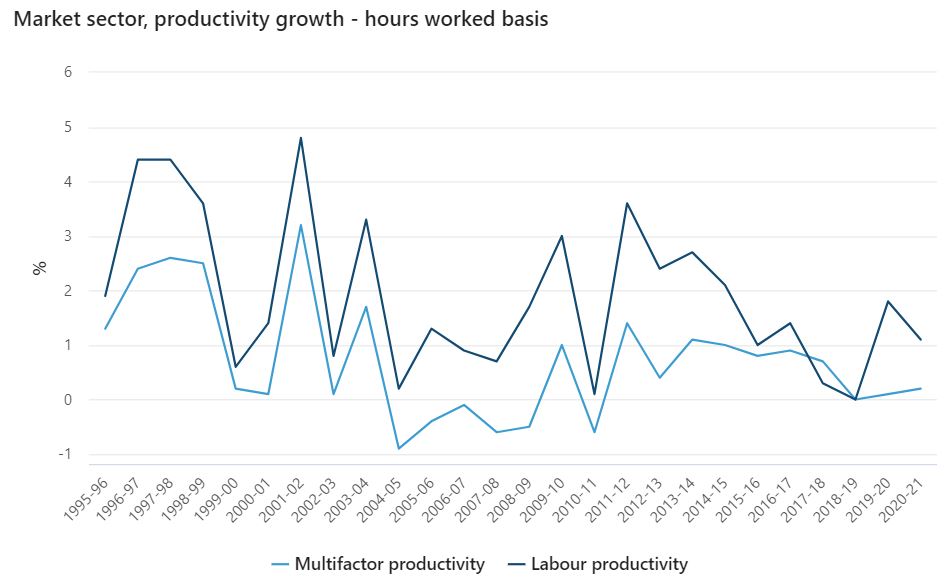
That is, we have gotten more output per unit of labour but capital ain’t doing shite. Yet, it is the latter that has captured the gains:
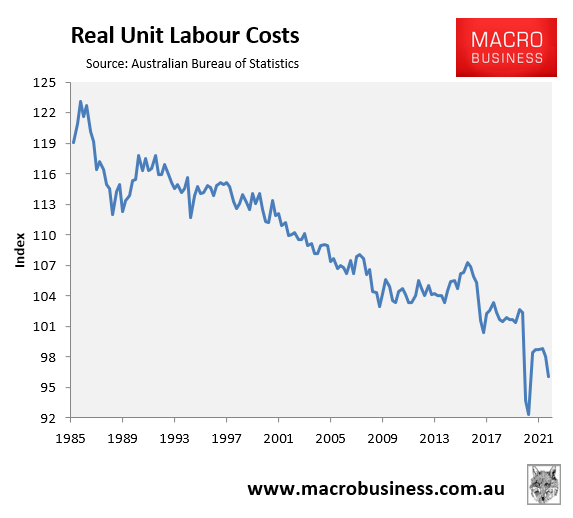
Surely, at some fundamental level, this is an indictment of the very business leadership that is represented above. It spends so much time lobbying to capture more of the pie that it seems to have forgotten how to invest to grow it by itself.
This is hard evidence of what I wrote yesterday. Led by the trickledown wankers at the AFR and Murdoch, in league with idiot politicians, Australian business culture has itself shifted towards a form of ownership of the political economy over acting to compete within it.
Ironically, as the edifice of CEO worship rises ever higher, the performance of the same falls away. Leading to the wrong people running businesses amid ever-greater attempts to control politics over their own businesses.
How, then, is labour to compete to raise wages? This is not just an academic question. It is a crucial mechanism of national advancement. Not only in terms of equity and economic structure, but in terms of growing productivity itself.
“Business” has already been granted its wish for a resumption of mass immigration. We know that this is very disproductive. It triggers capital shallowing, clogging everything in sight: it suppresses labour’s bargaining power, and it gives businesses the incentive to disinvest into sweatshop supply chains.
Chronically weak wages make this even worse. Why look to efficiency when it is so easy to break your human resources? That is, weak wages and weak productivity are circular, not linear cause and effect.
As an example, has anybody been to the supermarket lately? Pre-COVID, the joints were awash with migrant labour. During COVID, the staff profile shifted to local kids and the firms were forced to bid for labour. A few years on, and now I have to be my own checkout chick with the aid of an automated process.
This is a classic productivity advancement via investment in technology and new process. The tech will have been part of the trigger but so will the pressure on the labour bill.
The resulting higher profits are then shared with consumers as lower prices (all things equal such as no La Nina!) and, if the bargaining power is in place, with the smaller workforce that has to be upskilled to work with the machines as well.
Discarded labour can move to other areas in need.
Using this example for the broader economy, if industrial relations are left as they are amid a resumption of mass immigration and”business” wanker lobbying, we know the outcome. Another lost decade for Aussie workers and more weak capital productivity to boot.
In short, we need microeconomic reform to counteract macroeconomic settings hostile to wage growth, and to give bosses the incentive to innovate.
The only form of power I know that can do that is to strike! Notwithstanding that unions are wankers of equal magnitude to business, an evil as necessary as the super-rich that incentivises innovation.
Therefore, I support Labor’s IR bill.
