
Roy Morgan has released its labour market estimates for October with the unemployment rate rising 1.1% to 9.2% and the combined unemployment and underemployment rate soaring to 19.7% – its highest rate since late 2021:
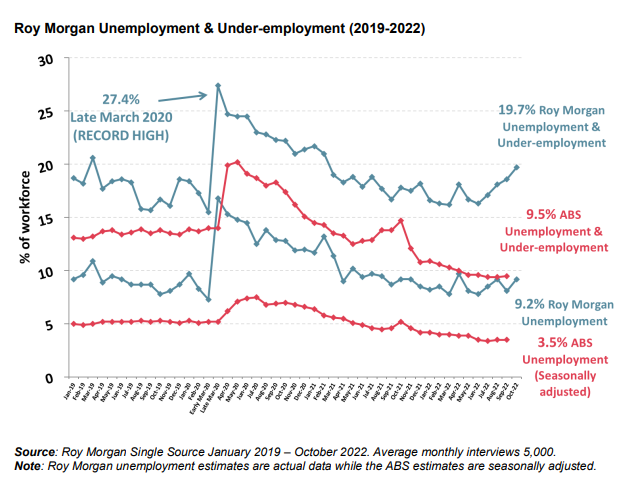
Key points from the release are:
- The workforce was down 77,000 in October driven by the large fall in full-time employment. The workforce in October was 14,830,000 (down 77,000 from September) – comprised of 13,468,000 employed Australians (down 237,000) and 1,362,000 unemployed Australians looking for work (up 160,000).
- Employment drops in October driven by decline in full-time employment. Australian employment dropped 237,000 to 13,468,000 in October. The decrease was driven by a drop in full-time employment, down 309,000 to 8,572,000, although part-time employment increased to a new record high, up 72,000 to 4,896,000 as all COVID-19 restrictions came to an end in mid-October.
- Unemployment rises in October as drop in employment forces many people to look for work. 1,362,000 Australians were unemployed (9.2% of the workforce) in October, an increase of 160,000 from September with more people looking for part-time work, up 170,000 to 837,000 although there were slightly fewer people looking for full-time work, down 17,000 to 525,000.
- In total 2.92 million Australians (19.7% of the workforce) were either unemployed or under-employed in October, up 152,000 on September – the highest overall figure for over 18 months since February 2021.
Michele Levine, CEO Roy Morgan, noted that the end of COVID-19 restrictions in mid-October will have a profound impact on the labour market going forward as those contracting COVID-19 are no longer forced into mandatory isolation or eligible for government COVID-19 payments:
“The ending of COVID-19 restrictions in mid-October means Australians contracting COVID-19 are no longer required to undertake a mandatory isolation period of five days at home. The ending of the mandatory period of isolation means businesses are now less likely to hire additional employees to fill vacancies created by the forced periods of isolation.
“Throughout this year the over 10 million cases of COVID-19 have heavily distorted the employment situation due to the government rules on mandatory isolation. The early indicators from this month’s employment estimates show overall employment falling which may be the first indication of businesses adjusting to the ending of COVID-19 restrictions by letting go of employees hired as ‘cover’.
