
TSLombard is the next to pivot to the Chinese structural ex-growth thesis. The only thing I would add is that copper is very exposed as well.
China faces three large growth headwinds in the coming decades: debt (property), deglobalization, and demographics. We think that over the next 10 years, China’s potential growth rate will fall to 2-3% yoy under the impact of these “3 Ds”, the most pressing of which is property.
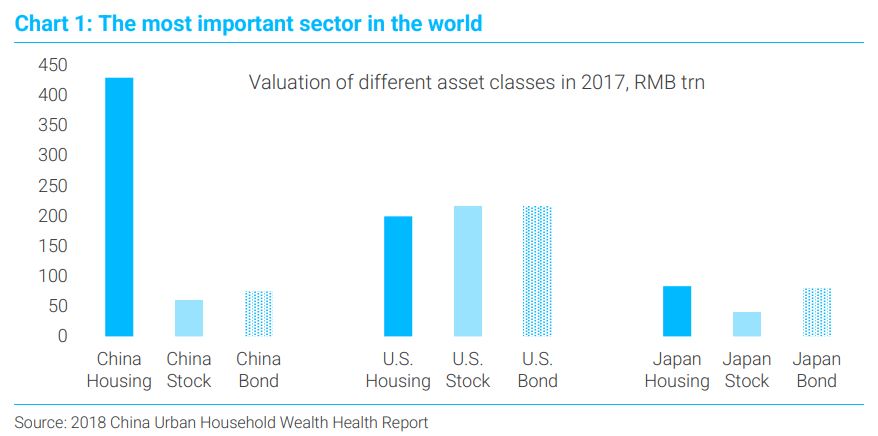
The multi-decade property bull market has peaked: real estate has moved from growth driver to headwind, with the property share of credit and GDP in terminal decline. A slump in what is rightly described as “the most important sector in the world” has major macro, market and political implications for China and the globe. To put it bluntly, it means slower, less commodity-intensive growth and greater domestic political and geopolitical risks. For assets, this puts the onus on stock pickers over China index allocators: it is long-term bearish RMB and property- linked commodities (not those involved in the green transition), especially iron ore, but bullish CGBs.
Property is driven by finance in the short term, land (supply) in the medium term and demographics in the long run. The current cyclical downturn catalysed by developers’ financing woes is occurring amid a longer trend decline centred on demographics and the PRC’s slowing urbanization rate. President Xi has made it clear that Beijing will continue to suppress cyclical upswings (a property tax is finally in the works).
To estimate the extent of the growth hit, we calculate a sustainable run rate for property sales and investment based on underlying urban job growth and assume Beijing maintains a conservative monetary and property stance. This calculation suggests the property sector is 30% larger than underlying demand. In this relatively benign scenario, a contraction of just under 30% in real estate – a sector accounting for ~20% of GDP – leads to an annual drag of 1.2 ppts on potential growth over five years. And that is a hit equivalent to roughly 20% of the pre-pandemic growth rate, bringing potential growth to ~4% after the covid cycle ends.
‘Japanification’ and balance-sheet recession. Real estate’s central position within the economy and financial system means any slowdown has wide-ranging spill over risks. China is unlikely to experience a GFC-style crisis. It is likely, however, to enter a period of “Japanification,” characterized by slower growth, lower private-sector demand and disinflation. A balance-sheet recession – whereby corporates and households faced with falling asset prices and fixed liabilities pay back debt, forgoing consumption – is probable for households. A scenario of property-sector contraction exceeding our relatively benign 30% contraction is certainly possible; risks are weighted firmly to the downside.
From Chinese dream to nightmare. Xi Jinping is attempting to shift the source of Party legitimacy away from all-out growth to the still nebulous “Common Prosperity” model. Property is at the nexus of this difficult political economic balancing act. Swapping the China Dream of home ownership and rapid increases in material prosperity for what is as yet an undefined but certainly slower model is fraught with economic, social, and financial risks.
Beijing has limited policy options to resolve core property-sector difficulties (local government land revenue financing, falling demand, a developer model reliant on Ponzi-like pre-sale funding) and the ensuing macro headwinds. A sharp crisis is not likely, but nor is a solution. Policymakers are banking on “new” infrastructure spending and consumption to offset property, but “new” investment is too small and reform efforts too slow to boost growth in the next five years. Instead, greater central government debt and a weaker RMB will be needed to combat the slowdown. Even these drivers, which Beijing appears reluctant to use, will only mitigate the damage rather than accelerate growth. China’s structural slowdown is just getting started.
From ‘rational’ bull market to bubble
For a long time, rapid growth in China property investment and valuations was fully justified. The economy moved from an entirely state-controlled residential market to one led by the private sector in the late 1990s. Concurrently, China joined the WTO and continued on a path of rapid industrialization, led in part by export-oriented manufacturing. The resulting internal migration added 300mn to China’s urban population between 1990 and 2010, and turbocharged construction activity in the 2000s.
In the early 2010s, the market was pushed out of balance by weaker, albeit still decent fundamentals combined with the post 2008 stimulus, an implicit government backstop for prices and incentives for local governments to actively encourage construction. The necessary reset nearly occurred in 2015, but Beijing blinked, launching the shantytown renovation programme funded by the PBoC and thereby further exacerbating instability. The upshot today is a sector with a number of frailties across key economic actors.
Household demand
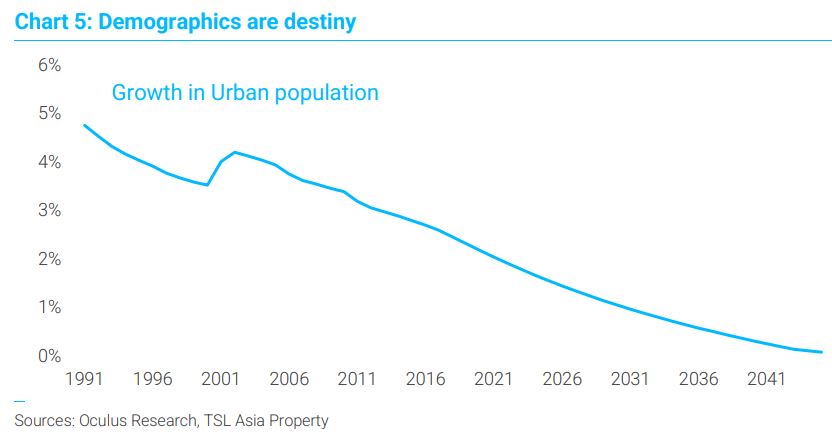
• Urbanization rates are set to stagnate over the next 10 years, with no growth on TSL and official projections for the next five years
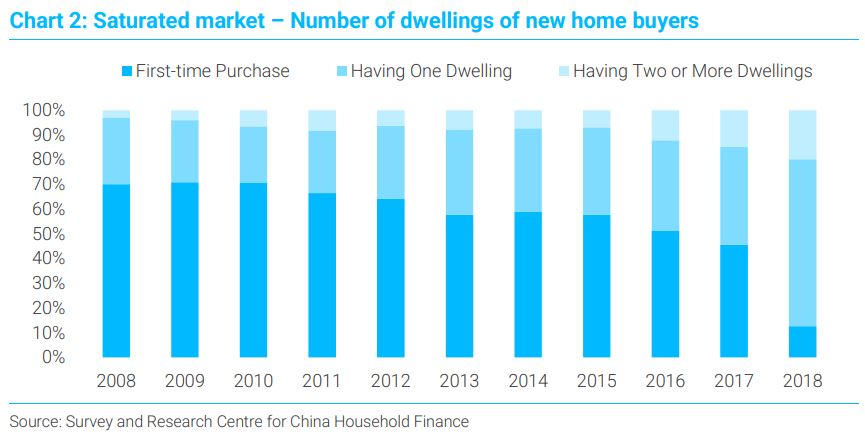
• Home ownership is approximately 92% with the share of first-time buyers in new transactions at just 10% in 2018 (Chart 2)
• The national vacancy rate is estimated at between 15-25%
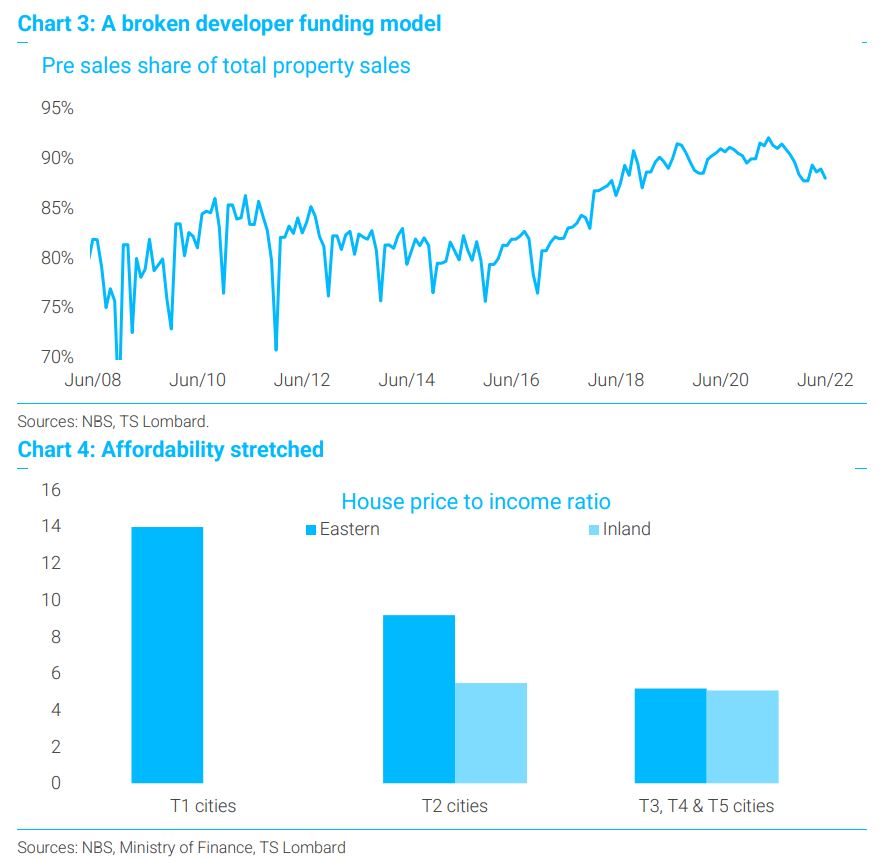
• Valuations are stretched: rental yields are 1-2% and price to income ratios are above 5 even in Tier 4 cities (Chart 4) Developer, bank and local-government financing model
• Sales of uncompleted properties account for 90% of developer sales (Chart 3)
• Real-estate offshore debt is estimated at US$2trn
• Two-fifths of local-government revenue comes from land sales
• Lending to the property sector accounts for 25% of banks’ loan book
In short, the property-sector model is broken. The question is not if but when – and how quickly – a restructuring of the sector will occur.
Terminal decline via economic gravity & Party power
The multi-decade bull run is coming to an end. Property is driven by finance in the short term, land (supply) in the medium term and demographics in the long run. The cyclical downturn catalysed by developers’ financing woes is occurring amid a longer trend decline centred on demographics
and the PRC’s slowing urbanization rate.
The current slump was triggered by government efforts to improve the health of the property sector after a decade of the massive developer mismanagement and speculation. Compressing (rather than popping) the property bubble is a core element of the emerging “Common Prosperity” framework: an overly dominant real-estate sector goes against the key development goals of raising the birth rate, improving productivity, lowering inequality, de-risking the financial system and using fewer fossil fuels.
Clearly, Beijing misjudged the “three red lines” on developer debt ratios issued in late 2020. The policy, which followed on the heels of caps on bank lending to the property sector, centralization of land auction revenue and continued tightening of home purchase regulations, tipped a fragile system off balance just as more virulent Covid strains were derailing the wider economy.
As sales continue to slump and the economy remains sluggish, central authorities have been reluctant to provide strong overt support. This is indicative of the firmly held belief that China must wean itself off property-led growth – “houses are for living in not speculation”. For his part, Xi characterizes himself as a man willing to take the tough choices needed to reverse years of mismanagement. The lack of stimulus on the part of Beijing also stems from the absence of vision and/or political consensus behind China’s new property model.
Efforts to compress the property sector will continue when this cycle eventually turns. Following the cyclical recovery, Beijing is likely to implement the next step in property-sector reform – a widely telegraphed pilot property tax in 20 cities as a prelude to the first national property tax. The recent Party Congress Political Report included a forceful line on “regulating the mechanism of wealth accumulation”, which we view as reinforcing the political momentum behind a property sector tax.
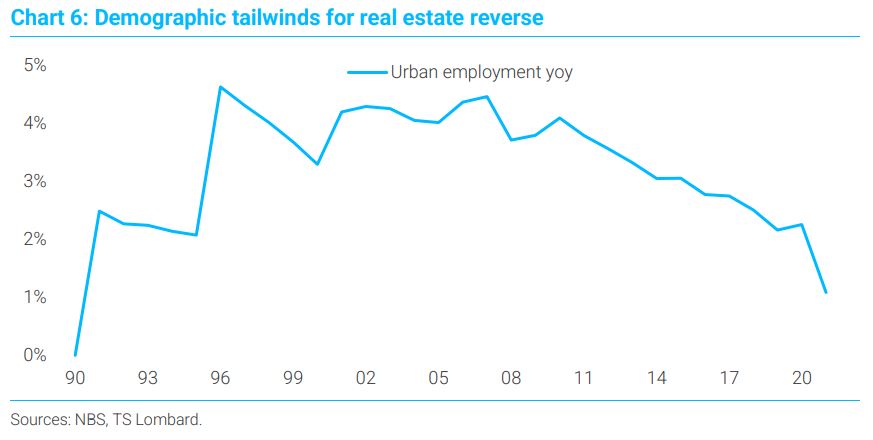
Beijing’s deliberate targeting of finance and land components of the cycle comes at a time when household demand is increasingly saturated and the demographic driver in the form of urbanization is slowing. The official urbanization rate is 65%, with government projecting no
increase over the 14th Five-Year Plan period to 2025. That figure is likely to understate the true urbanization rate. Migrant workers numbered 376mn in the latest census, and are only partly accounted for in official urban-population statistics. Private-sector research estimates that about half of the population of the four Tier 1 megacities (Shanghai, Beijing, Guangzhou and Shenzhen) were migrants in 2020. Moreover, detailed data from the 2010 census show that 44 per cent of the population in cities with more than 5 million people were migrants; three-quarters of them held a rural hukou.
Urban employment is a better measure of the rate of demand for property, and growth here has slumped to just 1% yoy. Efforts to reform the hukou system are under way and will prove supportive of property demand in the long term. China could reasonably aim for an urbanization rate of 80%, in line with regional peers Korea (81.4%) Japan (91.8%) and Taiwan (78.9%). However, reform efforts are wholly insufficient to offset medium-term trends. The fact of the matter is that both urbanization and job creation are in trend decline. China’s Lewis turning point – at which surplus rural labour is fully absorbed into the manufacturing sector – has long since passed.
In short, the Party will compress cyclical property recoveries while demographics will set the structural downward trend.
Multiyear drag on investment and consumption
With property-sector sales, investment, and share of credit creation and GDP having all peaked last year, one of China’s major growth drivers is now a headwind. We estimate an annual drag of 1.2ppt on potential growth over the next five years – a hit equivalent to roughly 20% of the prepandemic growth rate, bringing potential growth to ~4%.
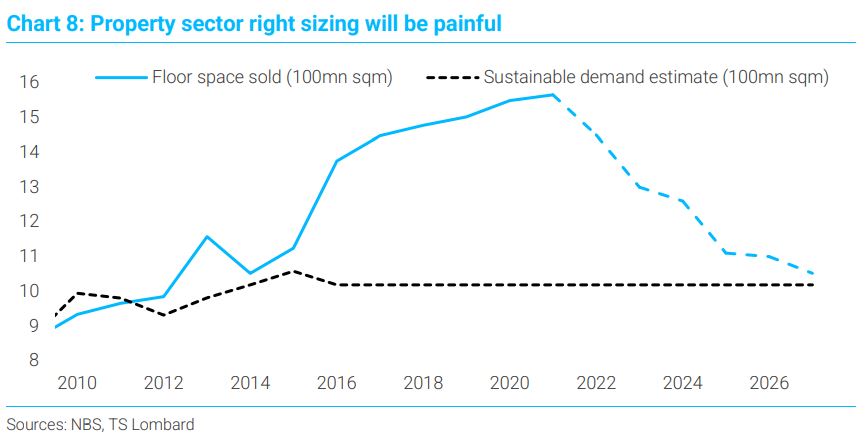
To quantify the scale of the slowdown, we look at demand for property and, by extension, investment and related consumption. We breakdown demand into three broad components: 1) new urban residents; 2) upgrading by existing residents; and 3) replacement of dilapidated homes. Of these drivers, only the first is likely to provide a meaningful fillip to sales over the next 10 years. China’s housing stock is still relatively young, largely built from 1998 onwards, while house penetration among existing urban residents is already high, at about 92% (Chart 2 above).
Based on these assumptions, a sustainable level for real estate sales growth should be slightly above the growth in new urban residents (give or take some upgrading and positive hukou reform effects), with the actual sales volume trending down towards this level.
To form this baseline, we match housing sales by volume to growth in urban employment. The chart above shows sales far outstripping job creation over the noughties when China rapidly built up its private housing stock. From 2010 to 2014, the two rates were broadly in line, but from 2015 onwards they diverge once again. The divergence marks the transition from rational to irrational bull market. Beijing launched a massive shanty town renovation programme in 2016-18 to clear excess inventory and drive sales. From 2019 onwards loose monetary and excess pandemic saving pushed sales to fresh highs through to end-Q3/21. And this period coincided with a rapid rise in household debt and the dominance of a Ponzi-like pre-sale developer funding model.
The major deviation of 2015-20 house sales data from the historical trend is likely be a one-off. Beijing has made it clear that it will maintain a conservative stimulus stance, particularly with regard to property, while the scope for further shantytown renovation is limited by a lack of dilapidated properties. In the long run, floor space sold should fall back to the trend level or even below to adjust for the previous overgrowth. Using the period 2010-14 as a benchmark, sales and, by extension, investment have overshot base demand by 500mn square metres since 2014. We project annual sales falling by 30% back to 2010-14 levels over the coming five years as the sector “right-sizes” to demand and constrained financial conditions.
The implications for GDP growth follow through financing and commodities/finished goods demand. Current sales are the key financing channel for existing investment and future project planning. Sales also drive local government revenue and spending as well as downstream furnishing and consumer goods spending.
To estimate the scale of activity impacted, we calculate real estate’s share of GDP using inputoutput tables. We adjust the construction share to strip out infrastructure and other unrelated activity and add real estate services to obtain a share of total GDP of 18.6% as of 2017.
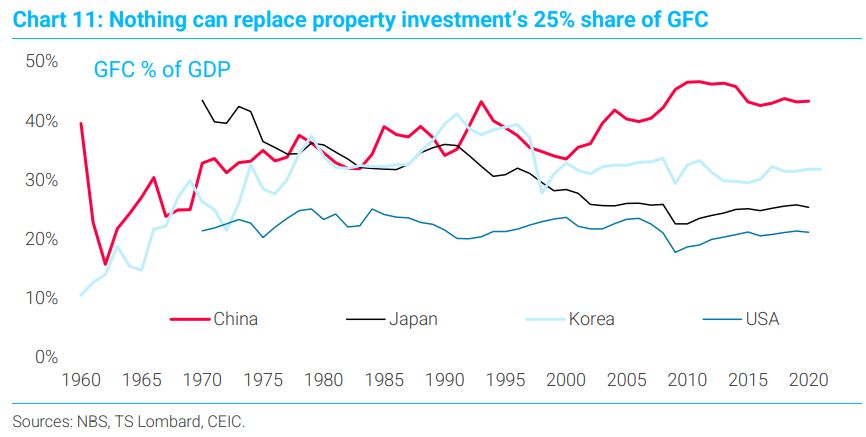
We also look directly at the contribution of real-estate investment to GDP via GFCF. Using the ratio of property fixed-asset investment within total FAI, we calculate real estate’s share of GFCF, finding that the direct investment contribution of real estate to GDP growth averaged 1ppt over 2015-20. As a share of GDP, real estate investment is ~10%, but this understates the sector’s wide array of linkages throughout the economy.
Returning to our base line demand forecast, this implies around a fifth of the Chinese economy shrinking by 30%. Where the contraction to occur over five years, it would knock around 1.2ppt from potential growth, this is out base case and puts GDP growth at ~4% in the post-Covid cycle.
Japanese financial risks
Real estate’s central position within the economy and financial system means any slowdown carries wide-ranging spillover risks. Land is the core asset for households (70% of wealth), local governments (40% of revenue) and banks (25% of loan book). Moreover, as growth slows owing to the property-sector decline, misallocation of capital across the economy becomes harder to digest; this is the proverbial tide going out and revealing who has been swimming without any clothes on. There has never been a property-bubble deflation without a financial crisis, and the
size and rapidity of China’s debt build-up are unparalleled.
China is unlikely to experience a GFC-style crisis, as Beijing controls the balance sheet of the banks, households (capital controls), and large parts of the private sector. It is likely, however, to enter a period of “Japanification”, characterized by slower growth, lower private-sector demand and disinflation (although this may be offset by green energy and tech mobilization transition costs) as the contribution of real-estate growth declines and unproductive investment and assets are very slowly processed by the banking system.
Beijing has studied Tokyo’s missteps and will attempt to follow a different policy path. In the early years of its post-bubble economy, Japan hiked interest rates, consolidated its fiscal position, experienced a massive stock-market crash and kept the Yen strong. Even since “Japanification”
became entrenched, policymakers have remained reluctant to adopt outsized fiscal-easing measures. We expect China to run a policy mix that centres on greater government spending, accommodative monetary policy, including a bailout for the sector, and a weaker RMB (mainly REER rather than nominal owing to domestic and international political constraints).
Balance-sheet recession
The most pressing financial risk is the liquidity crunch among developers. Their main source of funding – advanced sales of uncompleted apartments, accounting for 90% of total sales – has collapsed as households are hammered by zero Covid policy and question developers’ ability to complete property. Beijing has been reluctant to provide national funding to support firms’ ability to meet liabilities, of which the most urgent from a financial and social stability perspective is delivery of pre-paid units. Nevertheless, should Beijing maintain zero Covid beyond H1/23 (not our base case), then a large central government package would, in our view, become increasingly necessary to limit financial contagion spreading further into the banking system.
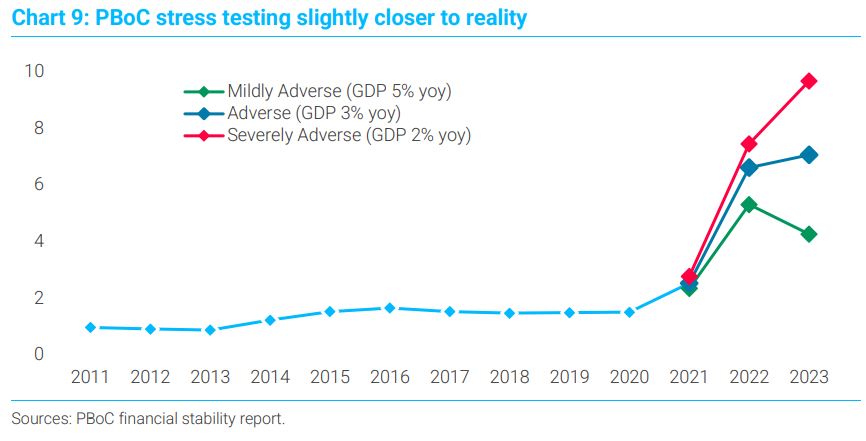
Estimating NPL rates in China is difficult at the best of times. The official data put the number at an unbelievable 1.67% as of July. The published rate is well below the figure given in PBoC’s own risk modelling; indeed, the bank’s “severe downside scenario”, which has growth slowing to 2.8% yoy (above our forecast of 1.6% for 2022), suggested the NPL rate would rise to 9.69%. The PBoC financial stability projection is somewhat closer to market estimates, which put the extent of property-sector substandard debt at 25-30%, up from the low 20s at the start of the year.
Mortgage strikes have disappeared from headlines but they do continue. The need to limit contagion is clearly growing, as is the difficulty local government face in ring fencing problem projects.
Central leaders are loath to condone mismanagement and take a step back from the path of reducing moral hazard. However, should signs of stress emerge in the banking system, Beijing would be forced to intervene. One method of intervention with a high chance of success is a national pre-sale construction guarantee fund. Based on construction halts reaching 10% of floor area under construction and a build cost of RMB3000/sq m, we estimate that at least RMB2.5trn would be needed. The funding required could quickly increase as developers and local governments were incentivized to rely on central government largesse rather than sacrifice their own capital. We think Beijing is banking on a Covid-19 exit – probably in Q2/23 – to restore confidence in the sector and will continue with ad-hoc stimulus measures for as long as possible.
Japanification
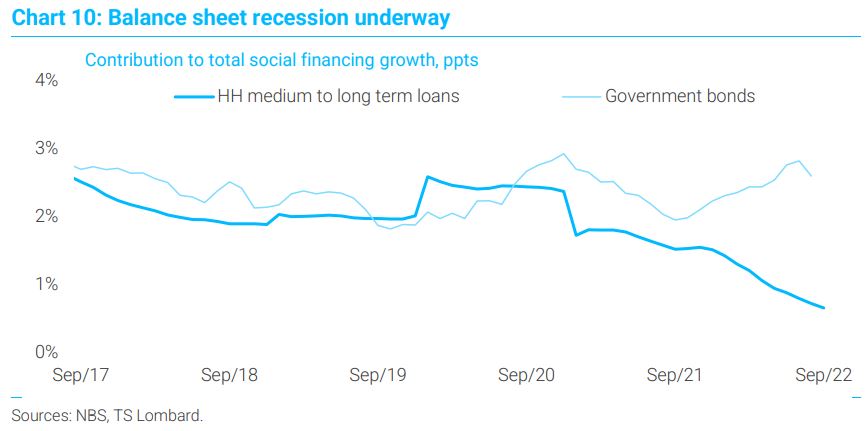
National backing for pre-sales would resolve short-term issues, as would a return of household confidence generated from the end of the zero Covid policy. However, overcapacity of roughly 30%, mispriced underlying assets and large piles of developer + supplier debt would remain structural issues, as would the lack of an alternative growth driver and savings offset (more on this below). Tackling the much larger pile of non-performing and mispriced assets is a much bigger task, one that will take a number of years to achieve Japan experienced a balance-sheet recession from the 1990s to the mid-2000s, largely triggered by the rapid fall in property and stock prices. Corporates and households faced with falling asset prices and fixed liabilities paid back debt, forgoing consumption. As the value of existing property assets at a minimum undershoot prior growth expectations, China is likely to experience a balance-sheet recession, probably milder than Japan’s, given lower corporate and household leverage, a slower bubble bust and politicians cognizant of past policy errors, but a balance-sheet recession nonetheless.
Fearing the repercussions to social stability from falling home values, Beijing has attempted to institute a price floor across Chinese cities over the past 12 months. Clearly, this has not helped prop up either the market or sentiment and has, in fact, made it more difficult for developers to offer discounts to clear excess inventory and raise cash. Moreover, it has not prevented the start of conditions similar to those of a balance-sheet recession type emerging in the private sector.
The outlook of falling demand and, at the very least, much slower price growth will necessitate the recapitalization of banks, entailing more unproductive, centrally generated credit. Real-estate lending accounts for about 25% of the total commercial bank loan book, equal to RMB53trn as of end of Q2/22. Loan loss provisions of commercial banks are RMB 6trn, meaning an official substandard loan coverage ratio of 203%. Unofficially, if 30% of real estate lending is substandard, as market research suggests, banks need another RMB 10trn to meet loan coverage ratios, more than twice the amount used in the last real-estate shantytown renovation stimulus programme. The result: weaker, less productive credit creation and, consequently, slower economic growth.
Could a grey rhino become a black swan?
In Party parlance, property difficulties have always been a “grey rhino” – a big risk that is difficult to resolve but one that can be seen coming from a long way off. The grey rhino turned out to be bigger, arrived faster and coincided with a zero Covid defeating Omicron outbreak. For a sharp GFC-style crisis to occur, a sudden break and rapid contagion would need to emerge faster than Beijing could mobilize financial and security resources to contain the damage. The two primary risks are local-government financing vehicles and regional banks. Both financial entities are heavily exposed to real estate and under stress. Meanwhile, the conditions for a black swan event are building while Beijing refrains from a comprehensive bailout, but it is difficult to pinpoint the catalyst. The longer central authorities refrain from a wide-ranging backstop, the greater the downside risk.
China may have learned from Japan’s mistakes, but policy action can only ameliorate and delay economic gravity rather than fully offset it. Given the linkages from property into the real and financial economy, risks are firmly to the downside; and a slowdown larger than our baseline 30% contraction over the next five to ten years is possible.
Limited options – Chinese dream turns to nightmare
China is committed to doubling real 2020 GDP by 2035, an ambitious goal that requires growth to average just under 5% during this 15-year period. Achieving that rate with a declining property contribution will be very difficult indeed. At the same time, and partly as a result of a structurally slower growth path, Xi Jinping is attempting to introduce a new political-economic framework under the “Common Prosperity” catechism, shifting the source of Party legitimacy and social compact away from all-out growth to an undefined model. As our Chief EM economist, Lawrence Brainard, notes, property is at the nexus of this difficult political-economic balancing act. Swapping the Chinese dream of home ownership and rapid increases in material prosperity for an as yet undefined but certainly slower growth model is fraught with economic, social and financial risks.
At present, the “Common Prosperity” framework is rather sparse, with only the economic sphere having a proximate road map. The economic vision is for slower, more sustainable and more equal growth, coupled with structural reform and much greater state market intervention. In theory, new growth drivers of productive investment into technology and “new”-type infrastructure, together with increased domestic consumption, will offset the property slowdown and enable China to hit ambitious targets.
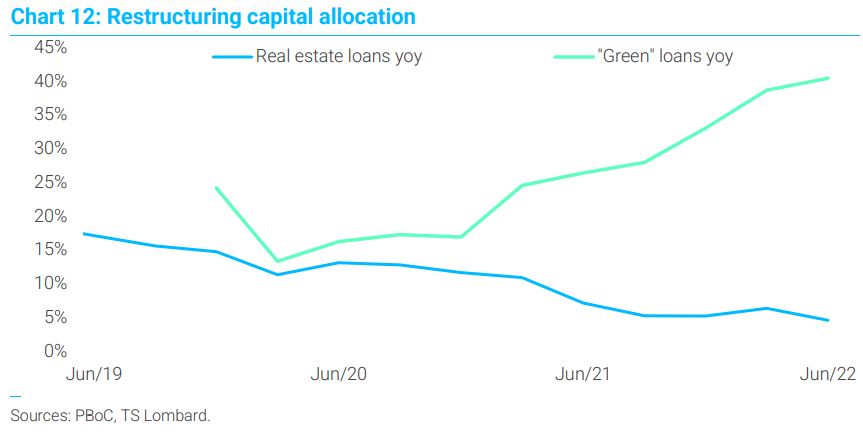
Higher productivity, tech investment and consumption are laudable goals but unlikely to prove sufficient to offset the decline in property. Chinese spending on core technology via both infrastructure, subsidies and direct/indirect financing will certainly continue to ramp up and will in part be aided by the forced reallocation of capital from traditional industries (Chart 12). The picking winners/infant-industry approach will generate tech breakthroughs and offer a powerful equity investment theme especially with the national mobilization of resources we expect to counter Bidens chip restrictions.
However, the macro impact is likely to be relatively small, at least initially. Total infrastructure investment is roughly equal to real estate investment, but the “new” component of infrastructure spending is only about 10% of total infrastructure FAI and therefore too small to offset the property decline.
Boosting consumption is a long-standing goal of the Party; however, the practical measures to raise spending are difficult to implement. Reform of the welfare system, particularly the hukou and migrant worker rights, is politically fraught and would involve an effective wealth transfer from local governments to citizens. Xi appears to recognize the need for a better social-safety net and more “Common Prosperity”; and he also has the political firepower to finally deliver on hukou reform. Some programmes have been accelerated by the current property crisis as local officials seek to find new buyers. Nevertheless, policy will need time to be designed and implemented and will take longer to bear fruit, albeit proving insufficient to offset the medium-term growth drag from real estate, especially when negative wealth effects are factored in.
Given the constraints on consumption and new tech, if Beijing wishes to maintain growth at what the PBoC and a host of Party think tanks believe is its potential 5-6% range, then central and local governments (particularly given the loss of land sales revenue) will need to take on more debt either for infrastructure or for welfare-related spending. China has room to borrow, but debtfuelled growth runs counter to the widely published de-risking and sustainability goals.
This means the Party is caught between contradictory commitments to growth and broader “Common Prosperity” goals (property and debt de-risking).
The result is likely to be a policy pendulum that swings between growth and reform poles; however, the bias will be towards a lower growth rate at high levels of local and central government debt. The period 2021 to the present day is a microcosm of the future pendulum: strong growth in 2021 allowed property regulations to tighten, with Covid and the real estate slump pushing the pendulum back to infrastructure-led growth and property easing this year. The new stop-go cycle adds a cap to growth and makes the traditional policy put much harder to activate. Beijing is likely to have to find a way to quietly drop its 2035 growth target.
After the Covid reopening boom has passed we think the “3 D’s”, led by property sector, will push China’s average growth rate to 4% yoy for around five years, before slowing further to an average growth rate of 2-3% yoy at the end of this decade.
Macro and market spillovers
The terminal decline in “the most important sector in the world” has broad macro, market and political consequences. To put it bluntly, China growth will be slower, less commodity-intensive and less dependent on private-sector debt. Cyclical bottoms are likely to be lower and harder to turn without a property stimulus trigger and amid lower private-sector goods, services and credit demand. Politically – as counterintuitive as that may seem right now – with growth and age against him, the power of Xi Jinping may be at or close to its peak. We set out some top-line political and asset-class implications below. The greatest market mispricing today appears to be in projections of Chinese iron-ore demand and needs revising sharply lower.
Politics – trouble for Xi
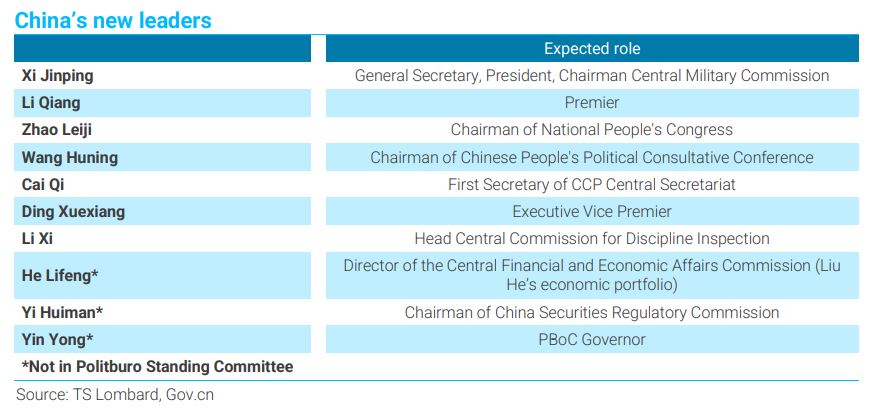
Xi Jinping completely dominated the 20th Party Congress, removing technocrats, promoting allies and quashing any hint of factionalism (full details here). However, Xi may already be approaching the peak of his power. The structural slowdown facing China and a necessary reorientation of its political economy will be very difficult indeed. Party performance legitimacy will need to change to something beyond growth, probably a national populist ideology. Growth and legitimacy challenges are profound and will occur as Xi reaches a natural retirement age This is not to suggest a positive outlook for China’s political fortunes – it is unclear whether another leader would or even could take a widely divergent path from that chosen by the current leadership. Succession struggles could hinder policy implementation, while a leader under pressure may fall back on a more jingoistic foreign policy.
Equities – stock pickers over indexes
A backdrop of slowing nominal growth and greater state market intervention, not to mention significant geopolitical headwinds, suggests sector or single-stock allocation will outperform broad indexes.
The mantra for China equity investment should always be “don’t fight the Party” or, indeed, “invest with the Party”. In practice, this means picking policy favourites clearly highlighted by Five-Year plans as well as other high-level documents and speeches. Areas with strong political and financial backing are electric vehicles, clean energy, 5G and advanced telecommunications, robotics, semiconductors and a host of other strategic emerging industries. Most of these combine domestic support with the broader shifts under way in the global economy, offering twin growth tailwinds.
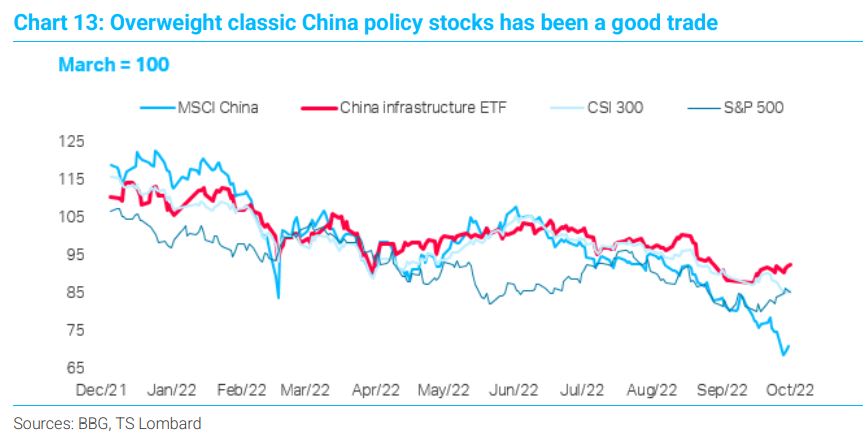
When growth slows and the policy pendulum swings, a different type of policy favourite – namely, infrastructure-related equities – tends to outperform. This year, since the policy pivot we highlighted in March, as we expected infrastructure ETFs have outperformed both Chinese and US benchmarks.
Rates – multiyear bull market for CGBs?
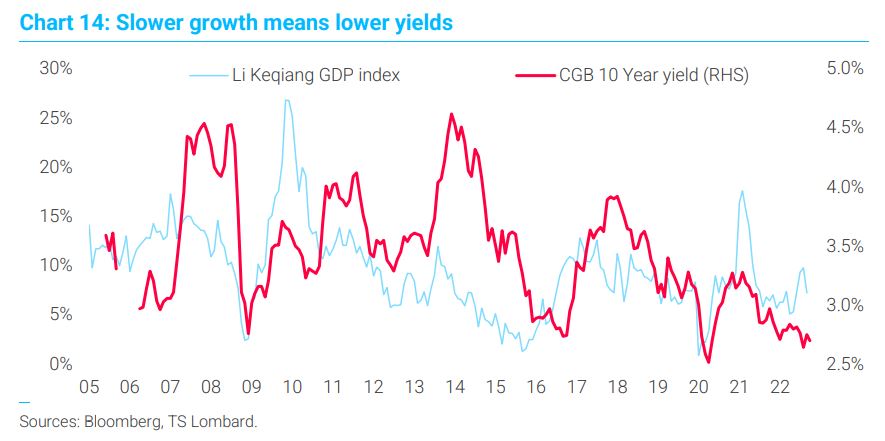
Long-term yields are determined primarily by growth expectations and inflation. As Covid-19 restrictions ease, the Chinese economy will turn, sending growth, inflation and yields higher. However, given the property-sector headwind (as well as those of deglobalization and demographics), annual growth is likely to never surpass the reopening high. Barring outsized inflationary impact from the green energy transition, inflation, too, is likely to remain subdued as China digests decades of capital misallocation. This setup creates the conditions for a continued decline in China Government Bond yields Beyond CGBs, the outlook is less clear. Risk repricing is coming across China, and we think anything other than central government and policy bank debt is vulnerable. There are plenty of relative trades within this – for example, “green” provinces vs commodity producers, new private economy vs old economy – but a bull market is unlikely.
FX – RMB depreciation
Savings minus investment equals net exports. This basic accounting identity suggests China will run a large current account surplus for some time as investment falls and households maintain high savings rates. To balance the equation, China will need either to run an internal deficit or find a means to export excess savings. (Exports are essentially a form of saving. They are products that are not consumed at home, while saving is defined as what is not consumed out of income.) Both policy options spell RMB depreciation.
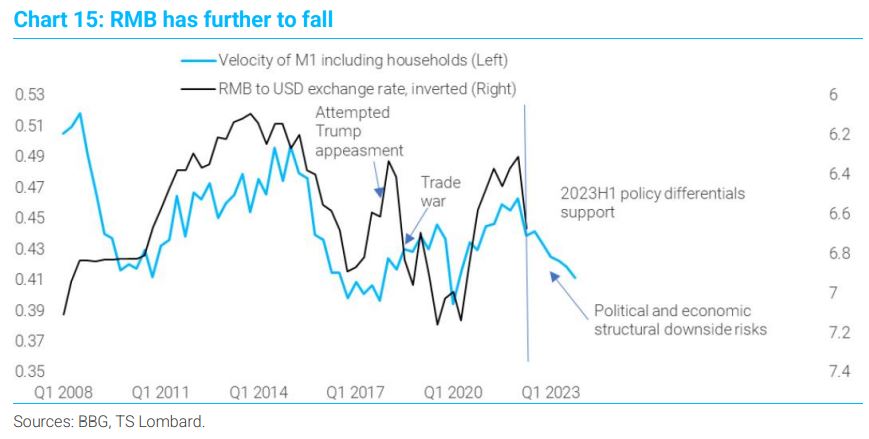
Government deficits are one solution that Beijing is likely to adopt, especially facilitate tech “national mobilization” and green upgrading. As the government assumes the mantle of borrower of first resort, the creation of liquidity switches from demand- to supply-driven. When money is created owing to demand, it has a natural place in the economy, along with the investment or consumption of the borrower who took out the loan (a process that creates money). When it is created by the authorities expanding supply, it has to find its place and it often fails to do so; as a result, the ratio of GDP to money simply declines. As economists, we can think of this as a decline in velocity. There are more RMB compared with things that can be bought in the real economy, ultimately reducing the value of the currency, whether through nominal or real channels.
The other alternative is to allow RMB weakness, thereby making Chinese goods more competitive. China’s unit labour cost-adjusted real effective exchange rate peaked in 2022 and global market share flatlined from 2015 to 2019. A weak RMB policy would sit well with Beijing’s interpretation of the importance of the Plaza Accord and a stronger Yen in causing Japan’s lost decade, via lost export market share and the resulting surge in domestic credit creation.
In practice, both greater state borrowing and deliberately weak RMB policies are likely to be pursued. We think depreciation will be greater in REER terms than in nominal ones, as the geopolitical and domestic political backdrop makes a larger nominal devaluation difficult to countenance. However, nominal depreciation is likely in the next six months as PBoC seeks to prevent a deep recession and the Fed tries to create one. RMB depreciation could also reaccelerate if Beijing were forced into a rapid and more wide ranging property sector backstop.
Commodities – demand destruction
A smaller property sector means less commodity consumption. Chinese real estate is the single largest user of copper, cement, glass and steel in the world. Its upstream and downstream linkages to white goods, construction equipment, furnishings make it a major user of minor industrial metals.
Iron ore and steel is where growth is likely to slow most sharply and have the most impact on macro and markets. Cement is largely domestically produced, while copper has a strong tailwind from “new”-infrastructure investment and the global energy transition. China accounted for 70% of global iron-ore imports last year. Real estate consumes about 30% of the total, compared with 20% for infrastructure. On our baseline five-year horizon, property activity will shrink by 30%, implying a direct drop in global iron-ore demand of 6-7%. As we make clear above, the property sector drag on China growth and iron-ore demand will continue well beyond the five-year horizon.
Industry views are more sanguine. Rio Tinto’s CEO recently commented “I see [the problems with the Chinese property market] more as short-term issues, not impairing the long-term prospects and prosperity of Chinese growth.” Vale noted “China’s level of urbanization is expected to continue to rise over the next five to 10 years, thus supporting demand for steel in real estate.”
Miners are in for a rude awakening: Chinese iron-ore demand has certainly peaked.
Conclusion
China faces three large growth headwinds over the coming decades: debt (property), deglobalization and demographics. We think that by the end of the next 10 years, China’s potential growth rate will fall to 2-3% yoy under the impact of these “3 Ds”, the most pressing of which is property. The multi-decade property bull market has peaked; real estate has moved from growth driver to headwind, with the property share of credit and GDP in terminal decline. A slump in what is rightly described as “the most important sector in the world” has major macro, market and political implications for China and the globe. To put it bluntly, it means slower, less commodity-intensive growth and greater domestic political and geopolitical risks. For assets, this puts the onus on stock pickers over China index allocators; it is long-term bearish RMB and property- linked commodities (not those involved in the green transition), especially iron ore, but could set up a multiyear bull run in CGBs
