CBA tips one more 0.25% interest rate hike
By Gareth Aird, head of Australian economics at CBA:
Key Points:
- The RBA has made an upward revision to their forecast profile for inflation, as expected.
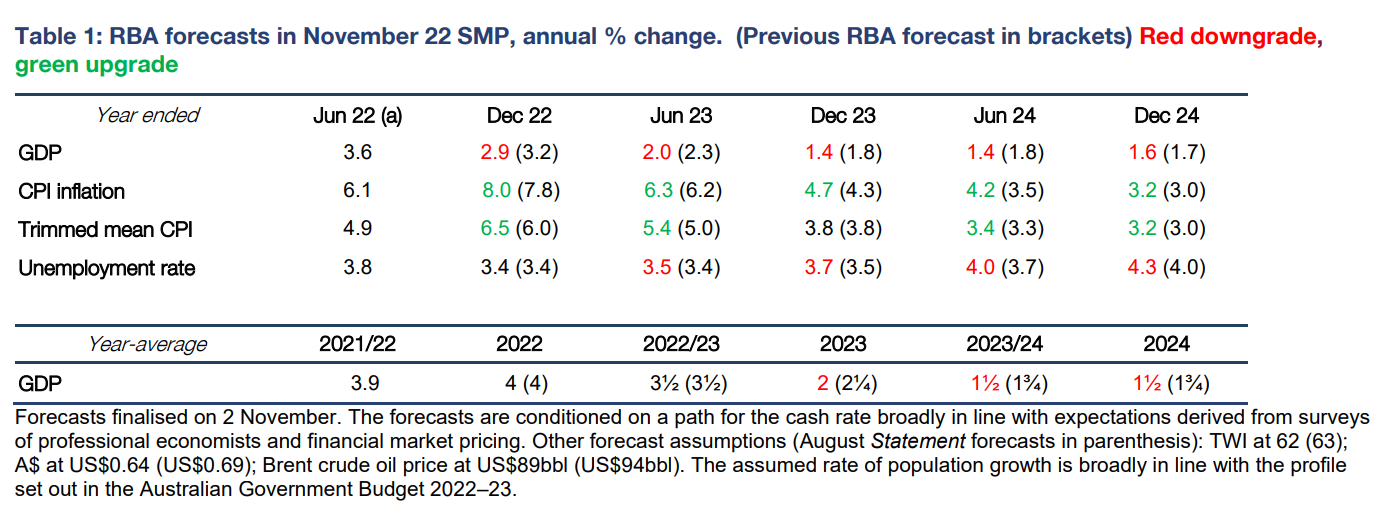
- The RBA now expects annual inflation to peak at 8.0% in Q4 22 and to be 4.7% in Q4 23.
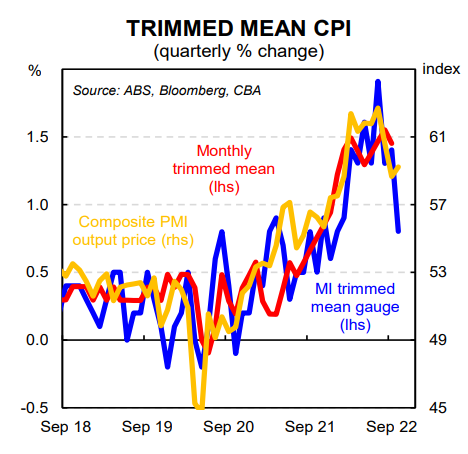
- Underlying inflation is forecast to peak at 6.5%/yr in Q4 22 (which implies an increase of 1.5%/qtr in Q4 22) and to be 3.8%/yr in Q4 23.
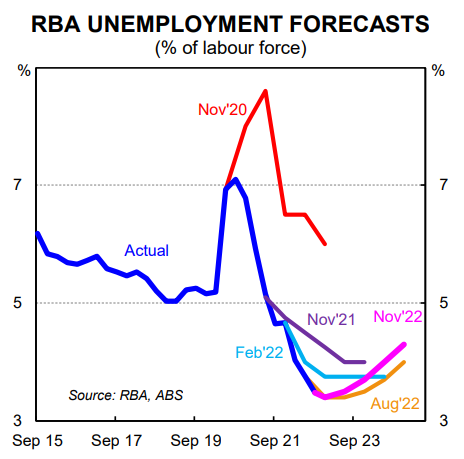
- The RBA expects the unemployment rate to be 3.7% by Q4 2023 (we forecast a higher number of 4.3%).
- The RBA’s forecasts for inflation and wages growth indicate that they expect real wages growth to be negative until mid2024.
- The RBA have downwardly revised their GDP profile and expect growth of 2.9%/yr in 2022 and 1.4/yr% in 2023.
- We expect one further 25bp rate hike in December which would take the cash rate to 3.10% (our expectation for the peak in the cash rate). The risk sits with a higher terminal rate, but we continue to look for rate cuts in H2 2023 and favour 50bp of in Q4 23.
The RBA is not on a pre-set path and will walk the narrow road
The RBA’s November Statement on Monetary (SMP) comes in the wake of the 25bp rate hike at the November Board meeting, which took the cash rate to 2.85%. It also comes after the Governor’s remarks on Tuesday at the Reserve Bank Board Dinner following the Board meeting.
The communication from the RBA has been crystal clear this week. The Governor has unmistakably articulated the Board’s objectives from here, which in many respects have not changed over recent months. But that in and of itself is important given the stronger than expected Q3 22 CPI.
The RBA have not wavered in their intention to return inflation to the target range while at the same time “keeping the economy on an even keel”. The analogy and imagery of an ‘even keel’ is about keeping the economy at full employment, which means the RBA do not want the unemployment rate to rise much above 4%. Staying as close as possible to full employment whilst returning inflation to target is Plan A.
The SMP on Friday reiterated that, “there are many uncertainties surrounding these forecasts that make the path to achieving the Board’s objective of returning inflation to target while keeping the domestic economy on an even keel a narrow one”. We agree. But it is nonetheless the right path to follow.
From a monetary policy perspective the desire to keep the economy ‘on an even keel’ was at the heart of the decision to slow the pace of tightening down at the October Board meeting. The 25bp hike was a surprise to market participants, but it was in line with our call. It would have been hard to keep the economy ‘on an even keel’ whilst continuing with mega rate hikes of 50bp each month (akin to the US Fed hiking at a pace of 75bp every six weeks).
The RBA continued with a ‘business as usual’ rate hike of 25bp last week despite the upside surprise in the Q3 22 CPI because the objective to keep the economy on an even keel remains intact. Indeed in a new development this week Governor Lowe stated, “if we need to step up to larger increases again to secure the return of inflation to target, we will do that. Similarly, if the situation requires us to hold steady for a while, we will do that” (our emphasis in bold).
This was the first time since the start of the tightening cycle that the notion of pausing had been flagged in official RBA communication. It appeared again in the SMP today. We are encouraged that the RBA is open to this idea. Our central scenario for a peak in the cash rate of 3.10% is premised on the notion that the RBA will pause after an expected 25bp rate hike in December. Some softening in the activity data over summer, as we expect, would support such an approach to policy setting early next year.
Holding the cash rate steady for a while in early 2023 would afford some time to more fully assess the lagged impact of the already delivered rate hikes. We believe that provided there is a sufficient pause in the tightening cycle the Board will come to the conclusion that the economy does not require further rate rises in 2023.
Indeed our analysis indicates that taking the policy rate deeper into restrictive territory would be inconsistent with keeping the economy ‘on an even keel’.
RBA forecasts in the November SMP
Taken at face value the RBA’s revised forecast profile for inflation and wages growth is not good news for Australian households. The RBA’s updated forecasts in the November SMP imply that real wages, as measured by consumer inflation deflated by the wages price index (WPI), remains negative until mid-2024.
The weaker outlook for real incomes as well as the rapid pace of interest rate hikes delivered to date and the expectation of further policy tightening has meant the RBA has downwardly revised their outlook for GDP growth, as expected.
GDP is forecast to grow by 2.9%/yr in Q4 22 (from 3.2%/yr previously) and 1.4%/yr in Q4 23 (from 1.8%/yr previously). Note that at this stage we are not focussed on RBA forecasts for the economy in 2024 given the inherent uncertainty in forecasting the further the forecast horizon extends.
In annual average terms GDP growth is forecast to be 4% in 2022 and 2% in 2023. This compares with our forecast for GDP growth of 3.8% in 2022 and 1.3% in 2023. We think the RBA’s GDP profile sits on the optimistic side of the fence, largely because the RBA has a stronger H2 22 than our forecast profile.
Notwithstanding, we believe respectable growth outcomes can be achieved provided the cash rate does not go much higher from here. Our forecasts are prepared on the assumption there is just one further 25bp rate hike in December that would take the cash rate to 3.10%. Indeed our forecast profile assumes there is monetary policy easing in late 2023. If the RBA take the cash rate to a more restrictive setting we will downgrade our GDP forecast for 2023.
There is an inherit circularity in discussing economic forecasts and a profile for the cash rate. Ultimately what the RBA delivers on the monetary policy front will play a big role in determining economic outcomes. And the evolution of the economy will in many respects dictate the RBA’s policy moves.
Headline inflation is forecast to peak at 8.0%/yr in Q4 22 which implies a 2.1% increase over the quarter. We see inflation peaking at 7.7%/y in Q4 22; our difference in the peak in inflation is small change in the scheme of things.
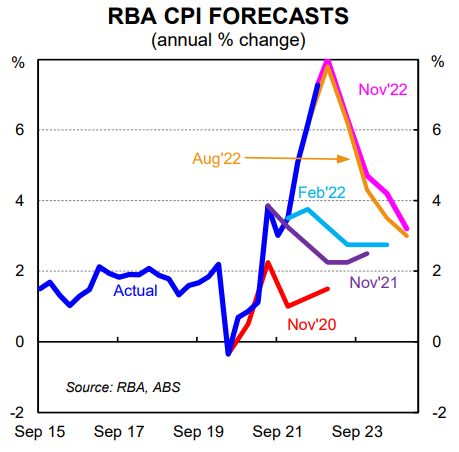
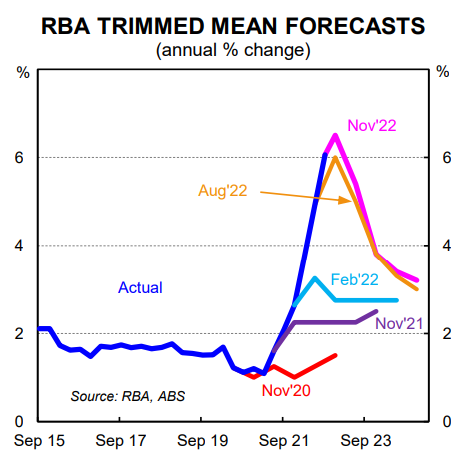
Our main point of contention is the speed at which inflation is forecast to drop in 2023. Our forecast profile sees inflation slow more materially in 2023. We expect headline inflation to be 5.9%/yr in mid-2023 and 3.4%/yr by end-2023. In contrast the RBA forecast the annual rate of inflation to be 6.3% in mid-2023 and 4.7% by end-2023.
Our near-term outlook for inflation still sees another two quarters of elevated inflation pressures that will affect households’ cost of living. But we see a more material stepdown in the pace of price rises from Q2 23 as the fuller impact of the RBA’s rate hikes flow through to the economy. Base effects will mean that the annual rate of inflation will still remain above the RBA’s 2-3% inflation target over the next year. But we expect the six-month annualised rate of change to be within the RBA’s target by end 2023.
We anticipate a number of the forces that have driven the spike in inflation to weaken and/or dissipate in 2023. And we expect a policy response from the Federal Government that means the massive spike in energy prices flagged in the October Budget does not fully materialise over 2023. Finally we think the household sector will struggle more under the weight of higher interest rates than the RBA’s forecasts suggests.
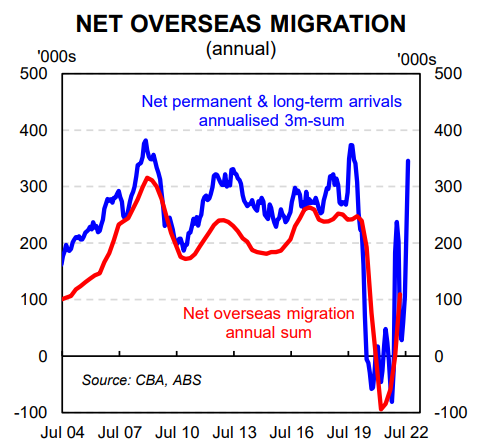
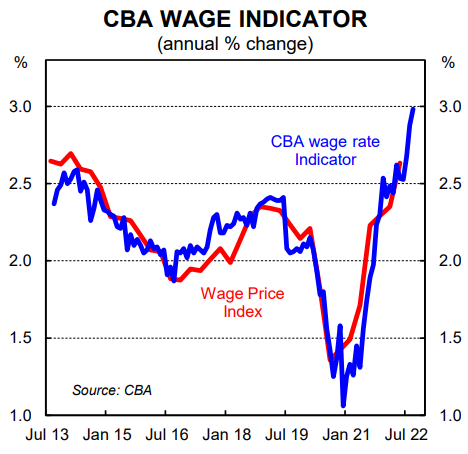
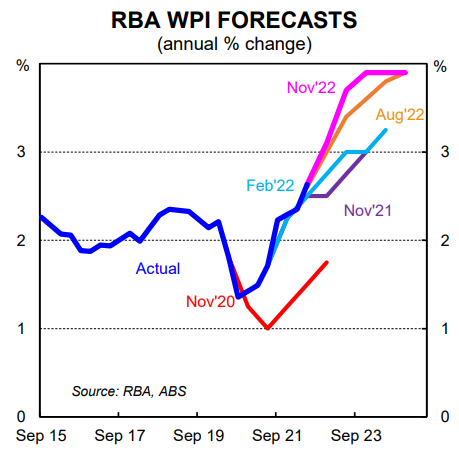
Our forecast profile sees wages growth, as measured by the WPI, peak at 3.5%/yr in mid-2023. In contrast the RBA forecast the WPI to peak at 3.9%/yr in Q4 23. We believe the high intake of migrants coupled with a higher unemployment rate and slower growth in aggregate demand will make it harder for annual wages growth to push beyond 3.5%.
The global backdrop remains important for the RBA. The RBA expects growth in our trading partners to be below 3½% in 2022 and 2023. That is well below the pre-pandemic average (~4½%) and is also a large downward revision from forecasts earlier in the year.
However, the importance of the global backdrop for the RBA stems not from the need to keep pace with the tightening by other central banks; rather, the RBA is worried about growth prospects – notably for China but also in advanced economies like the US and the European economies – and the knock-on impacts it may have on Australia. Indeed, the RBA views the risk to the global outlook as skewed to the downside. In that context, and in addition to the domestic factors discussed above, the RBA’s more cautious approach in slowing the pace of monetary policy tightening is pragmatic.