Goldman with a useful primer on one pre-requisite for ending zero-COVID.
Expect CDC trials to pave way for new EUAs: Based on the historical trial enrollment pace for COVID-19 vaccine booster studies, we expect the CDC-run comparative booster study of 14 domestic COVID-19 vaccines (ChiCTR2200062207, N=1,216, see prev. tracker) to generate data in 4Q22, and the parallel study of similar design run by The Third People’s Hospital of Shenzhen to lag for a few more weeks (started Aug, c.3wks later than CDC trial initiation). Those two studies aim to assess the efficacy of new vaccines as the 3rd/4th dose booster to inactivated virus vaccines, and, in our view, are critical in paving the way for EUAs of variant-specific vaccines, including mRNA vaccines. While we await more details to gauge the
timing, we see YE22/early 2023 as a possible window given regulators’ potential access to CDC trial data and key readouts of most advanced domestic vaccines.
Positive data from new vaccines: We are focusing on the upcoming data readouts of CSPC’s SYS6006 (potentially in coming days), while we are also encouraged to see new progress from more vaccines: 1) Sinocell Tech‘s protein-based vaccines have a positive phase III data readout as a heterologous booster for prior inactivated virus vaccines, showing stronger immunogenicity than homologous boosters against Omicron; 2) Wantai released a positive data readout of the phase III trial for its inhale viral vector COVID-19 vaccine, showing that efficacy against hospitalization was 100% and efficacy against Omicron infection was 55% as a primary dose and 82% as booster dose; 3) Everest’s mRNA vaccine PTX-COVID19-B achieved non-inferior results vs. Comirnaty as a primary vaccination in a global phase II study.
Paxlovid/Lagevrio localization our new focus: New approvals of domestic oral anti-COVID drugs are unlikely before YE22 as the most advanced in the pipeline are still at phase III – Junshi VV116 recently initiated a new phase III trial for mild to moderate COVID-19 (NCT05582629, N=1,200) with a primary endpoint of time to sustained clinical symptom resolution; Simcere’s SIM0417 targets interim readouts of its pivotal study by YE22/1Q23. We are increasingly focusing on the tech transfer / production localization progress of Paxlovid (by Huahai) and Lagevrio (by Sinopharm), which might come earlier than meaningful supply of domestic oral pills.
Vaccination rate
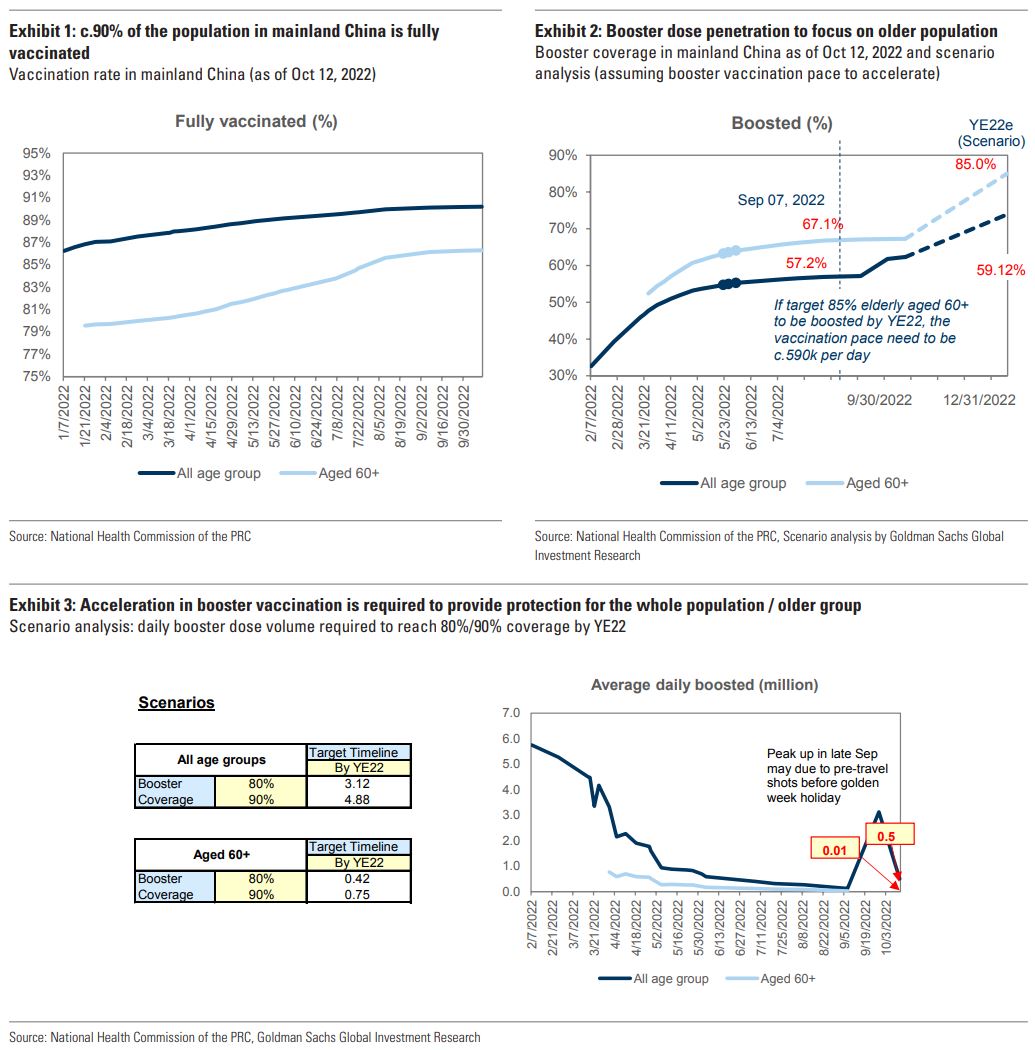
67% of elderly boosted: In mainland China, as of Oct 12, 2022, 90.2% of the total population (all age groups) had been fully vaccinated, with 62.3% having received boosters (i.e., 878.32mn doses). For older people, aged 60+, 86.3% were fully vaccinated with 67.25% boosted. As of Sep 28, 2022, only 5.68% of booster shots were heterologous boosters (i.e., 45.73mn doses), mainly CanSino’s adenovirus vaccines (injection) and protein-based vaccines from Zhifei, while CanSino’s inhaled version and Livzon’s V-01 are still at a very early stage of supply.
Slower vaccination pace: Since the majority of the population received an inactivated virus vaccine in the primary course and given that 3 doses are required to provide effective protection against severe disease / death (see real world data in Hong Kong), we are focusing more on the booster dose vaccination growth trajectory, particularly for the more vulnerable older group:
o The pace of booster vaccinations for the elderly showed a further slow-down trend: in those aged 60+, 1) average daily primary doses of 50k between Sep 7 and Oct 12 (same as between Aug 9 and Sep 7); and 2) booster: 10k vs. 30k for the same two periods. The recent acceleration in vaccination pace in late Sep was probably due to pre-travel vaccinations for traveling in the golden week holiday (China’s national holidays from October 1 to 7).
o If we assume a target of 80%/85%/90% of the elderly to be boosted by YE22, our analysis suggests the pace of vaccination would need to reach 420k/590k/750k per day by YE22, see Exhibit 2. To achieve this, we think efforts to push people towards receiving boosters may be needed, and potentially even the need to make them mandatory, see Exhibit 3.
Initial 4th doses: While a 4th dose booster is yet to be widely available in mainland China, and the government is still more focusing on pushing the 3rd dose booster, we see some initial cases of 4th dose booster with CanSino’s inhaled vaccine in the past week in selected cities (e.g. Xinjiang), likely to healthcare professionals with higher exposure to potential infection.