
Check out the below chart from Tuesday’s speech by RBA deputy governor Michele Bullock at the AFIA Annual Conference. It shows that the RBA has been aggressive with rate hikes compared to its global peers:
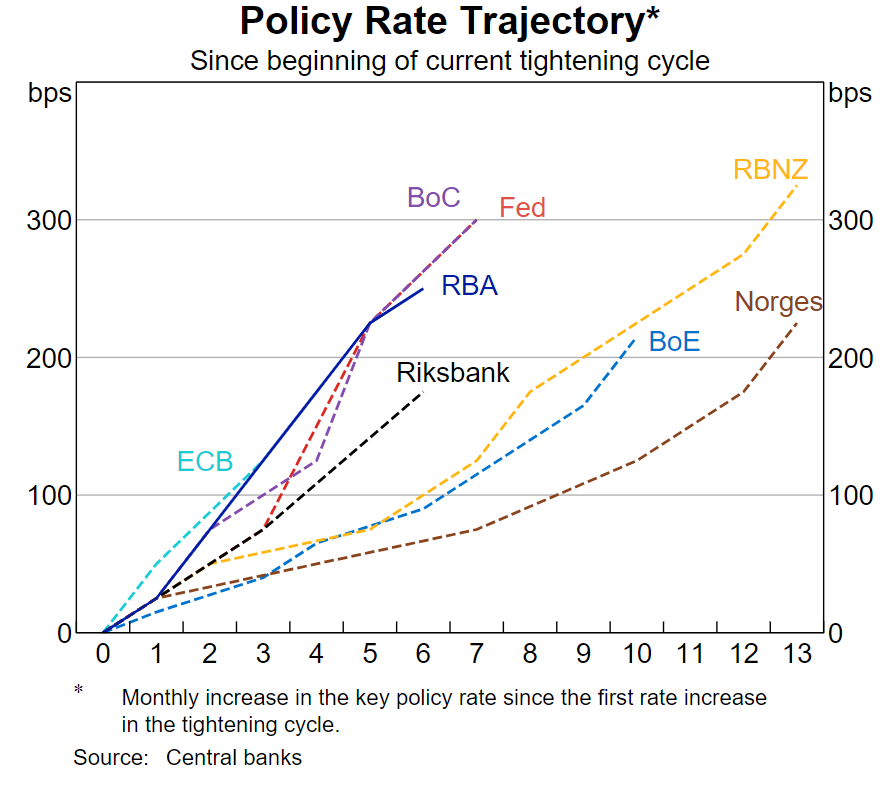
RBA uber aggressive on rate hikes.
It also explains why the RBA believes it now should slow the pace of hikes to assess the impact of this unprecedented tightening.
The steepness of the RBA’s rate hikes is also pertinent given Australian households are arguably the most sensitive to interest rates in the world because:
- Australian households carry the second highest household debt loads (behind Switzerland); and
- Unlike other nations, the majority of Australian mortgage borrowers are on floating rates, meaning changes in interest rates are quickly passed on.
As a counterpoint, the US Federal Reserve has been even more aggressive than the RBA in raising rates. However, US household debt loads are roughly half that of Australia and the majority of US mortgage borrowers are on 30-year fixed rates.
These facts alone mean that the Federal Reserve must hike interest rates far more aggressively than the RBA to exert the same pressure on households.
The Federal Reserve is also more justified in raising rates because wage growth is running hot in the US, unlike Australia:
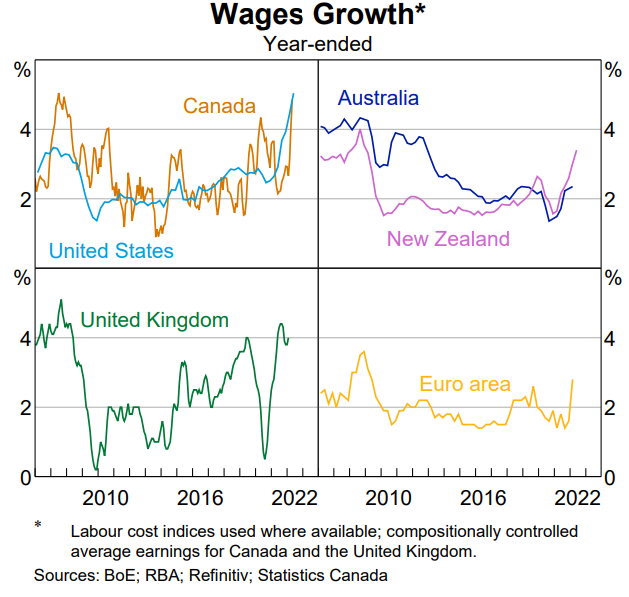
Australian wage growth is weak.
In fact, Australian wage growth is among the weakest in the developed world.
The above factors explain why the RBA should not “follow the Fed” and can afford to take a measured approach to rate hikes while it waits to see the impact.
