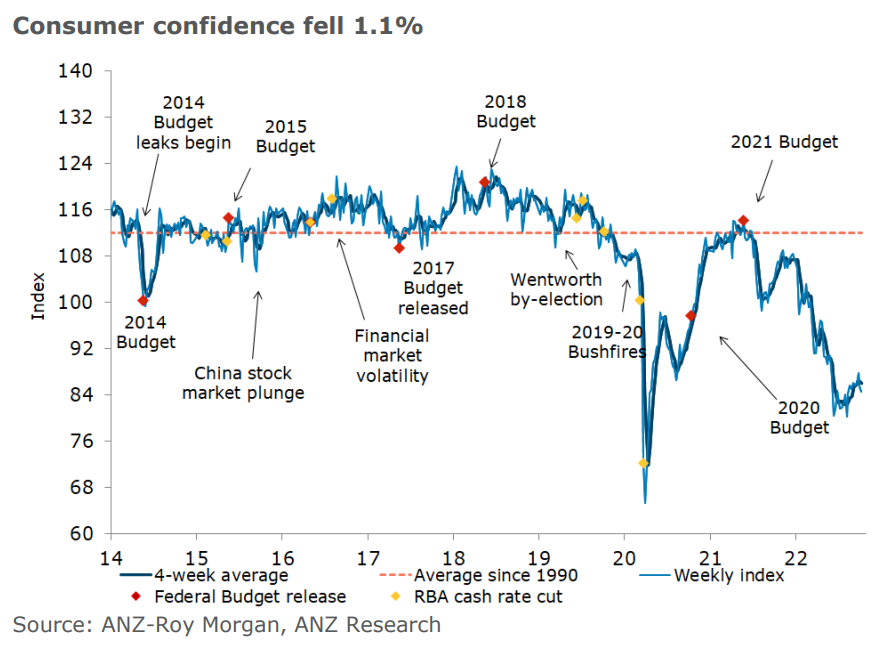
The ANZ-Roy Morgan weekly consumer confidence index fell another 1.1% last week to its lowest level since mid-August after the Reserve Bank of Australia (RBA) hiked the official cash rate another 0.25%:
The key movements driving the result are summarised below, with three out of five sub-indices declining:
Consumer confidence decreased 1.1% last week, falling to its lowest level since mid-August. Among the mainland states, confidence dropped in NSW, Victoria and WA, while it increased in Queensland and SA.
‘Weekly inflation expectations’ fell by 0.1ppt to 5.5%, while its four-week moving average remained unchanged at 5.4%.
Three of the five confidence subindices declined. ‘Current financial conditions’ dropped 3.6%, while ‘future financial conditions’ were up 1.8%.
‘Current economic conditions’ fell 3% after a 7.6% decline the week before. ‘Future economic conditions’ gained 2.2%.
‘Time to buy a major household item’ lost 4.4% after an increase of 14.6% over the previous five weeks.
Advertisement
ANZ head of Australian economics, David Plank, noted that mortgage holders drove the decline in confidence:
Consumer confidence dropped by 1.1% last week, despite the smaller than expected 25bp rate hike by the RBA. The decline was bigger than the 0.5% decline following September’s 50bp rate increase. Though it is worth highlighting that consumer confidence has remained in the 84-88 range since mid-August despite higher rates.
The loss last week was mainly driven by a 3.2% drop in confidence among those paying off a mortgage. For those who own their home, confidence was down by 0.4%, while for those renting, it was up 0.9%. Household inflation expectations dropped to 5.5% as average petrol prices fell slightly over the week.
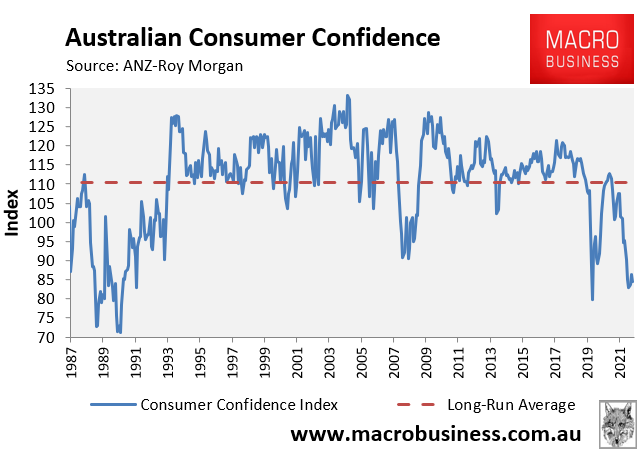
The next chart plots consumer confidence on a monthly basis over the long-run:
Advertisement
Aussie consumers remain deeply pessimistic, with confidence still tracking well below the GFC trough.
More at Westpac:
Advertisement
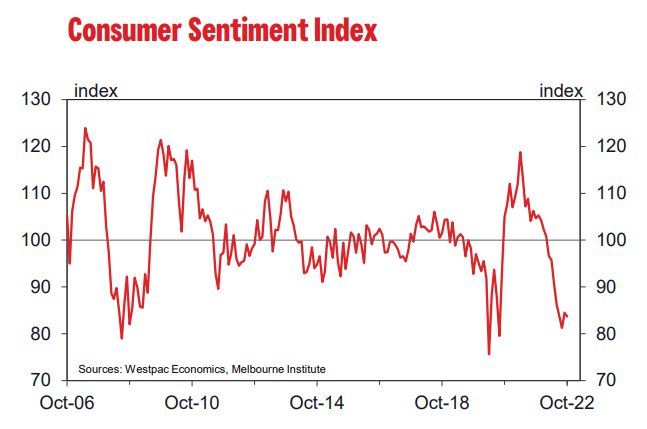
The Index remains in deeply pessimistic territory at a level comparable to the lows briefly reached during the pandemic and the extended weakness experienced during the Global Financial Crisis. The key drags on confidence continue to come from a surge in the cost of living, rising interest rates, and concerns about the near- term outlook for the economy.
Notably, the detail suggests the October result could have been significantly worse if the Reserve Bank had chosen to raise the cash rate by 50bps instead of the 25bp it delivered at its October Board meeting. Markets and the media had conditioned households to expect yet another 50bp move in October, following four consecutive 50bp increases in June, July, August, and September.
The survey of 1200 respondents has been conducted over the four days from October 3 to October 6. The Reserve Bank’s cash rate decision was announced at 2:30 pm on October 4. The interviews are typically conducted in the evening. There were 476 interviews on October 3, which are counted as “pre-RBA” with the remaining 724 counted as “post RBA”.
Sentiment amongst those sampled before the RBA decision showed a depressing 77.4 index read, down 8.3% from the print in September. If this had been the overall result for the month it would have been the second weakest since the early 1990s recession, the only weaker read in recent times being when the pandemic shock hit in April 2020.
Clearly, respondents were extremely concerned heading into another prospective 50bp increase in the cash rate.
Sentiment was considerably better amongst those surveyed after the RBA’s smaller than expected move, with an index read of 88.7, up 14.6% compared to those surveyed on the Monday and 5% above sentiment in September.
To be clear, the official number for the full sample period which is reported for October, 83.7, covers both the pre and post interest rate announcement periods.
The post-RBA ‘relief rebound’ in the October survey is unlikely to be repeated in future months. The Reserve Bank is still widely expected to continue raising the cash rate. We expect four more consecutive 25bp rate hikes at the November, December, February and March meetings (there is no meeting in January).
While each step from here may not be as large, the higher starting point for rates means the pressure on household finances will become more intense.
There is unlikely to be much near-term respite on the cost of living. We expect inflation, which is currently printing at 6.1%, to lift to 7.6% by year’s end.
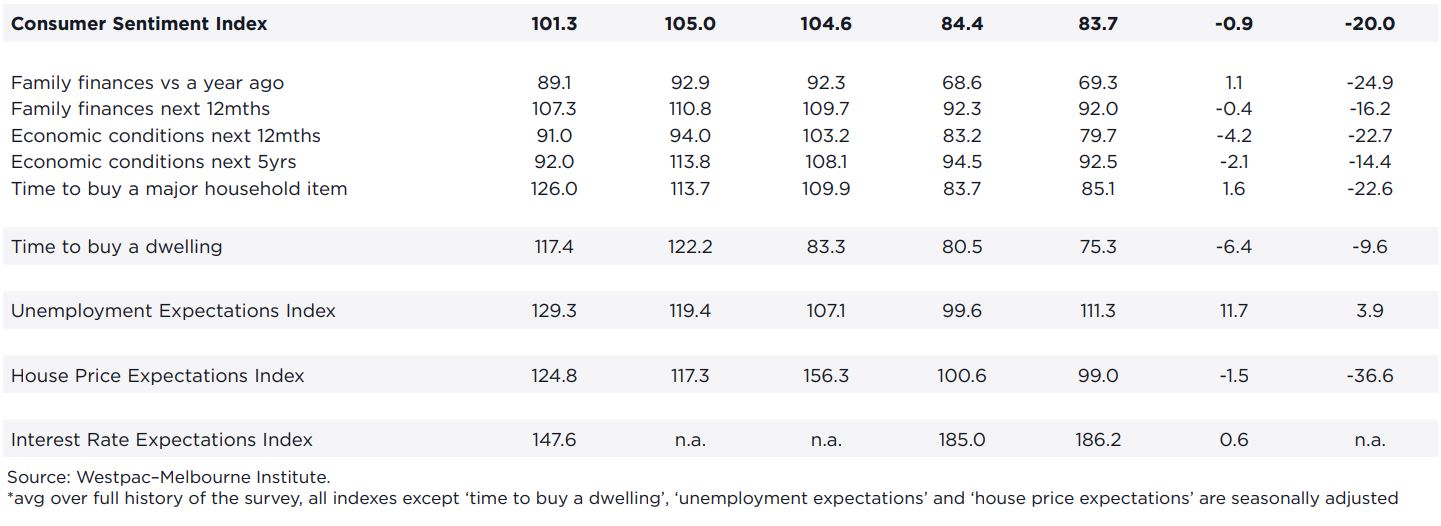
The index components showed limited movements for the overall survey. Assessments of family finances were largely unchanged. The ‘family finances vs a year ago’ sub-index up 1.1%, but to a still very weak level of 69.3, and the ‘family finances, next 12 months’ sub-index was down 0.4%.
Attitudes towards major household purchases, which have shown a sensitivity to rising prices and interest rates, lifted modestly. The ‘time to buy a major household item’ sub-index was up 1.6%. A print of 85.4 is still extremely weak for this subindex which has a long run average of 126.
Views on the economic outlook were notably softer in October.
The ‘economic outlook, next 12 months’ sub-index recorded the biggest decline for the month, down 4.2%, and the ‘economic outlook, next five years’ sub-index also dropped 2.1%. Some of this likely reflects rising concerns in the media and official circles that Australia and other developed economies may be headed for recession.
All component indexes showed big reversals pre and post the RBA decision.
The most striking improvement was around assessments of ‘family finances vs a year ago’ which swung from a confronting 62.7 pre-RBA (down 9.5% vs September) to 74.5 post decision, an 18.8% jump to a level 8.6% above the September read.
The surprise slowdown in the pace of RBA tightening had little impact on consumer expectations for a continued rise in interest rates. Most still anticipate significant increases.
Amongst those surveyed after the RBA decision, 54% expect rates to increase by 1ppt or more over the next year, comparable with the 57% share in the September survey.
There was a surprising deterioration in the outlook for the labour market. The Westpac-Melbourne Institute Unemployment Expectations Index increased by 11.7% from 99.6 to 111.3 (recall that a higher index means more consumers expect unemployment to rise in the year ahead). While this is a sharp deterioration, the Index is coming from a near record low in September and it is far too early to call a sustained deterioration in confidence in the labour market.
Conditions in the housing market remain lacklustre. The ‘time to buy a dwelling’ index fell by 6.4% to 75.3. This Index has been in the 75-80 range since March this year. The October fall took it to the lower end of the range and 43% below the most recent peak in November 2020.
The decision by the RBA had a very significant impact on the outlook for house prices.
The Westpac Melbourne Institute Index of House Price Expectations printed 85.9 in the “pre- RBA “sample. The “post RBA” sample printed 109.3 – a staggering 27% reversal.
The print for the overall sample is 99.0 – a modest 1.5% fall from the September print.
After tumbling by 38% between February and August the overall Index has been steady at around that 100 level for the past three months – meaning consumers are evenly divided on whether prices will rise or fall over the year ahead.
The stability in this Index is encouraging for the housing market given that in the February – May 2019 period, in response to the consistent house price falls between October 2017 and June 2019, particularly in Sydney and Melbourne, the Index averaged only 89.5.
One ominous sign is that the lowly February–May 2019 average print is still well above the “pre-RBA” print from this survey.
State indexes were mixed in the month, both NSW (–5.8%) and Victoria (–7.9%) gave back some September gains.
Queensland surged 15% after a weak read in September. That fall was possibly related to concerns around potential changes to state government land tax rules that have since been abandoned. While quite volatile, the state indexes have also tracked within stable ranges in recent months.
The Reserve Bank Board next meets on November 1. It is very likely to increase the cash rate by a further 25bps. But this time markets and the media will be anticipating the decision and there will be no ‘surprise factor’ to support confidence.
Instead, what may become clearer is that the tightening cycle still has significantly further to run. That is likely to keep the Consumer Sentiment Index firmly in deeply pessimistic territory in coming months.
Certainly, the 54% of consumers currently bracing themselves for a further 1ppt rise in interest rates are unlikely to have much cause for optimism.
Leith van Onselen is Chief Economist at the MB Fund and MB Super. He is also a co-founder of MacroBusiness.
Leith has previously worked at the Australian Treasury, Victorian Treasury and Goldman Sachs.