
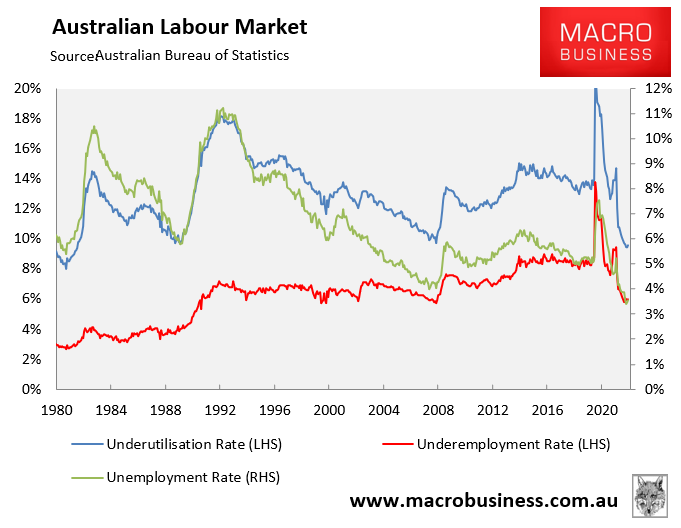
On Thursday, the Australian Bureau of Statistics (ABS) released its labour market survey for September, which revealed that Australia’s unemployment rate rose marginally to 3.5% (still close to its lowest level since August 1974). The underemployment rate (6.0%) also rose marginally (+0.1%) with underutilisation (i.e. unemployment and underemployment combined) up 0.2% to 9.6%:
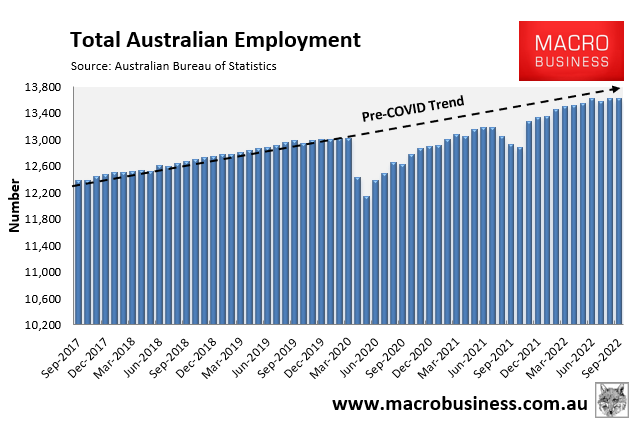
Employment rose 900 in September, with jobs growth remaining below the pre-COVID trend:
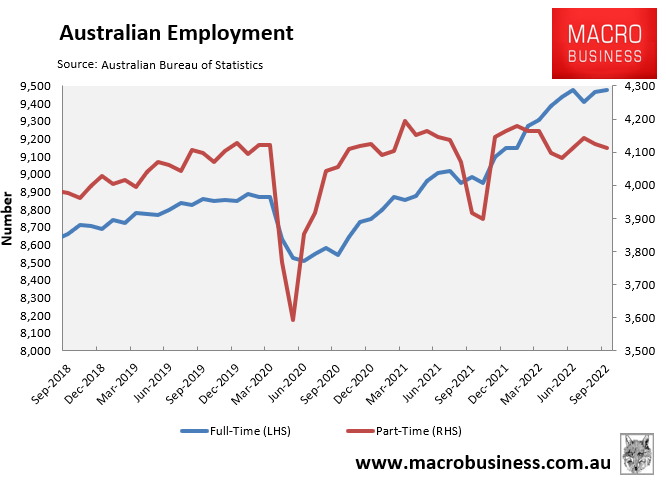
However, full-time jobs are booming, up 6.8% over the pandemic versus a 0.2% fall in part-time jobs:
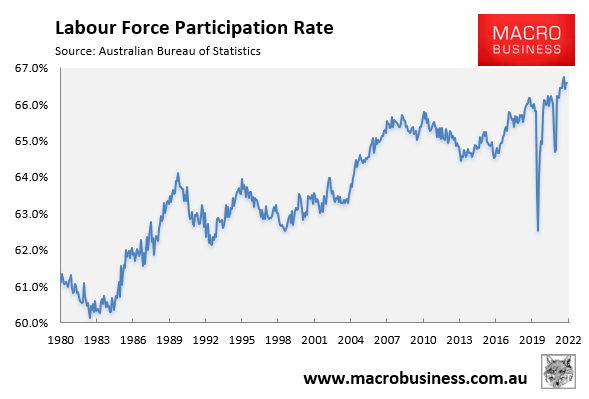
The Labour force participation rate was steady at 66.6% in September – a whisker below the record high 66.8% recorded in June 2022:
The employment-to-population ratio fell 0.1% in September to 64.2%. But over the pandemic it has soared as the denominator (population) has stagnated:
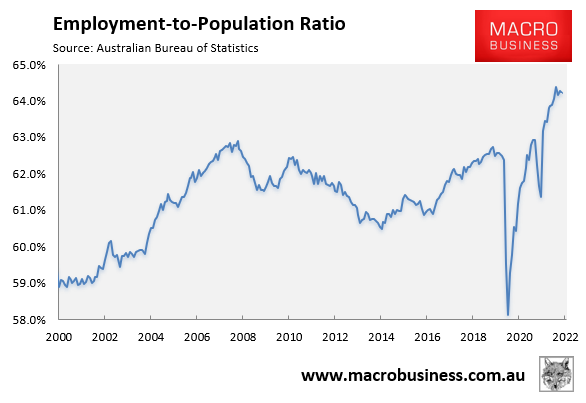
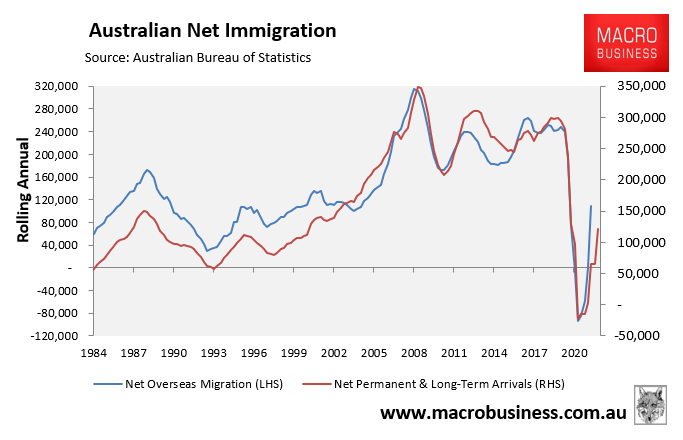
Given Australia’s jobs growth has lagged the pre-COVID trend, while labour force participation has increased, the main explanation for Australia’s near 48-year low unemployment is because labour supply has grown much more slowly, thanks to low immigration over the pandemic:
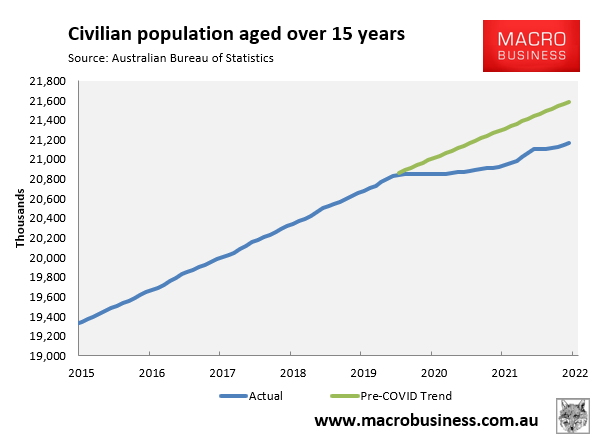
As shown in the next chart, Australia’s civilian population aged over 16 has gone from growing strongly (circa 25,000 people a month pre-pandemic) to growing only slowly:
Therefore, the newly created jobs have gone to unemployed Australians rather than migrants.
Had immigration continued at its pre-COVID level, Australia’s civilian population aged over 16 would be roughly 420,000 larger than it is currently. In turn, both unemployment and underemployment would be significantly higher and the employment to population ratio would be much lower (due to an increase in the denominator).
Foward looking indicators suggest Australia’s jobs market has lost steam.
The National Skills Commission’s job ads survey has turned lower:
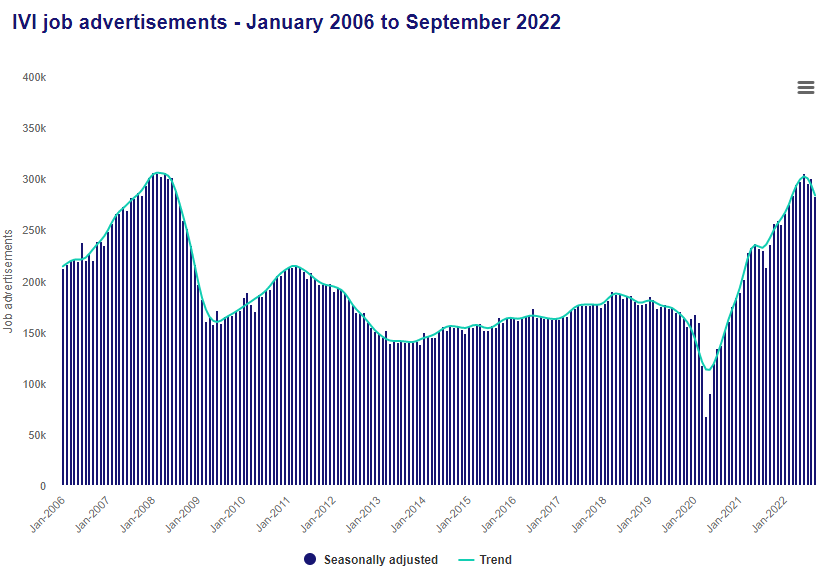
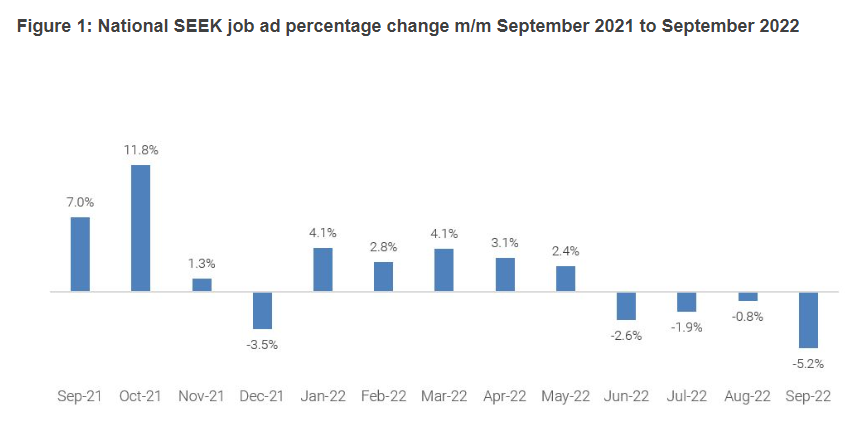
As has SEEK’s:
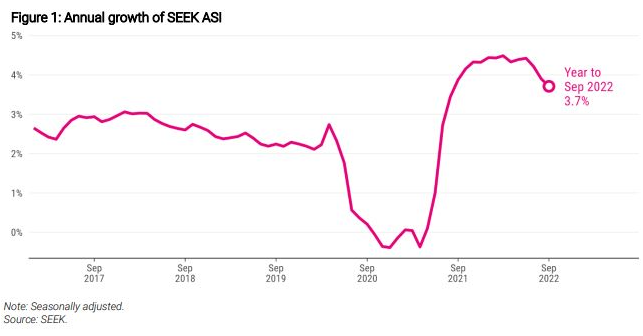
SEEK’s annual salary tracker has also rolled:
The Reserve Bank of Australia’s aggressive monetary tightening is clearly working to slow the economy and curtail jobs growth. Given there is a two to three-month lag between rate hikes and their impact on mortgage holders, much of the tightening to date has yet to be felt.
This is problematic because the Albanese Government has committed to the largest temporary and permanent migration program in this nation’s history, which will necessarily ramp-up labour supply and increase unemployment (other things equal) next year and beyond.
When combined with the RBA’s aggressive rate hikes, expect to see the Australia’s unemployment rate rise back up to pre-COVID levels or above over the Albanese Government’s term.
