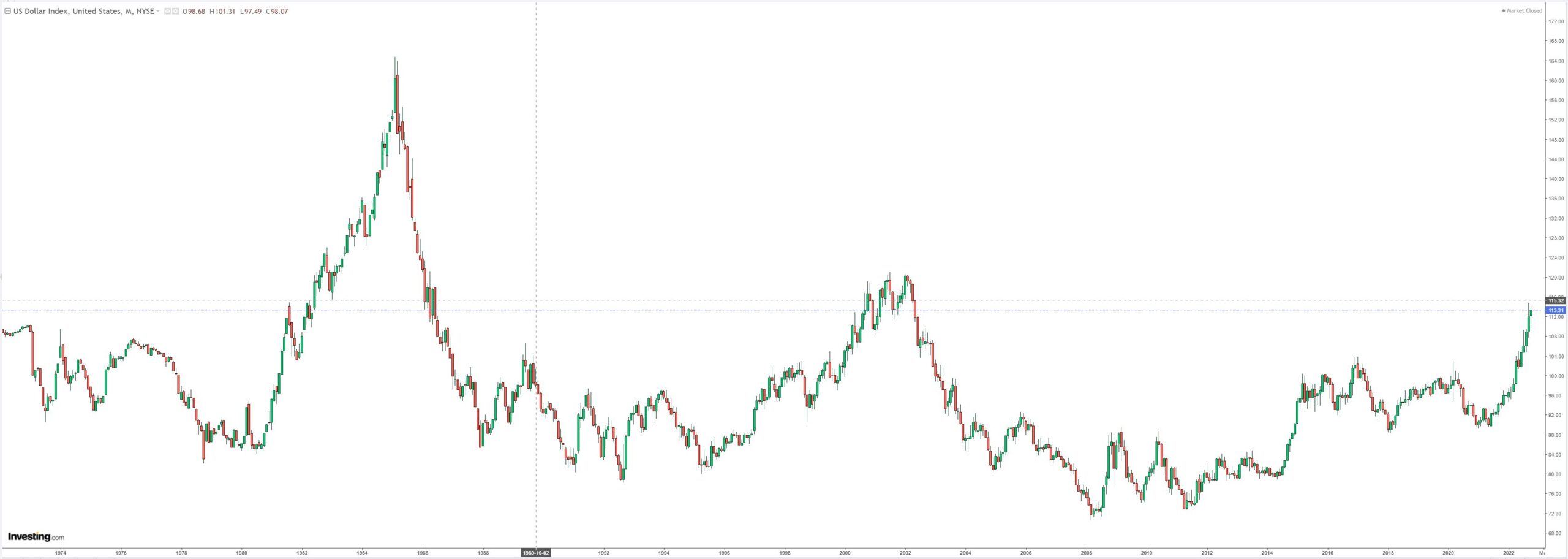
I have long held a target of around 120, matching the Millennial high:
Could we go higher? Sure, for a couple of reasons:
- Sticky US inflation triggers a Fed overshoot.
- Fed breaks something and all markets crash.
- A China external crisis.
- The Ukraine War gets worse.
But, barring another left-tail event, I think we are closer to the end than the beginning of this bull market.
Below find two pieces from Goldman and Citi. The former has been hopeless on DXY for years so its bullishness is a bearish sign for me. The latter has been better and is slowly turning bearish.
Goldman first.
USD: The growing case for continued upside. The US Dollar has a lot going for it at the moment. Domestic data have been relatively resilient, there is a strong safe haven appeal in a rocky risk environment, and it is hard to find a candidate replacement given a recessionary outlook in Europe and ongoing activity restrictions in China. Consistent with this, we encounter very little resistance in our client conversations to our baseline outlook for continued Dollar strength in coming months. However, the lack of follow-through in the Dollar following both the employment report last week and CPI this has raised questions whether this view is “priced” and further upside in the Dollar is likely to be more limited. On the one hand, we have some sympathy with these concerns—to the extent the market continues to worry about overtightening risks and foreign intervention, Dollar upside is likely to be slower than in September. But we also think recent developments have also exposed a growing, and we think under-appreciated, tail risk that Dollar strength could prove more persistent despite a challenging valuation picture. US inflation has shown little signs of slowing (Exhibit 1), and the source of strength has transitioned from temporary supply constraints to the very tight labor market. This presents the risk that the Fed will have to stay at an aggressive pace for longer. That is a feat that other central banks seem unlikely to be able to match for a variety of reasons, including a weaker growth outlook and faster pass-through from rate hikes to financial conditions (mostly via variable rate mortgages). Just this week, our economists revised down their forecast for the ECB in December (from 75 to 50bps) while bringing forward the timing for balance sheet runoff—a net negative change for the Euro on both counts. In addition, the challenging fiscal environment—for now exemplified by the UK—demonstrates the potential for policy missteps to add to Dollar upside. Finally, recent developments have prompted concerns about financial stability, which should also add to the global reserve currency’s safe-haven appeal. Of course, lower energy prices would help solve a lot of these problems, and that is the biggest risk in the other direction. But, barring that, we think investors should continue to position for a more persistent Dollar cycle.
Citi.
We recently discussed our bullish USD base case, and various scenarios.
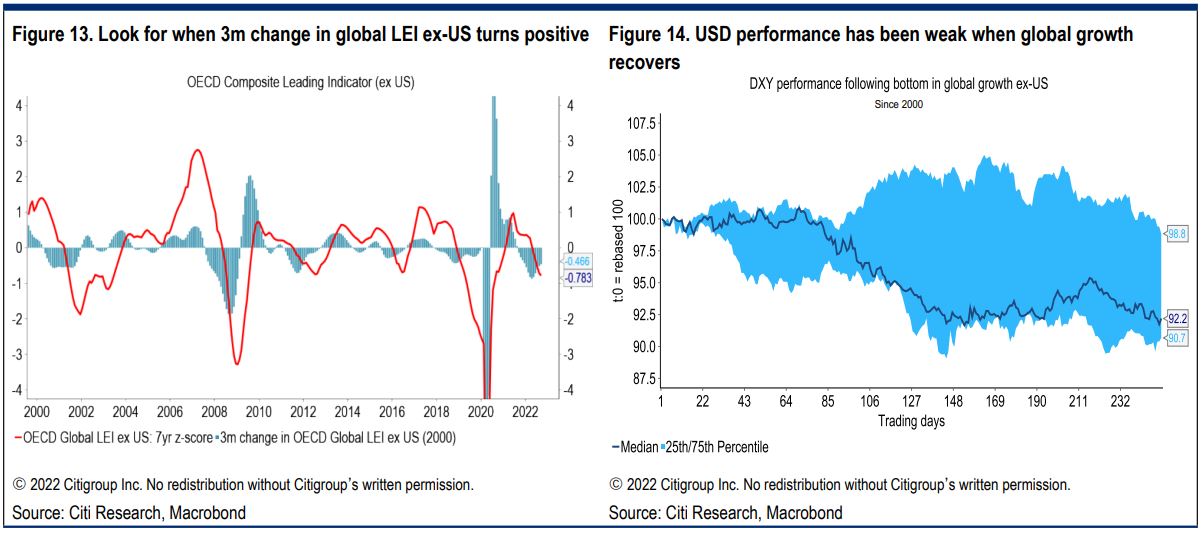
What are the conditions needed for a definitive USD top? To be clear, we do not think we are there. A Fed pivot/cut would likely be a necessary, but probably not sufficient, condition for a USD reversal. What we think is needed for a USD top is a bottom in global growth. Over the past 20 years, when the 3m change in OECD global (ex-US) leading index turned positive, the USD depreciated ~8% over the following year. If the Fed starts cutting while Europe and China are coming out of the woods in mid-2023, this could lead to significant USD weakness. Other catalysts we see: 1) end to China’s zerocovid policy, 2) European joint issuance, 3) UK fiscal wind-back, 4) end of BoJ YCC. Some of these might be changing at the margin.
Wen USD top? — In our view, there needs to be a narrative shift in order to change the trajectory of the USD. Could a Fed pivot do the job? History suggests that in recent decades, final Fed hikes and first cuts can slow the USD rally. But the dispersion is high, and the analog we point to would be the 2001 episode. Back then, equities peaked early in 2000 and the Fed soon after stopped hiking. Then equities continued to sell off, the Fed eventually cut at the beginning of 2001 but the USD continued to rally.
Watch for global growth bottom — A Fed cut is a necessary but not sufficient condition for the USD to completely reverse direction. What probably needs to change is the trajectory for global growth outside of the US. We can proxy this by building an OECD LEI (ex-US), where a bottom in global growth is captured when the 3m change in the leading index turns positive from previously depressed levels. This has been a much better factor for explaining the reversal in the USD, particularly over the past 20 years, and particularly when overlaid on Fed cutting cycles. The USD could easily depreciate by 10% or more in these regimes.