
It’s early days but earnings are beginning to break down in the US profits season. BofA has more.
Estimate cuts continue, tracking a 1% miss
Following Week 1, 36 S&P 500 companies (including early reporters) comprising 10% of index earnings have reported. 3Q EPS estimates continued to slide last week, -1% to$54.83 (vs. our $55 and consensus $55.58), after a bigger-than-usual 7% cut heading into earnings. Just 42% of companies beat on both sales & EPS, below the historical post-Week 1 average of 47% and the weakest proportion since 1Q20.
Banks: well-capitalized but eco sensitivity key risk
The first set of big bank earnings reaffirmed that banks are well-capitalized and consumer balance sheets remain solid. Higher rates also benefitted net interest income. However, bank executives echoed concerns about economic uncertainty: JPMorgan sees immediate ‘significant headwinds, ’Citi expects an economic recession in 2H23, Wells Fargo anticipates a further decline in mortgage revenues and Morgan Stanley hinted at job cuts.
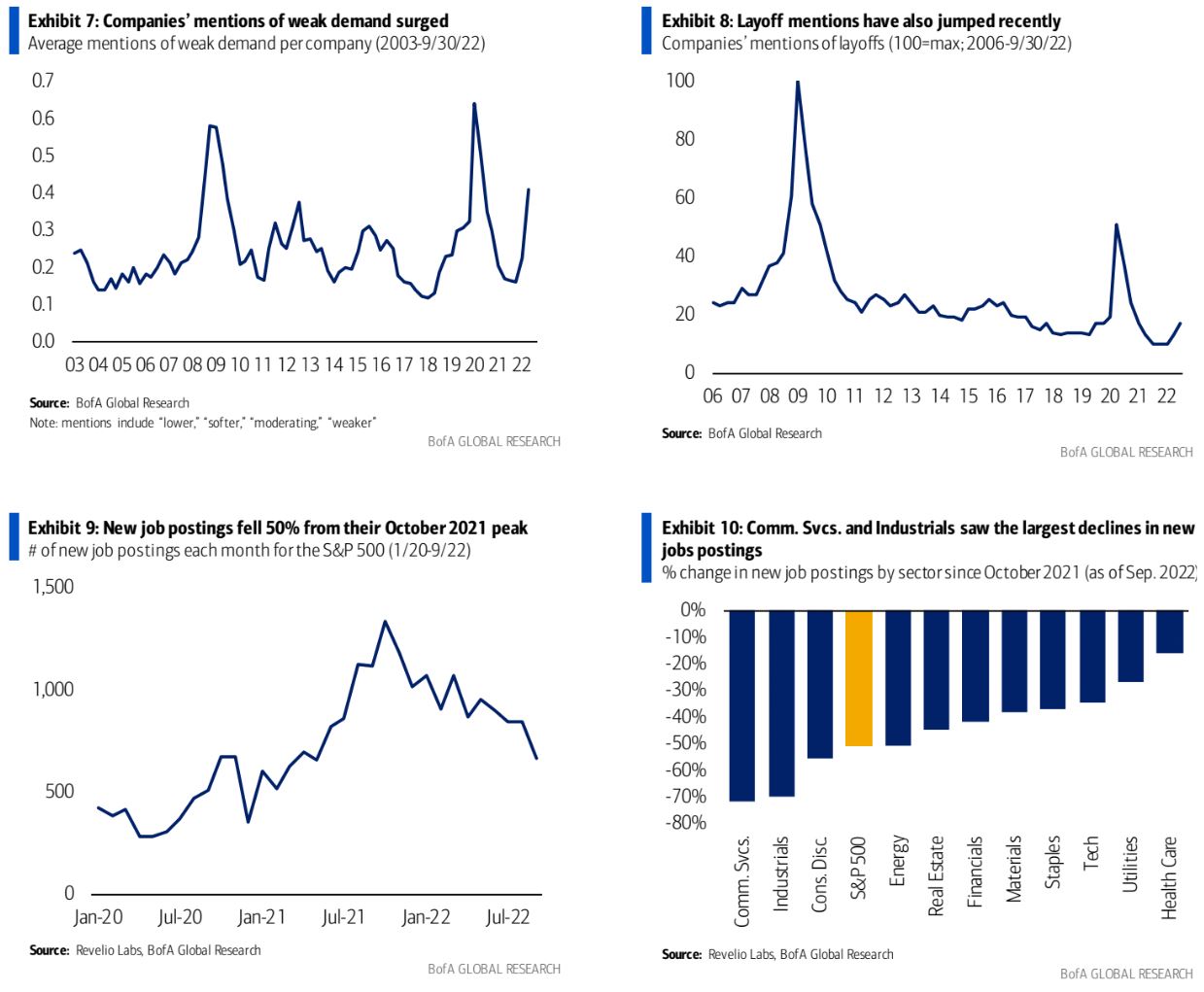
Continued demand for services & staples
Early readings so far suggest continued strength in services and staples. Delta Air Lines reported record revenues in 3Q amid ‘tremendous demand’ for travel and guided to better-than-expected 4Q revenues amid continued momentum. Similarly, Pepsi raised its guidance following +17% YoY in 3Q pricing, underscoring continued strength in demand.
…but goods canaries are squawking
Weakness in big ticket items was evident in the prior two quarters and this weakness has broadened out (e.g.,semis, FedEx, Apple, etc.). Fastenal, an Industrial barometer, also missed margin expectations after not raising any prices in 3Q, implying weakening demand on a broader basis; FAST also states it is preparing for a ‘softer 2023.’
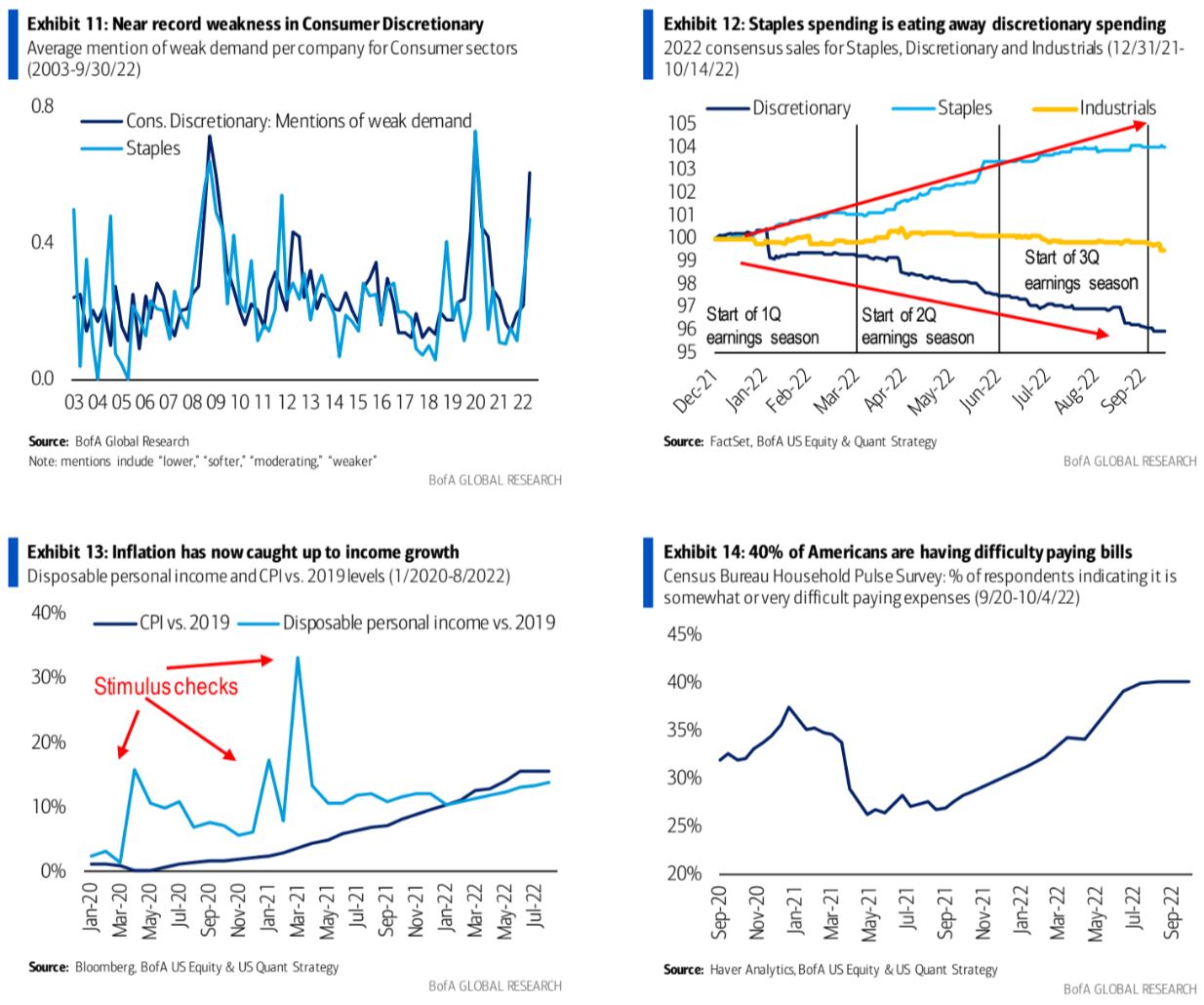
Bad news: S&P geared to goods, not services
As we highlighted in our recent note,we view the combination of continued demand/inflation in services and staples and weakness in goods as negative for stocks. Unlike the US economy (70% services) or small caps (more than two-thirds services), S&P 500 earnings are 50/50 goods/services. Moreover, Consumer Discretionary is being hurt by inflation in input costs/staples (Exhibit 12). And hotter-than-expected services inflation strengthens the case for the Fed to stay hawkish, translating to a higher discount rate and likelihood of a harder landing.
Up next:16% of earnings across all sectors
Results broaden out across all 11 sectors this week as another 16% of earnings report.By the end of the week, ~70% of Financials earnings should be known. We are listeningfor key topics, including demand outlook, margins, FX, layoffs, and capex trends.
The Market Ear with more.
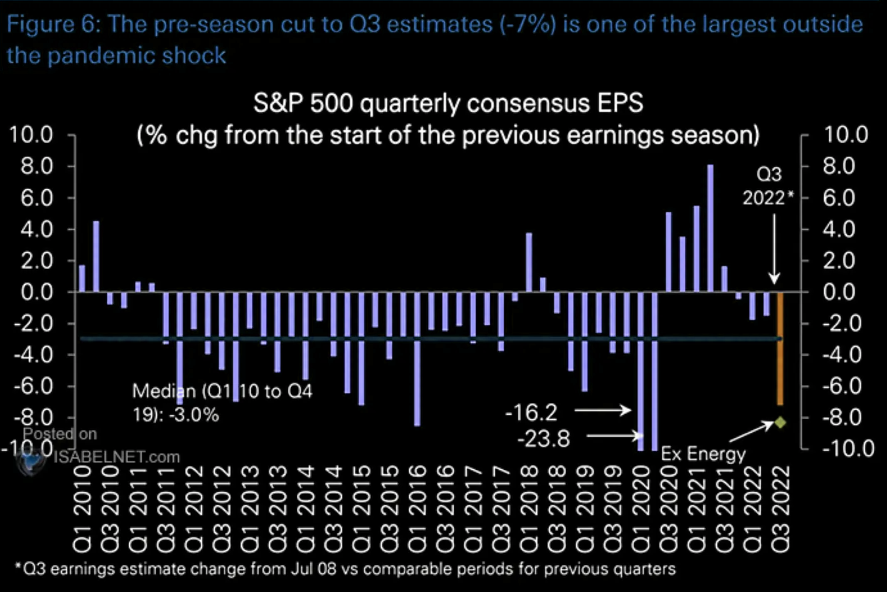
Estimates are now in free-fall
Big cuts to Q3 earnings estimates — worse than usual, and a stark departure of the pattern of the past couple years.
Deutsche Bank
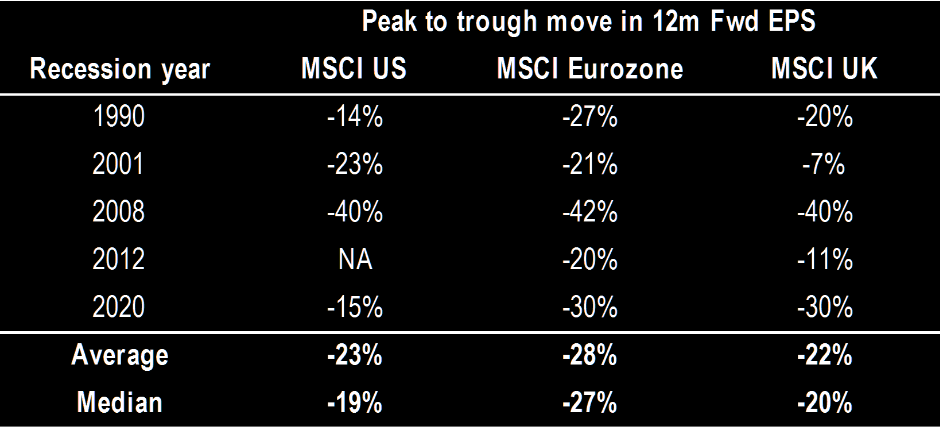
How bad will this earnings recession be?
In the past downturns, forward earnings fell 20-40%…
JPM Equity Strategy
Q3 has started just fine
“Three of the S&P 500’s top 25 (by market cap) stocks reported last week and all three came in just fine — suggesting that Corporate America may be as resilient as the US consumer. Healthcare bellwether UNH is up almost 2% on the week following Friday morning’s beat-and-raise results. And the country’s largest bank, JPM is up 5%+ for the week as it also reported strong results as it built its capital base at just the right time. And finally, beverage and salty snacks giant PEP is also up 5%+ for the week following Thursday morning’s beat-and-raise results. Earnings season has only just started but it is encouraging to see that 3 of the largest companies in the country across three disparate sectors have so far not seen profits materially impacted by everything that has taken place so far this year” (GS)
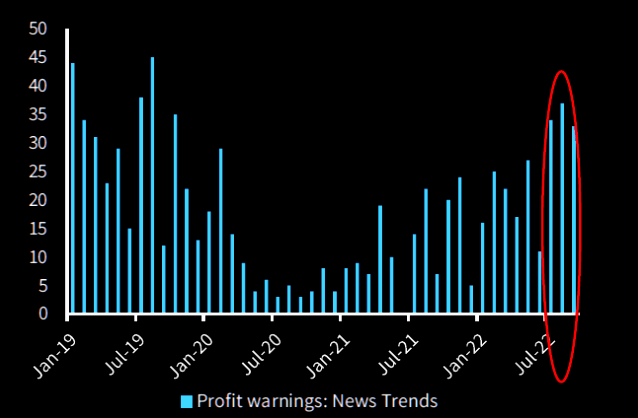
Newsflow around profit warnings have risen recently
More talk or actual profit warning action…?
Barclays
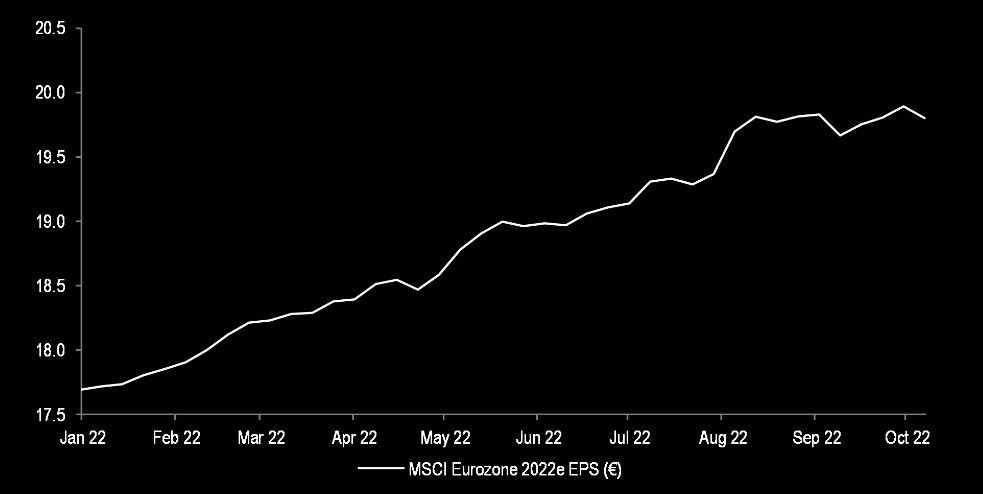
European earnings exceptionally resilient so far ytd…
Eurozone earnings projections for 2022 have been upgraded by 12% so far ytd, in spite of the clouding macro outlook.
Datastream
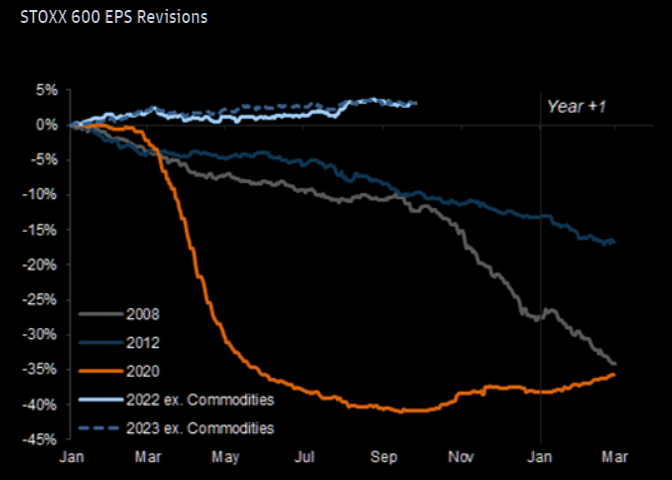
Why are European estimates not coming down?
2022 and 2023 bottom-up consensus estimates are yet to come down.
FactSet
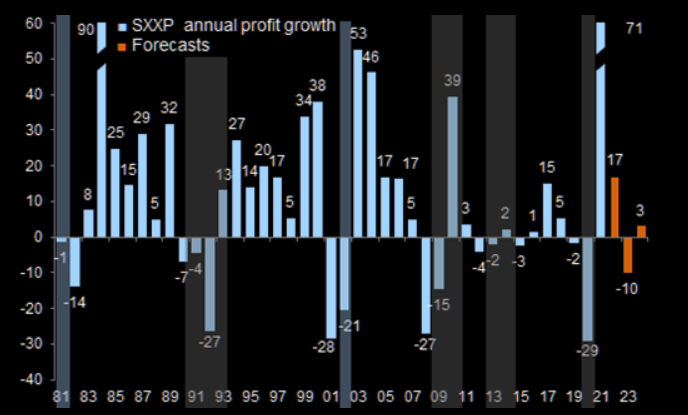
GS expects European earnings NOT to hold up
GS strategists expect a 10% drop in EPS for the STOXX 600 in 2023.
Goldman
In the US, the spring upgrades have been reversed
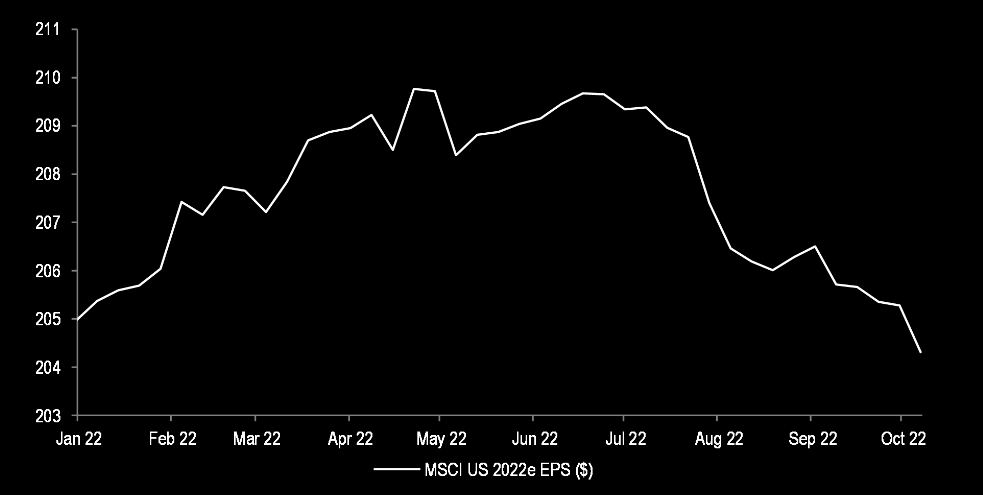
In the US, there was no real net downgrade ytd, although the spring upgrades have been reversed.
Datastream
A gap
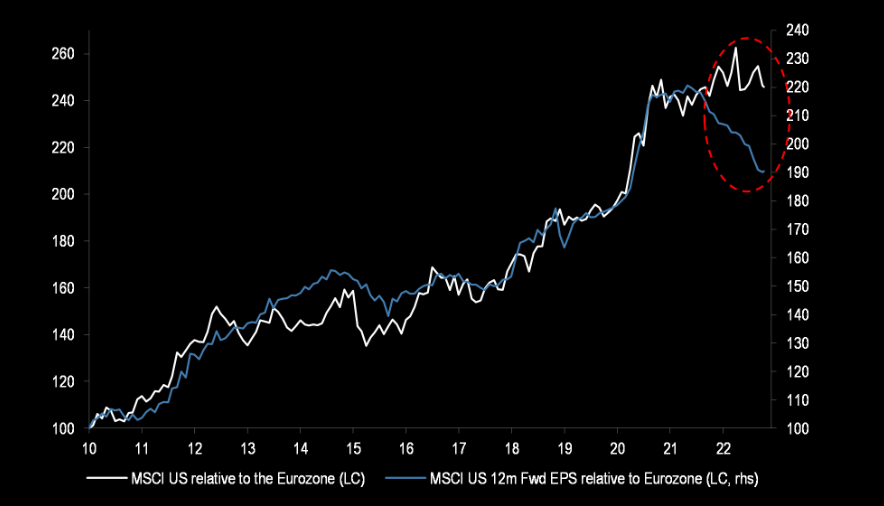
A gap has opened up between prices and earnings vs the US (relative Europe).
JPM Equity strategy
3 things on 23 estimates
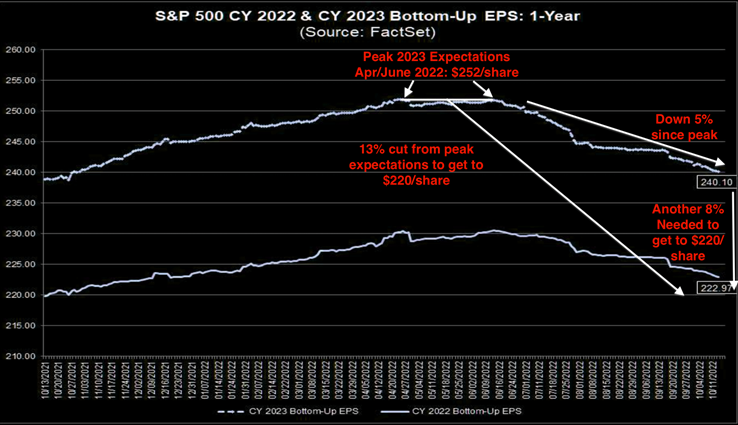
1. 2023 estimates peaked out in April/June at $252/share. They have since declined by 5% to $240/share.
2. For 2023 estimates to come down to the S&P’s current run rate of $220/share, analysts would have to cut their numbers by another 8%
3. If analysts ever incorporate a modest earnings recession in 2023 (a 10% decline versus 2022), estimates for next year would have to go $198/share. That would be a 21% from the $252/share peak noted in the chart.
Data Trek
2023 GDP
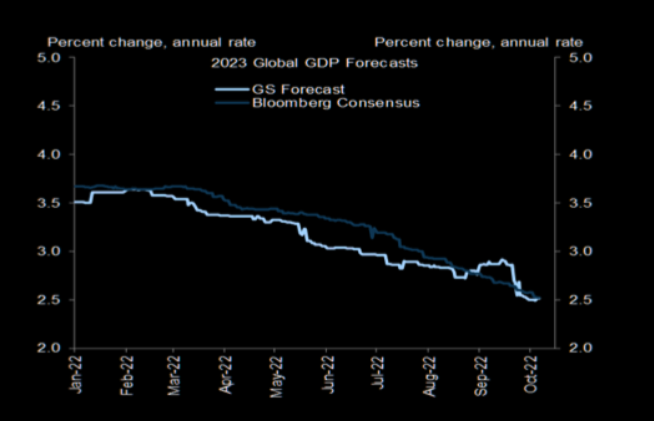
Global GDP growth forecasts have continued to decline.
Goldman Sachs
I still see the base case as a moderate US recession with a big inventory cycle that results in sever global feedback loops.
This is an earnings recession closer to 30% than 10%.
