
Goldman’s China credit team has an interesting take on the outlook today. There is nothing here that I disagree with, though the end of zero-COVID is pure guesswork.
The 20th National Congress of the Communist Party of China (NCCPC) convened on 16 October in Beijing, and will conclude on 22 October. Much focus is on whether the congress will be a catalyst for policy changes toward key areas including economic development, property sector support, and zero-COVID policy. Furthermore, the composition of the Politburo Standing Committee, which will be
revealed following the conclusion of the congress, will be closely watched. Overall, our China economics team expects many of President Xi’s long-term policies to remain unchanged, and they are not expecting major policy shifts immediately after
the congress. This is affirmed by President Xi’s opening remarks at the congress, in which he summarized the achievements over the past five years, and set out the blueprint for the Party and the country for the future. Our China economics team continues to expect relaxation of the zero-COVID policy could begin in Q2 2023, and that policymakers’ reaction function such as “no flooding of easing measures” and long-term goals such as “housing is for living in, not for speculation” are unlikely to change significantly after the Party Congress.
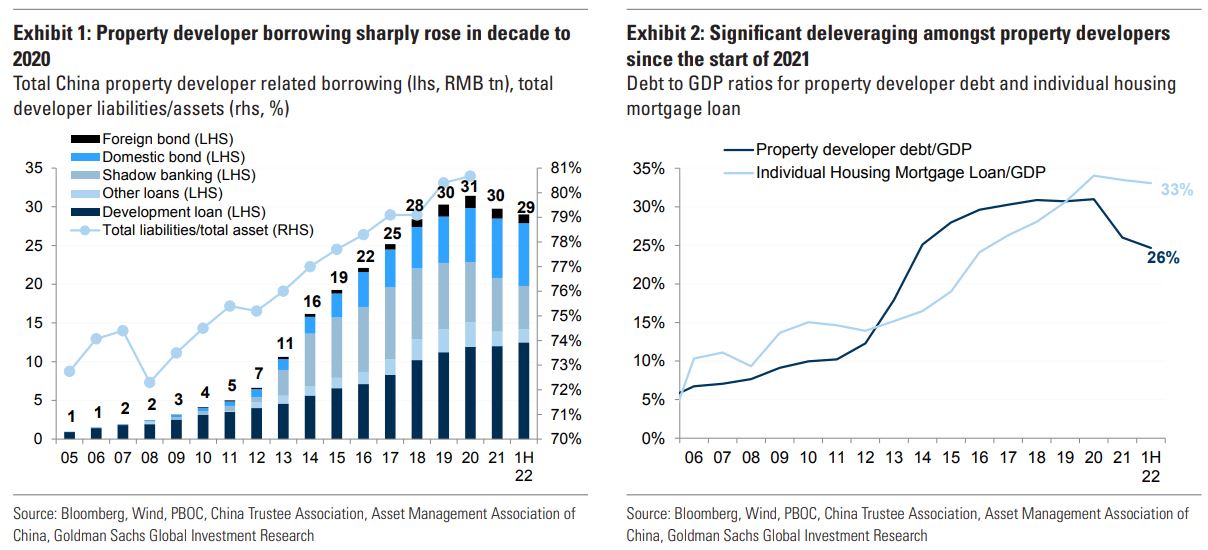
The indications thus far suggest that the deleveraging of the property sector is a medium term policy goal that policymakers will not deviate from. We estimate that total property developer-related borrowing reached RMB31tn at the end of 2020, nearly 8x higher than at the end of 2010 (Exhibit 1). This rise in borrowing occurred even as the government introduced policies to slow the growth in property development, including home purchase restrictions and limiting the availability of mortgages for non-primary residences. As a result, in late 2020 policymakers imposed “Three Red Lines” on the largest developers—a set of financial criteria they had to meet before they could borrow more funds. Amid these renewed efforts to delever China’s property sector, credit conditions tightened sharply, leading several developers to default and pushing leverage lower across the property sector—we estimate that the property development-related debt-to-GDP ratio fell from a peak of 31% at the end of 2020 to 26% in 1H22 (Exhibit 2). However, tighter credit conditions also caused a large slowdown in activity levels in the property sector. In the year through August, the value of property sales fell by 28%, the volume of new starts fell by 37%, and the volume of completions fell by 21% (all yoy).
Without meaningful shifts in macro policies, recovery in the China property sector is likely to be some time away. Our China economics team estimates that China’s current level of COVID restrictions is suppressing the level of GDP by 4-5%, and given their expected timeline on zero-COVID policy relaxation, they see the biggest growth boost from China reopening will likely occur from mid-2023 to mid-2024. With the near term economic outlook continuing to be soft and no signs of significant policy easing in the property sector, our China property team expects deleveraging to continue. In their 2023 outlook for the China real estate sector, they expect a 10% yoy decline of new home sales volume, flat average selling price, and thus 10% yoy lower property sales in 2023E. Furthermore, liquidity conditions remain tight, and they estimate Rmb740bn funding needs for stressed private developers to finish the presold projects that needs to handover to buyers in the next 12 months, and between Rmb7tn and Rmb12tn could be the implied write-down to hit the overall industry, and an estimated RMB 107tn in total assets at end-22E. The large amount of distress within the sector affirms our view that addressing stresses in the sector will likely take several years, and the road to restructuring is therefore long.
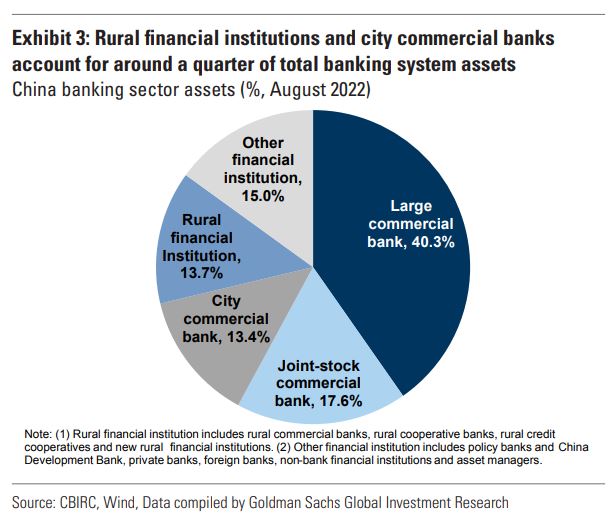
Whilst we believe policymakers are unlikely to adopt a strong reflationary stance towards the property sector, we do expect further policy easing will be implemented to contain systemic risks, and there two areas are important to watch for: (1) stressed property developers need access to a continuing supply of construction funding so that construction activities can continue and pre-sold properties can be delivered. Failure to do so could lead to a large increase in bad debts and have severe negative impacts on homebuyer confidence, and (2) while the banking system as a whole has sufficient buffers to absorb a shock, small banks look more vulnerable, as they have much weaker risk buffers and are susceptible to higher losses. Most small banks operate in low-tier cities where property credit quality could further deteriorate on higher vulnerability of mortgage risk and local property developer defaults. Our China Banks team’s stress test shows that ~9% non-performing loan (NPL) ratio could be the threshold for small banks requiring recapitalization, driven by higher loss given default of bank loans. Their estimates show that the total NPLs to digest for small banks is Rmb 3.84tn, compared with a Rmb 2.58tn risk buffer as of 2022E, highlighting their potential recapitalization needs. Note that small banks—including rural financial institutions and city commercial banks—together account for just over a quarter of total banking sector assets (Exhibit 3).
All in all, we expect China policymakers will continue to seek a path that balances between systemic risk prevention and medium term deleveraging. For example, policymakers have provided more support towards property completions, including news of funds being set up to support construction, but have refrained from offering bailout of stressed developers. These have helped to stabilize the reported cases of mortgage boycott incidents— which arose as homeowners refused to continue making mortgage payments due to delays in the delivery of pre-sold properties – though are not sufficient to boost overall sentiment towards the sector. To us, these suggest that China Property HY defaults will continue. We maintain our forecast of a 45% default rate for China Property HY in 2022, with the YTD default rate currently at 34%, and an overall “muddle through” scenario, where stresses stay elevated but unlikely to spillover to broader systemic concerns. Together with broad macro uncertainties on the global growth/inflation mix, we expect credit differentiation will continue, and we maintain our preference for shorter-dated carry and to be up-in-quality across both Asia IG and HY, and that investors looking at the China property sector should only invest in the very best developers (including those that are IG or are state-related).
