Who will win? BofA takes a look at the numbers. Infrastructure can offset property in random quarters as big lumps of funding hit but over the stretch property will win if sales keep falling. The spillovers into industry are much larger for property.
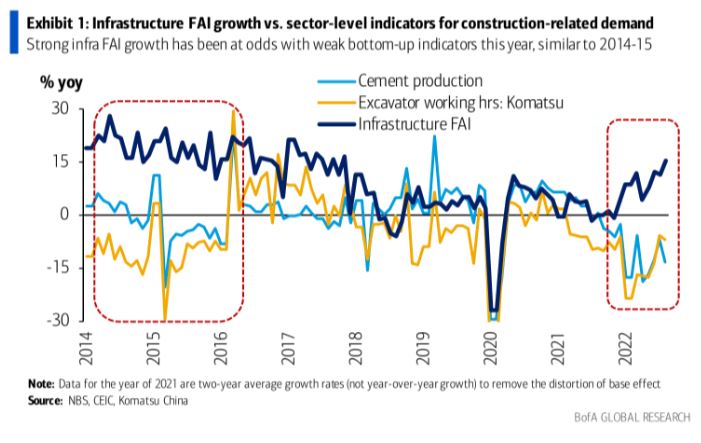
With the help of more stimulus, infrastructure fixed-asset investment (FAI) growth has rebounded to double-digit levels in yoy terms since June and held up so far. However, this has hardly lifted demand for commodities visibly–bottom-up indicators continue to show weak construction-related demand, such as for cement and steel (Exhibit 1). It makes one start to wonder: is infrastructure investment hot or cold right now?
In our view, infrastructure investment is, indeed, much stronger than in previous quarters. However, its boost to commodity demand is slow to evolve.
We see several reasons for such discrepancy. The primary driver is the fallout from a property market downturn, which more than offset any marginal improvement in infra-related demand. Meanwhile, the effectiveness of infrastructure stimulus in boosting real industrial demand has likely been capped by three factors this time around: (1) a longer time lag between fiscal funding measures vs. actual spending; (2) focus shifted away from traditional types of infrastructure; and (3) elevated commodity prices.
In our view, infrastructure spending will likely pick up more notably in 4Q and 1Q23, as the recent easing measures fully materialize and headwinds from COVID disruptions and high material costs abate. This could support a modest sequential recovery in industrial demand despite a likely continued drag from the property sector. Heading into 2023, we believe policymakers will continue to support infrastructure investment, as China’s growth may face stiffer headwinds from external demand slowdown.
Strong infrastructure FAI growth vs. weak bottom-up data
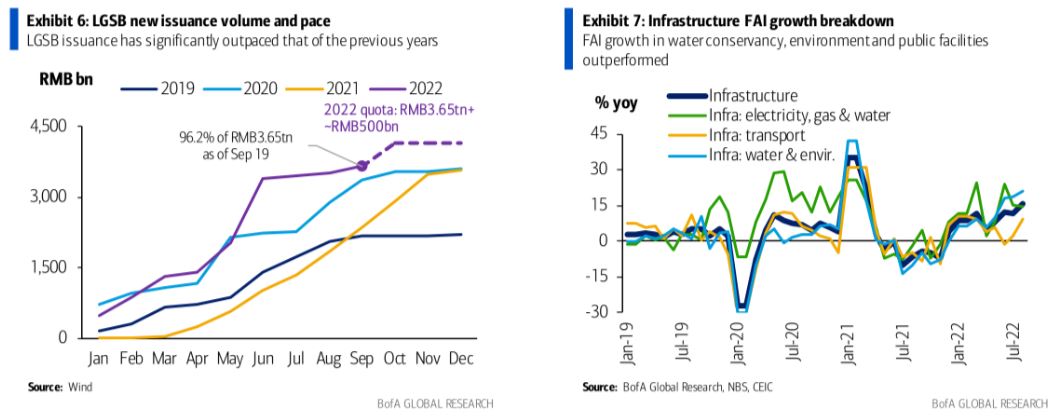
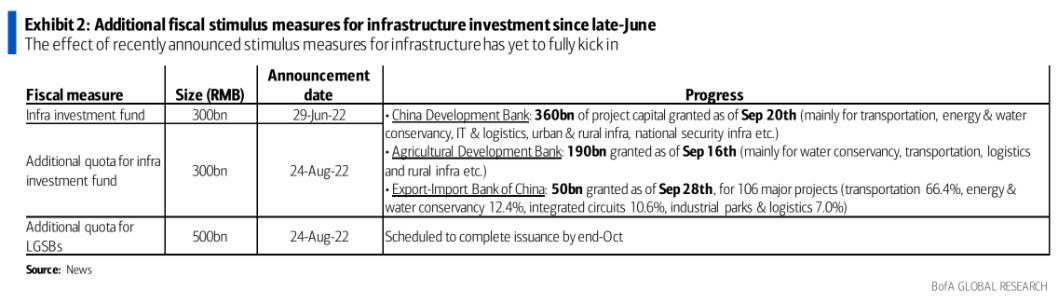
With the aim to stabilize growth, Chinese policymakers have pledged more support for infrastructure this year. In addition to the RMB3.65tn quota of local government special-purpose bonds (LGSBs), top decision makers announced in June and August several new stimulus measures amounting to a total of RMB1.1tn (Exhibit2)
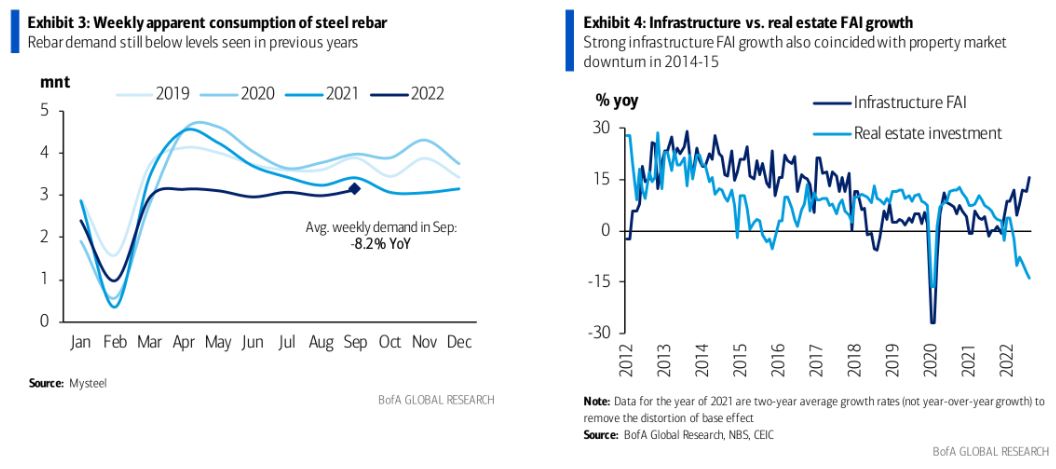
Concurrently, macro data point to a continued improvement in infrastructure investment. In August, infrastructureFAI growth rose to 15.4% yoy, with elevated year-to-date growth at 10.4%. Yet, it is puzzling that various key bottom-up indictors, including demand for cement, steel and excavators, still remain in notable contraction (Exhibit 1 and Exhibit 3).
In fact, such deviation is not new. A careful examination of historical data shows that industrial demand weakness also coincided with strong double-digit growth in infrastructure FAI during 2014-15.
Infra stimulus unable to fully offset property sector drag
Clearly, what’s similar between now and then is a severe downturn in the housing market(Exhibit 4). If history is any guide, this underscores how challenging it could be to count on infrastructure to turn around a property-led investment slump before any improvement occurs in the property sector per se.
While infrastructure and property take up a similar share in China’s total FAI (each around 24%), the property sector has a disproportionately large impact on overall domestic industrial demand. Taking into account both upstream and downstream linkages, the property sector contributes as much as 28.7% of China’s GDP. For many raw-material products (including cement and metals), residential housing construction used to consume a much higher share of their total outputs than infrastructure construction activities (Exhibit5).