CBA: ‘Line ball’ whether RBA hikes 0.25% or 0.50% on Tuesday
By Gareth Aird, head of Australian economics at CBA:
Key Points:
- The RBA will raise the cash rate at the November Board meeting.
- We expect a 25bp hike to 2.85%, but note there is a non-trivial risk the RBA opt for larger 50bp hike.
- We ascribe a 60% chance to a 25bp hike and a 40% chance to a 50bp hike (we consider the risk of any other move immaterial). These are the same probabilities we assigned to the cash rate decision at the October Board meeting.
- The RBA will publish their full suite of updated economic forecasts in the November 2022 Statement on Monetary Policy (SMP) on Friday.
- We expect the RBA to upwardly revise their peak for underlying and headline inflation in Q4 22 which will mechanically lift their inflation forecasts for 2023.
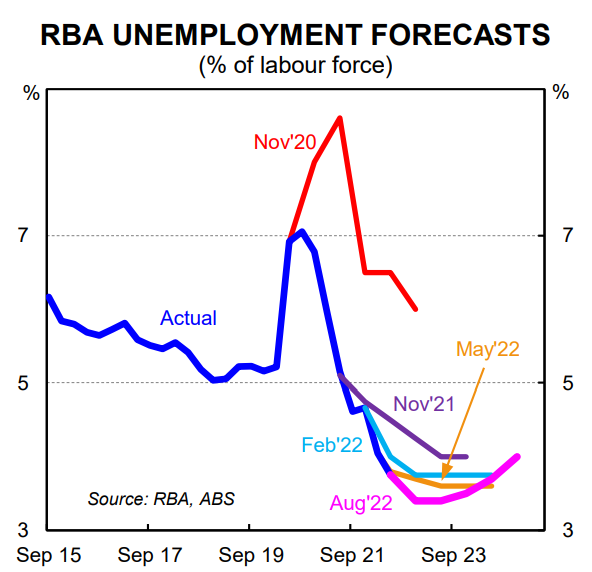
- We expect forecasts for wages growth and the unemployment rate to be left largely unchanged. More specifically, we don’t anticipate that the RBA will forecast the unemployment rate to rise to 4.5% by mid-2024 as per the Commonwealth Government’s forecast (the RBA’s current forecast is for the unemployment rate to be 4.0% in mid-2024).
- Our central scenario for the RBA has the Board delivering two further 25bp rate hikes in November and December which would take the cash rate to 3.10% (our expectation for the peak in the cash rate).
- The risk sits with a higher terminal rate, but we continue to look for rate cuts in H2 2023 and favour 50bps of easing towards the end of 2023.
The decision: 25bp hike the most likely choice but 50bp will be on the table
The coming week is another big one for Australian financial market participants.
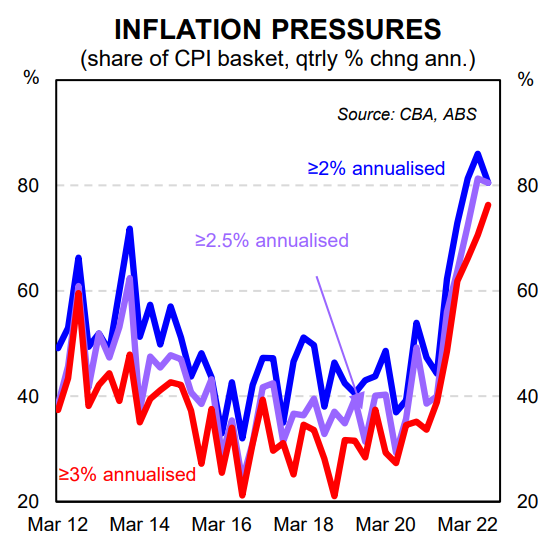
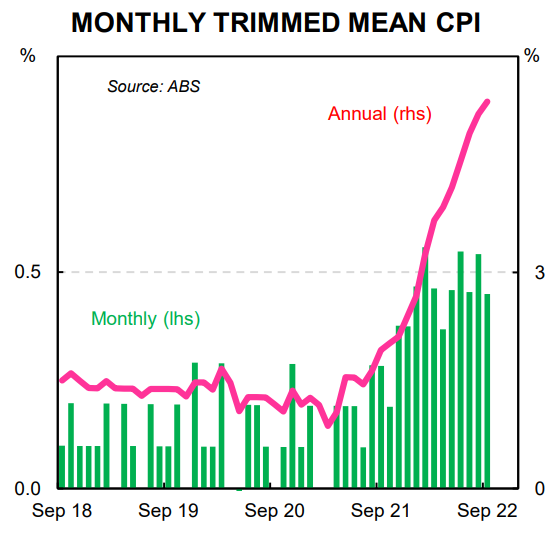
The RBA November Board meeting on Tuesday comes in the wake of the very strong Q3 22 CPI, which contained an upside surprise on the trimmed mean relative to the RBA’s forecast profile. The headline CPI printed broadly in line with the RBA’s implied profile.
The strength and breadth of price rises in the inflation data means another rate hike is a done deal at the November Board meeting. The consensus call across the sell side of economists is for a 25bp rate rise. That is also our expectation. But the decision will be ‘live’ and the Board will debate the case to raise the cash rate by either 25bp or 50bp, as was the case at the October Board meeting (no other
options were considered in October).
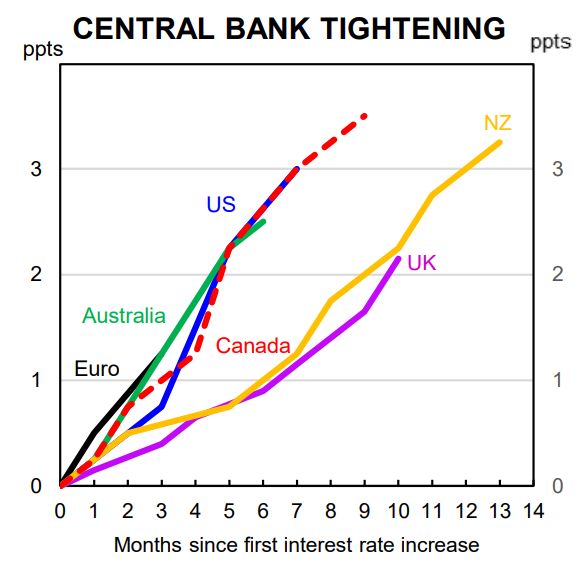
Regular readers will be aware that the 25bp hike in October was in line with our call but not in line with the market median forecast (the consensus among economists was a 50bp rate increase and the market had priced ~44bp heading into the meeting). As such, the RBA’s move to slow the pace of tightening in October was a surprise to the market.
Ahead of the October Board meeting we had ascribed a 60% chance to a 25bp hike and a 40% chance to a 50bp hike. The discussion presented in the October Minutes around whether to raise the cash rate by 25bp or 50bp in October broadly married up with our assigned probabilities.
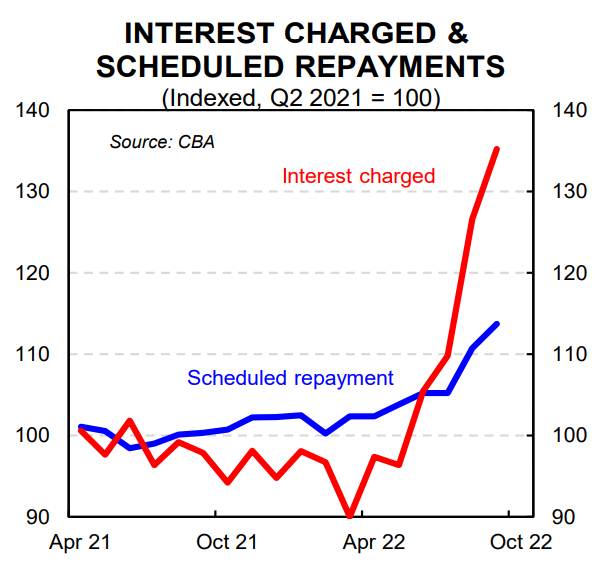
The Board made a very thorough and convincing case in the October Minutes as to why they slowed the pace of tightening in October. We covered it in detail. In summary the Board settled on 25bp because of the risks to global and domestic growth and the potential for inflation to subside quickly. The Minutes also made the very salient point that the full effects of higher interest rates were yet to be felt in mortgage payments and the increases in the cash rate were close to the interest rate buffer applied when many current borrowers took out their loans.
The arguments that underpinned the decision to rate the cash rate by 25bp in October will all be valid at the November Board meeting. And we expect these factors to once again trump the case for a 50bp rate hike.
It is important to note that arguments to increase the cash rate by 50bp will be canvassed in the context of ‘stepping up the pace of tightening’ rather than ‘continuing with 50bp increases’ as was the case at the October Board meeting. This creates an additional hurdle to raising the cash rate by 50bp in and of itself. The optics of dropping the pace of tightening in October and then stepping it up
the following month would not look good. And such a decision would send a very confusing message to households and businesses.
Monetary policy of course operates with a lag, particularly in terms of how it impacts price changes in the economy. The RBA’s aggressive tightening cycle (250bp of rate hikes between the May and October Board meetings) had no impact on the June or September quarter inflation outcomes. Indeed the rapid recent rate hikes and our expectation of some further modest tightening is unlikely
to shift the inflation needle over the December quarter; inflation is a lagging indicator. The impact of policy tightening will impact consumer inflation in 2023.
That all said, in the context of an upside surprise on the Q3 22 CPI we cannot dismiss the arguments the Board made for continuing with an increase of 50bp at the October Board meeting.
The case to raise the cash rate by 50bp in October “stemmed from the inflationary environment and risks to inflation expectations”. The Board acknowledged that being the first major central bank to reduce the size of rate rises “might in turn prompt an unhelpful reaction in inflation expectations and financial markets, if the community came to question the Board’s resolve to reduce inflation.”
These were valid concerns. But it is one thing to be the first major central bank to reduce the size of rate rises to a ‘business as usual’ hike. It would be quite another to be the first major central bank to step up the pace of tightening having just dropped it the previous month. This is particularly the case as a decision to raise the cash rate by 50bp in November would be made purely because of the
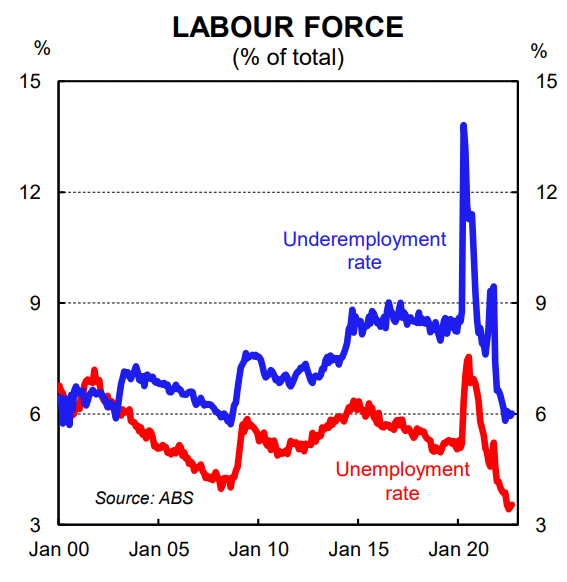
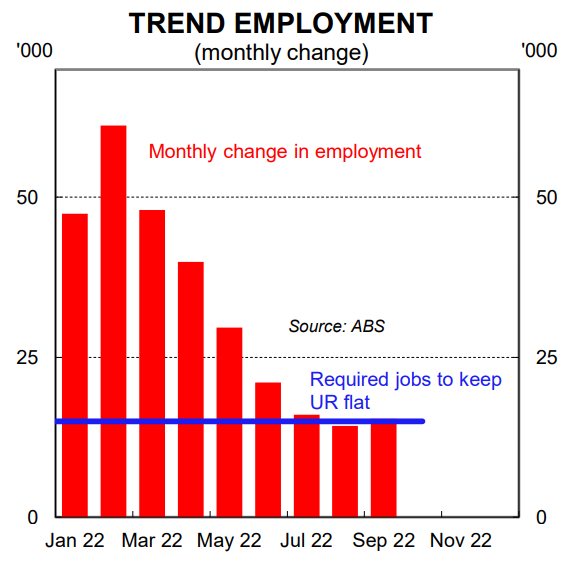
Q3 22 CPI. It would not be made based on any other recent domestic data – recall that the unemployment rate was unchanged at 3.5% in September and employment was flat over the month. In addition, the RBA Board recently noted that, “wages growth had not reached levels that would be inconsistent with the inflation target.”
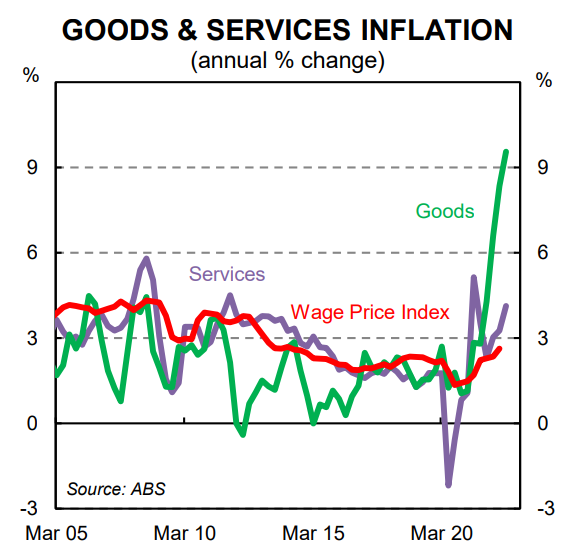
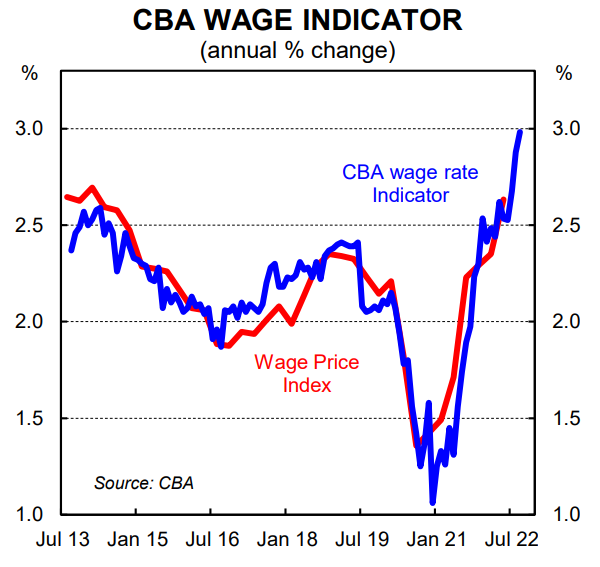
We very much agree and our internal data supports that notion. We would also add that high inflation in Australia has been very much driven by goods inflation rather than services inflation which is more closely aligned with wages growth (see below charts).
A 50bp hike in November would clearly highlight that the Board is, “resolute in its determination to return inflation to target and will do what is necessary to achieve that outcome”. But stepping up the pace of tightening again would not be consistent with, “keeping the economy on an even keel”. And it would run counter to the argument put forward in the October Board Minutes that, “the cash
rate had been increased substantially in a short period of time and the full effect of that increase lay ahead”.
On balance therefore we favour a 25bp rate hike at the November Board meeting, as we did at the October Board meeting. But we think it’s probably a closer call than is implied by market pricing (the market has currently ~31bp priced for the November Board meeting which ascribes a ~25% chance to a 50bp hike).
The Governor’s Statement and the November SMP
Governor Lowe’s Statement accompanying the November Board decision will be important as he will preview the RBA’s updated economic forecasts, which will be published in the November SMP on Friday.
The new economic forecasts will be tabled just a week after the Government published updated economic forecasts and projections in the 2022/23 Budget.
The ‘official forecasting family’ (i.e. Treasury and the RBA) tend not to differ too much in their outlook for the economy and by extension their economic forecasts. But we expect there will be some differences between the Treasury and RBA forecasts.
On inflation we think the RBA will upwardly revise their peak in the inflation rate to ~8.0% in Q4 22 from 7.8% (note the Government forecasts inflation to peak at 7¾%). A modest upward revision would not come as a surprise, particularly given Deputy Governor Michelle Bullock stated in early September that, “our forecasts for inflation are to peak at about 7¾% to 8% towards the end and early
into next year”.
A higher peak in the inflation rate will mechanically mean that the annual rate of inflation will be forecast to be higher over 2023. But we expect the RBA to retain their forecast from the August SMP that inflation will return to the top of the target band by late 2024. Note that we think inflation will recede more quickly in 2023.
The RBA will upwardly revise their peak in the trimmed mean CPI due to the upside surprise in the Q3 22 data. We think the RBA will forecast a peak in underlying inflation of 6.5%/yr in Q4 22 (up from 6.0%/yr). They are likely to retain their previous forecast that underlying inflation will return to the top of the target band by late 2024.
We expect the RBA to leave their unemployment rate profile broadly unchanged. If so, they will continue to forecast the unemployment to gradually edge higher to 4.0% by mid-2024. In contrast the Government forecast the unemployment rate to be 4½% by mid-2024. Such an outcome would be comfortably above the RBA’s estimate of full employment and we do not think they would forecast such
an outcome.
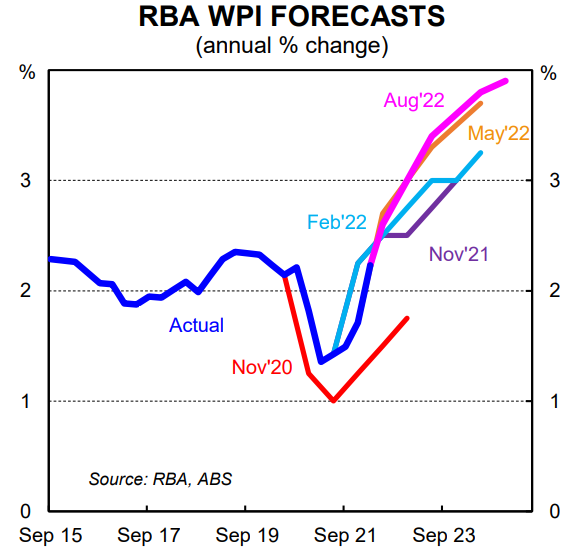
Finally we expect the RBA’s forecast for wages growth to be unchanged. The RBA expect wages growth, as measured by the wage price index, to climb to 3.9%/yr by end-2024. We think that forecast is a little too ambitious and expect annual wages growth to peak at ~3.5% by mid-2023. We believe the high intake of migrants coupled with slower growth in aggregate demand will make it harder
for annual wages growth to push beyond 3.5%.
The Governor’s speech
The RBA Governor will deliver remarks at the RBA Board Dinner with the business community in Hobart on Tuesday night following the Board meeting (7.20 pm AEDT). The speech was scheduled before the Q3 22 CPI printed. As such, there is no signal from the timing of the remarks around the likely policy decision at the November Board meeting.
The Governor will more fully flesh out the Board’s decision in his speech. And he will likely go through the RBA’s updated economic forecasts. A Q&A session will follow the Governor’s opening remarks.