Via Westpac.
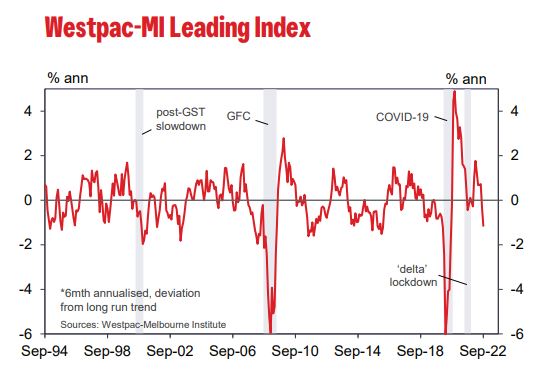
- Growth rate falls from –0.33% to –1.15%, weakest pace since pandemic hit.
- Signal consistent with Westpac’s forecast of sharp slowdown in 2023.
- Components for interest rates; commodity prices; global growth; equity markets; hours worked; and Consumer Confidence all weighing on Index.
The Leading Index continues to point to a material loss in momentum to a below-trend growth pace heading into 2023. The September Leading Index read is the weakest since the pandemic first hit in 2020, and, prior to that, since early 2016.
This signal is broadly in line with Westpac’s forecast that economic growth will slow from 3.4% in 2022 to 1.0% in 2023, highlighted by a sharp slowdown in consumer spending. That slowdown is likely to intensify through 2023 as rising interest rates and a softening labour market take their toll.
The Leading Index growth rate has declined from 1.21% in April to the current -1.15%. The main components driving the 2.36ppt deterioration have been: a rapid narrowing in the yield spread following aggressive RBA rate hikes (contributing –0.83ppts); softening global commodity prices in AUD terms (–0.79ppts); an end to the large reopening rebound boost to aggregate monthly hours worked (–0.52ppts); a sell-off in equity markets that has weighed on the S&P/ASX 200 (–0.32ppts); and a slowing in the global growth pulse evident in softer US industrial production (–0.17ppts). These additional drags have combined with continued weakness in the Westpac-Melbourne Institute Consumer Expectations Index and a softening in the Westpac-Melbourne Institute Unemployment Expectations Index. A stabilisation in dwelling approvals has provided some offsetting support but this looks unlikely to last.
The Reserve Bank Board next meets on November 1. We expect the Board will follow on from the surprise decision to raise the cash rate by only 25bps in October with a further 25bp increase in November.
Markets, analysts, and the media are comfortable with the new 25bp path and the Board will be reluctant to spring a surprise for the second consecutive month.
It is important to note from the October Board Minutes that the Board sees some advantage to an extended path of 25bp increases.
The Minutes noted: “Drawing out policy adjustments would also help to keep public attention focused for a longer period on the Board’s resolve to return inflation to target.”
This thinking is in line with our own expectations that we can expect a series of 25bp increments in the future months of November, December, February (no meeting in January) and March.
The risks to this profile are that the Board sees a need to extend the cycle even further, although, as signalled by the Leading Index and our own forecast for 2023, by the June quarter, the evidence will become clear that a significant slowdown is underway.