
APRA’s mortgage buffer comes back to bite
In July 2019, the Australian Prudential Regulatory Authority (APRA) relaxed the mortgage repayment buffer, removing the requirement for lenders to assess borrower at a 7% mortgage rate with a buffer of 2.5% above the loan’s interest rate.
In October 2021, APRA lifted the buffer to 3.0% in response to “growing financial stability risks from ADIs’ residential mortgage lending” amid soaring house price growth.
With the Reserve Bank of Australia (RBA) having hiked the official cash rate (OCR) by 2.5% since May, APRA’s 2.5% mortgage buffer has now been reached. This means that most households that borrowed last year at rock bottom mortgage rates will now be ‘in the red’ if the RBA further lifts the OCR.
That is, for every OCR increase from now on, there will be mortgage borrowers who are required to make higher repayments than they were tested for when they took out the loan.
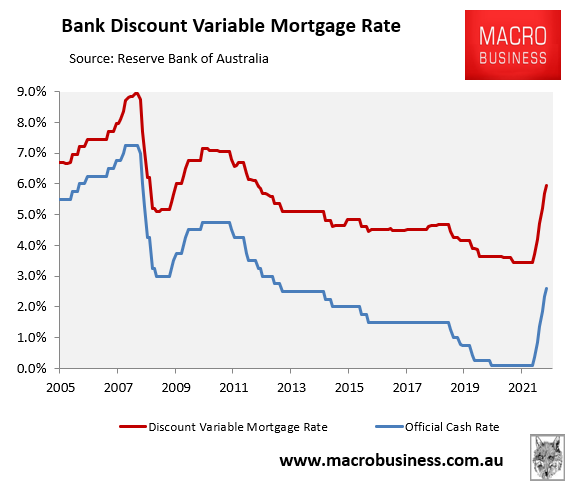
Mortgage rates have already hit the 2.5% repayment buffer.
In his last public appearance, outgoing APRA chair, Wayne Byres, was unrepentant about lowering the mortgage repayment buffer to 2.5%, which has now left borrowers and the system exposed to rapidly rising interest rates:
In an exclusive on-camera interview with the ABC, Mr Byres defended that move saying it was “an on-balance judgement” and he had “no regrets” about his actions while in charge of APRA.
“We’re comfortable with the setting where it is”…
“There’ll inevitably be some pockets of stress in the housing loan portfolios in the banks”…
“Borrowers with only a small equity buffer and/or high levels of leverage relative to their income will be particularly challenged”…
“Borrowers currently on very low fixed rates face a significant repayment shock in the future.”
As noted above by Byres, those borrowers that took out fixed rate mortgages at around 2% last year are especially exposed, as are those who borrowed to their maximum limit.
Loosening the mortgage buffer was the key policy maneuver that pulled house prices out of the Hayne Royal Commission swan dive.
Now it is coming back to bit amid the steepest rise in mortgage rates in this nation’s history.
