
Australian house prices have already fallen sharply in response to the Reserve Bank of Australia’s (RBA) aggressive interest rate hikes.
As illustrated in the next chart, dwelling values at the 5-City aggregate level have fallen 4.5% from their peak, driven by heavy 7.6% and 4.8% falls across Sydney and Melbourne, with Brisbane (-3.1%) now also falling quickly:
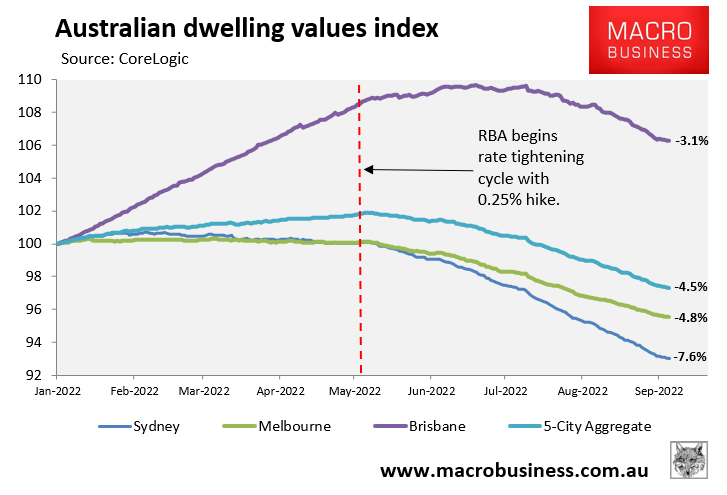
RBA rate hikes drive rapid decline in dwelling values.
The quarterly decline in dwelling values is the steepest since 1983 at the 5-city aggregate level and across Sydney, whereas Melbourne’s quarterly decline is running at its fastest since February 2019 and Brisbane’s since 2008:
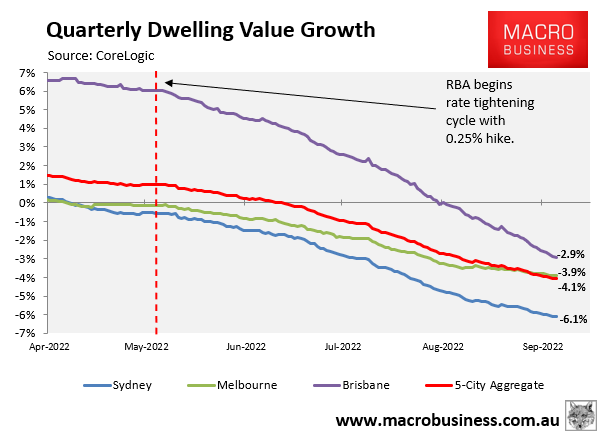
Dwelling values are falling at their fastest pace since 1983.
Tuesday’s 0.5% rate hike from the RBA – the fifth monthly increase in a row – will obviously add further downward pressure to house prices. Moreover, in its statement accompanying Tuesday’s decision, the RBA noted that “the Board expects to increase interest rates further over the months ahead”, meaning mortgage rates will rise even further.
Earlier this week, CBA’s head of Australian economics, Gareth Aird, released research showing that it typically takes two-to-three months for increases in the official cash rate (OCR) to hit mortgage holders.
Separately, Aird cautioned that the RBA’s aggressive tightening is “like having five shots of vodka in an hour and saying, everything is OK. But you know that it will soon have a big effect”.
This suggests that most of the impacts of the RBA’s aggressive rate hikes are yet to be felt. It also means that Australian house prices will continue to fall, likely resulting in the biggest price correction in generations.
The RBA’s modelling certainly suggests so. It’s latest Financial Stability Review estimated “that a 200-basis-point increase in interest rates from current levels would lower real housing prices by around 15 per cent over a two-year period”. Thus, the 2.25% of tightening to date suggests that dwelling values will fall by around 12% in real terms nationally, with Sydney and Melbourne falling more heavily than the average.
Given further rate hikes are certain over coming months – as explicitly flagged by the RBA in Tuesday’s statement – this necessarily means the peak-to-trough price fall in house prices will be even greater.
According to CoreLogic data dating back to 1980, dwelling values have never fallen by more than 11% across the combined capital cities. That record looks certain to be broken if the RBA continues to increase interest rates.
