
Mortgage slump signals sharper house price falls
Data released last week by the Australian Bureau of Statistics (ABS) showed that the value of mortgage commitments tanked by 8.5% July, to be down 11.3% year-on-year.
This decline in mortgage commitments captured the first three Reserve Bank of Australia (RBA) rate hikes – i.e. 0.25% in May and 0.50% in June and July – but obviously does not capture the 0.50% hikes in August and September.
Australian dwelling values have fallen sharply since the RBA’s first hike, with values down 4.6% at the 5-city aggregate level, driven by sharp declines across Sydney (-7.7%) and Melbourne (-4.8%), with Brisbane values (-3.2%) also lower:
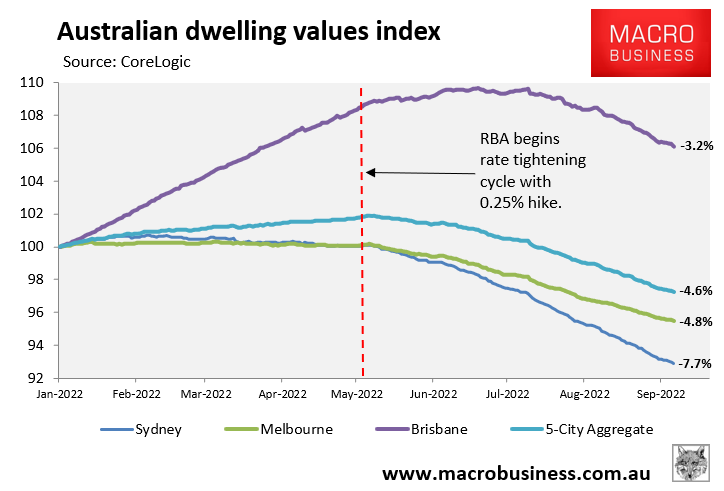
Heavy house price falls following RBA rate hikes.
The growth in new mortgage commitments has traditionally been a strong leading indicator for house price growth. Accordingly, the sharp decline in mortgage commitments in the year to July signals ongoing price falls nationally:
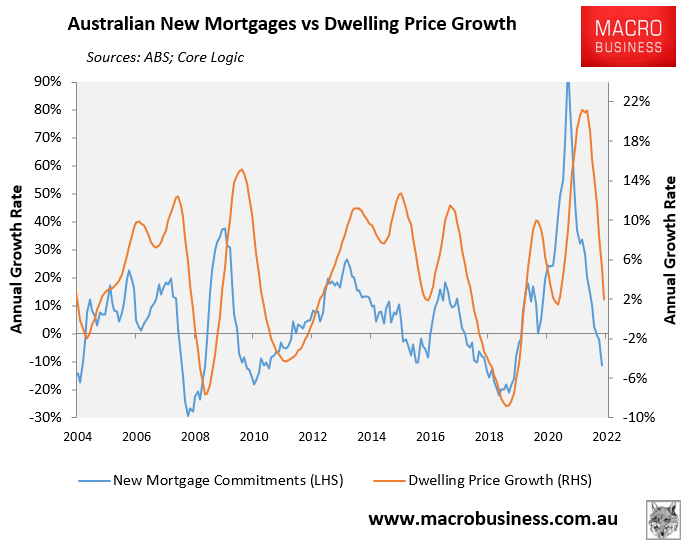
Falling mortgage commitments means falling dwelling values.
The falls are sharpest across Sydney and Melbourne, which are leading the nation’s house price correction:
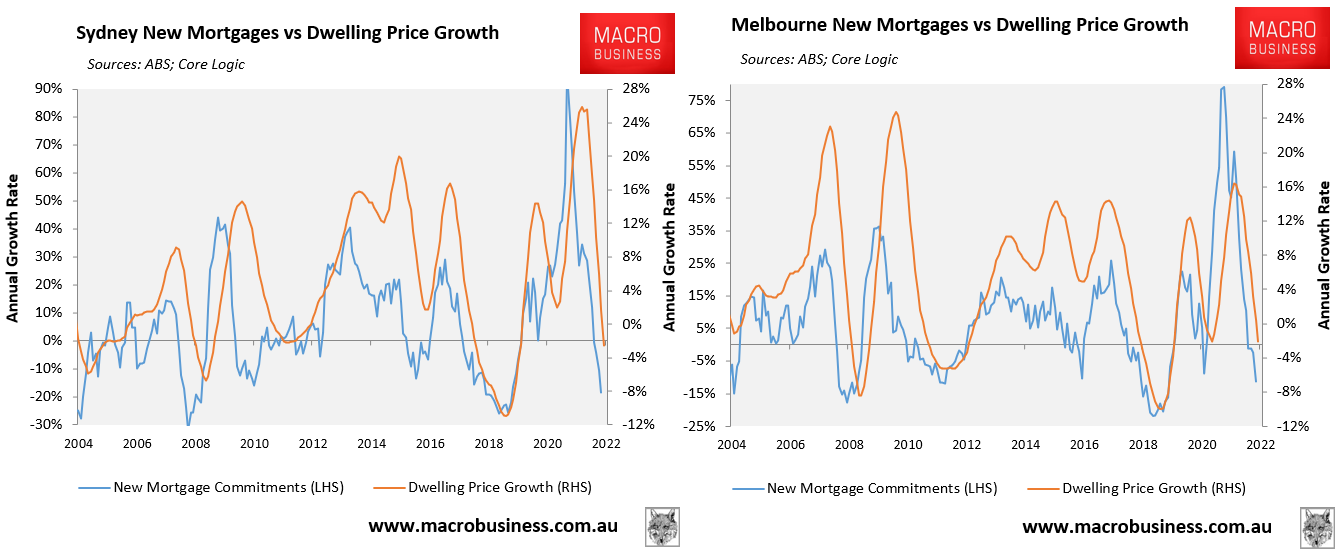
Mortgage demand collapses across Sydney and Melbourne.
As shown below, the five consecutive interest rate hikes from the RBA have already reduced borrowing capacity by 30%, which is a key reason why mortgage demand has shrunk:
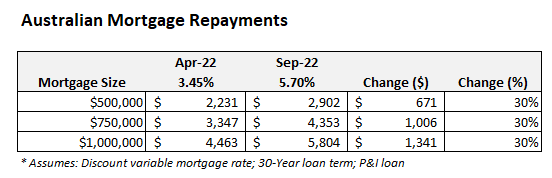
Mortgage repayments have soared following rate hikes, reducing borrowing capacity.
The other key factor is that “fear of overpaying” or FOOP has taken over from “fear of missing out” [FOMO].
In the RBA’s monetary policy statement accompanying Tuesday’s rate hike, governor Phil Lowe noted that “the Board expects to increase interest rates further over the months ahead, but it is not on a pre-set path”.
Therefore, we should expect that FOOP will intensify, buyers will remain on the sidelines, mortgage demand will fall, and Australian house prices will continue to fall.
