Yesterday’s RBA minutes showed a clearly nervous central bank:
In considering the policy decision, members noted that inflation in Australia was at its highest level in several decades and was expected to increase further over the months ahead. Global factors continued to explain much of the increase in inflation. However, domestic factors were also playing a role, with widespread upward pressure on prices from strong demand, a tight labour market and capacity constraints in some sectors of the economy.
Members noted that inflation was expected to peak later this year and then decline back towards the 2 to 3 per cent target range. The expected moderation in inflation reflected the ongoing resolution of global supply-side problems, recent declines in some commodity prices and the impact of rising interest rates. Medium-term inflation expectations remained well anchored, and it was seen as important that this remain the case. The Bank’s central forecast was for CPI inflation to be around 7¾ per cent over 2022, a little above 4 per cent over 2023 and around 3 per cent over 2024.
The Australian economy was continuing to grow solidly. Consumer spending had so far been resilient to higher interest rates, and national income had been boosted by a record level of the terms of trade. At the same time, the increases in interest rates had seen an easing of conditions in the established housing market alongside a softening in household demand for credit.
The labour market had remained tight and continued to indicate that the economy was having difficulty meeting the level of aggregate demand. Many firms were finding it challenging to hire workers. The unemployment rate had declined further in July to 3.4 per cent, the lowest rate in almost 50 years, and the continued high level of job vacancies suggested a further decline was in prospect over the months ahead. Members noted that many Australians are benefitting from the greater opportunities for work provided by the tighter labour market, notably young people, women and longer term unemployed people. Beyond the near term, some increase in unemployment was expected as economic growth slows owing to the effects of higher interest rates, although members noted that changes in labour market conditions tended to lag some other indicators of economic activity.
Wages growth had picked up from the low rates of prior years and there were some pockets where labour costs were increasing briskly. However, members noted that the rate of base wages growth so far had not reached levels that would be inconsistent with achieving the inflation target on a sustained basis. Nevertheless, given the tight labour market and the upstream price pressures, the Board would continue to pay close attention to both the evolution of labour costs and the price-setting behaviour of firms in the period ahead.
Members noted that an important source of uncertainty continued to be the behaviour of household spending. Higher inflation and higher interest rates were putting pressure on household budgets. Consumer confidence had also fallen and housing prices were declining in most cities and regions after the earlier large increases. Working in the other direction, people were finding jobs, gaining more hours of work and receiving higher wages. Many households had built up large financial buffers and the saving rate remained higher than before the pandemic. While the high levels of payments into offset and redraw accounts suggested that some households remained in a favourable financial position, members acknowledged that other households were finding conditions difficult in the face of higher interest rates and higher inflation. The Board would be paying close attention to how these various factors balanced out as it assessed the appropriate setting of monetary policy.
The outlook for global economic growth had deteriorated and posed a key uncertainty. Central banks in several large advanced economies had expressed further resolve in tightening monetary policy to prevent high inflation from becoming entrenched, and this was likely to entail a period of significantly lower growth. High inflation was also placing pressure on real incomes, most significantly in Europe, related to the worsening effects on energy markets following Russia’s invasion of Ukraine. In addition, COVID-19 containment measures and other policy challenges continued to weigh on the outlook for growth in China. Some slowing in the global economy would be important to returning inflation to central banks’ targets, but the potential for a sharp slowing continued to present a downside risk to the outlook.
Members judged that a further increase in interest rates would help bring inflation back to target and create a more sustainable balance of demand and supply in the Australian economy. They discussed the arguments around raising interest rates by either 25 basis points or 50 basis points. Members emphasised that price stability is a prerequisite for a strong economy and a sustained period of full employment. They acknowledged that monetary policy operates with a lag and that interest rates had been increased quite quickly and were getting closer to normal settings. Given the importance of returning inflation to target, the potential damage to the economy from persistent high inflation and the still relatively low level of the cash rate, the Board decided to increase the cash rate by a further 50 basis points.
The Board expects to increase interest rates further over the months ahead, but it is not on a pre-set path given the uncertainties surrounding the outlook for inflation and growth. The full effects of higher interest rates were yet to be felt in mortgage payments, and the broader effects on activity and inflation would take some time to be apparent. The Board was resolute in the need to ensure inflation returned to target, but mindful that the path to achieve this needed to account for the risks to growth and employment. The Board is seeking to return inflation to target while keeping the economy on an even keel. The path to achieving this balance remains a narrow one and clouded in uncertainty.
The size and timing of future interest rate increases will continue to be guided by the incoming data and the Board’s assessment of the outlook for inflation and the labour market, including the risks to the outlook. All else equal, members saw the case for a slower pace of increase in interest rates as becoming stronger as the level of the cash rate rises. The Board is committed to doing what is necessary to ensure that inflation in Australia returns to target over time.
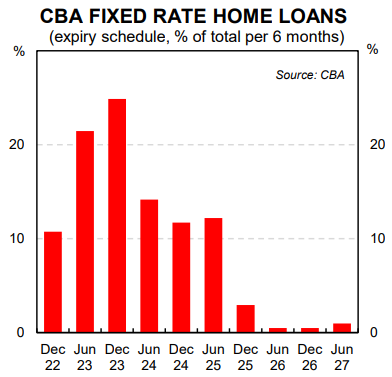
This is all a clear reference to the great mortgage reset that the RBA baked-in with its YCC policy and inglorious backflip. It should be afraid:
This $500bn mortgage steamroller has so much baked-in tightening (typically a lift in repayments from 2% to 5-6% overnight, that house prices are guaranteed to keep falling throughout 2023.
Advertisement
Given the speed of the correction to date, at 1% per month, even if the bank stops tightening now, that raises the prospect of a crash in property prices through 2023 greater than 20%.
Real prices will be closer to one-third.
Sydney will be down 30% and 40% in real terms. Melbourne slightly behind that. And Brisbane a little further back.
These are not trivial falls. Especially so fast. And there will be implications for banks, both earnings and balance sheets. Indeed, if the CEOs are not on the blower to Phil Lowe now then I’d be very surprised.
Advertisement
At his recent presser, Phil Lowe looked a bit unhinged. Is it any wonder?
He has allowed markets to bully him into hikes and humiliate what was perfectly reasonable policy.
He’s been abandoned by Chicken Chalmers who isn’t fixing energy, the RBA’s number one future inflation problem, while threatening the bank with a major review.
His deputy has walked out.
A full-scale housing crash is underway.
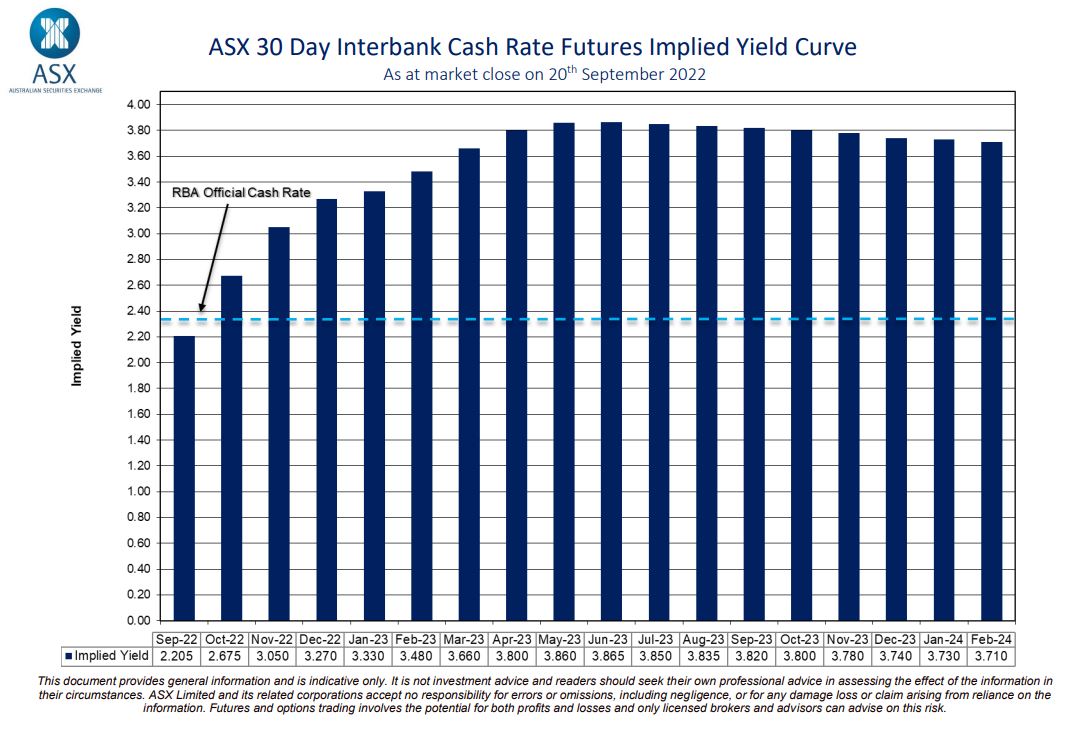
Cash rate futures have sensed the nerves. The terminal rate outlook has not fallen yet:
Advertisement
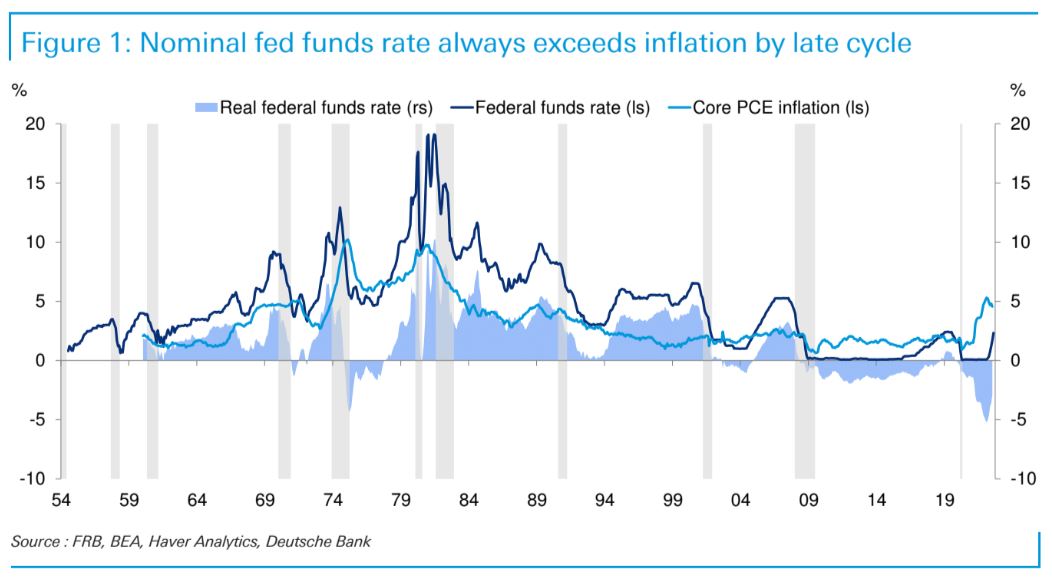
But Aussie yields have been falling behind those in the US as the Fed stays uber-hawkish and Wall Street faces the music. Deutsche:
This morning DB’s Chief US Economist Matt Luzzetti, has upgraded his terminal rate forecast to 4.9% based on a piece where they present two approaches for calibrating the appropriate terminal rate. Both approaches – comparing the nominal fed funds rate to inflation and a suite of common policy rules – suggest that a fed funds rate at or around 4.5% could be required by early next year. Accounting for risk management considerations, a rate approaching 5% is likely to be needed. As such, they now expect the Fed’s policy rate to peak at 4.9% in Q1 of next year.
Advertisement
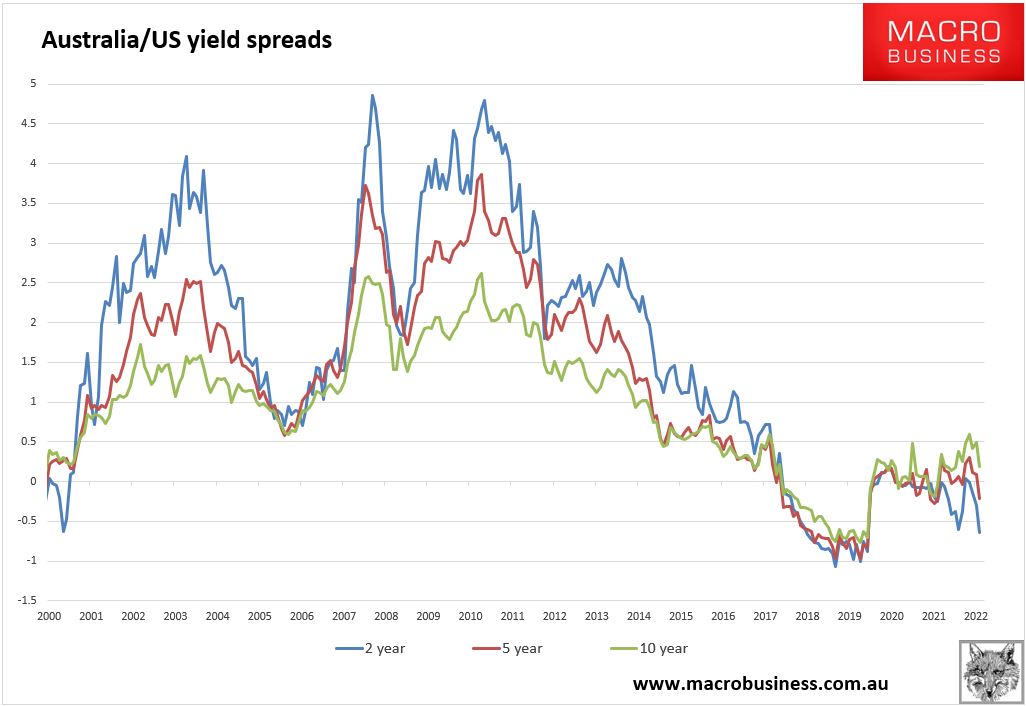
Hence, the yield spreads between the US and Australia are compressing, aiding the AUD lower:
In my view, the RBA has already overcooked tightening and baked-in a historic house price crash. It needs to stop mechanically following the Fed and listen to its fears.
Advertisement
Phil Lowe had a near-stroke in 2016. He may not survive this at all!
David Llewellyn-Smith is Chief Strategist at the MB Fund and MB Super. David is the founding publisher and editor of MacroBusiness and was the founding publisher and global economy editor of The Diplomat, the Asia Pacific's leading geo-politics and economics portal.
He is also a former gold trader and economic commentator at The Sydney Morning Herald, The Age, the ABC and Business Spectator. He is the co-author of The Great Crash of 2008 with Ross Garnaut and was the editor of the second Garnaut Climate Change Review.