
Economist Tony Alexander has released a note running through various factors that he believes signals that the downward leg of the New Zealand house price cycle has reached its endgame.
While house prices still have further to fall, Alexander believes the scene is being set for prices to flatten out potentially before the end of the year, before edging up over 2023-25:
_______________________________________________________________________________________________
The view I’ve been giving since early this year is that prices will fall for a while and at some stage before the end of the year we will enter the endgame for this period of price declines.
I’ve specifically noted that I won’t feel we have entered such a period until we see a decent amount of wallowing in the pessimism of two factors in particular.
One of those factors is talk of an over-supply of housing, largely with regard to Auckland. We have reached that stage now with a media focus on the view by one set of forecasters that such an oversupply may appear next year.
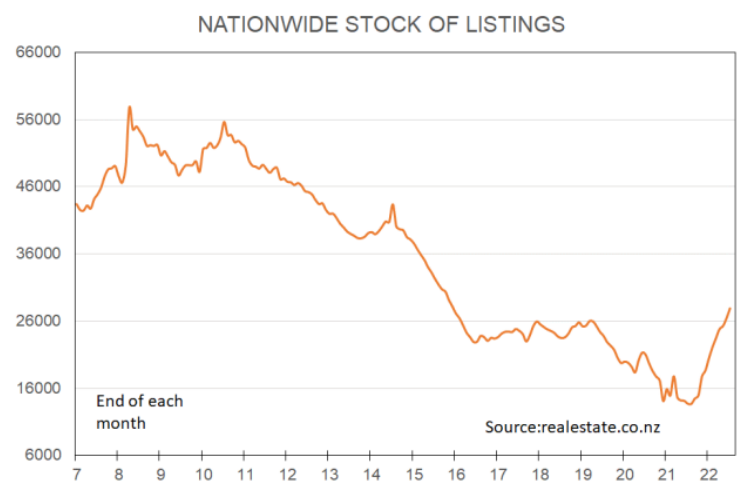
It is not the technical position of there being an over-supply or under-supply which matters – partly because if the market functions and prices are free to adjust (as they are with housing) then there is never an under or over-supply situation We simply get price changes.
What matters is the general discussion of an oversupply and the view people will take that this means there is no hurry needed to buy a house and prices will decline. We’re about there now. The over-supply talk will start with Auckland but eventually extend to other parts of the country – especially once the locals realise the special pandemic population surge they have just enjoyed will not continue.
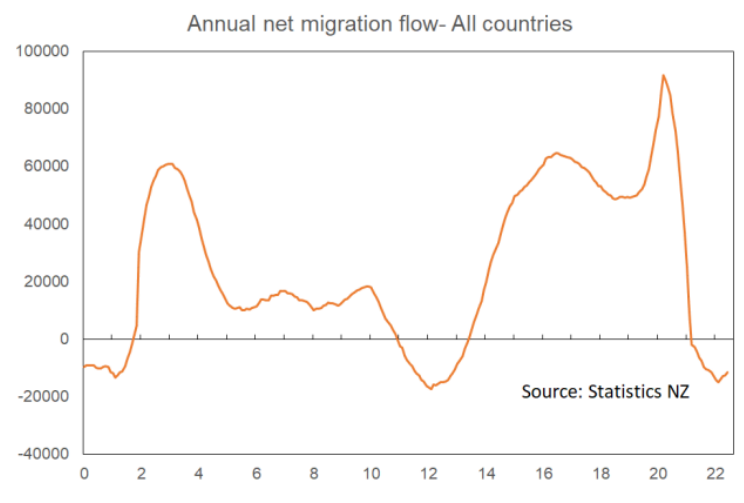
The other factor I have mentioned as needing to be in place before I will call the endgame underway is widespread talk of a brain drain. That ball is rolling though not in a forceful manner as yet. There is growing awareness of not just the net loss for the past year of over 11,000 people, but the fact that flows have been negative for over a year.
Here is an example of why more young Kiwis are going to head west – the strong incomes available in mining in Australia.
Why are these factors important? Because by wallowing in the negative price implications of them in an environment of deep concerns about the economy, we will see vendors hanging out for a good price finally meet the market. They will capitulate to the current reality and stop holding out hoping to get the price they could have got had they sold during the silly frenzy over the second half of last year.
I take as one sign of the endgame starting the survey results just released by ASB showing strong expectations by respondents that house prices will decline.
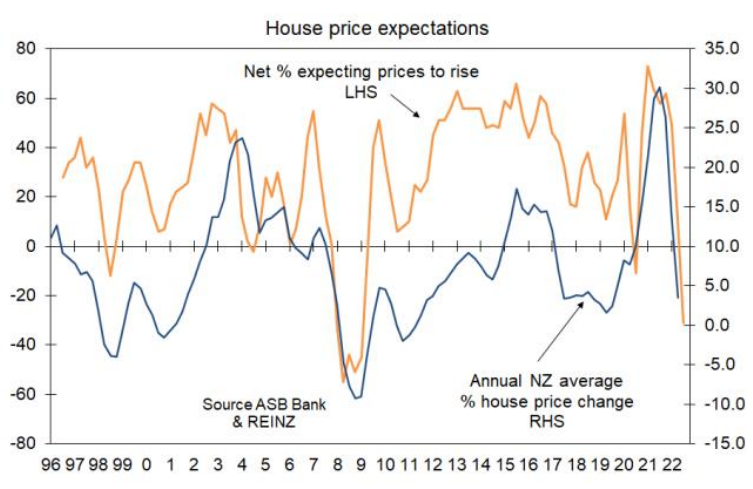
The net expectation for price changes in the coming 12 months sits at -31% from 11% last quarter. Note that in the December quarter last year when prices were already falling a net 62% of respondents expected them to keep rising. And in the March quarter when again they had already been falling away, a net 49% still expected prices to go up.
People’s house price change expectations alter after actual price changes, not before. I have noted in the past that this survey tends to reflect what is happening or has already happened with house prices.
We can see this as the blue columns showing expectations tending to shoot up after the red line showing quarterly house price changes has shot up. Same for down most recently.
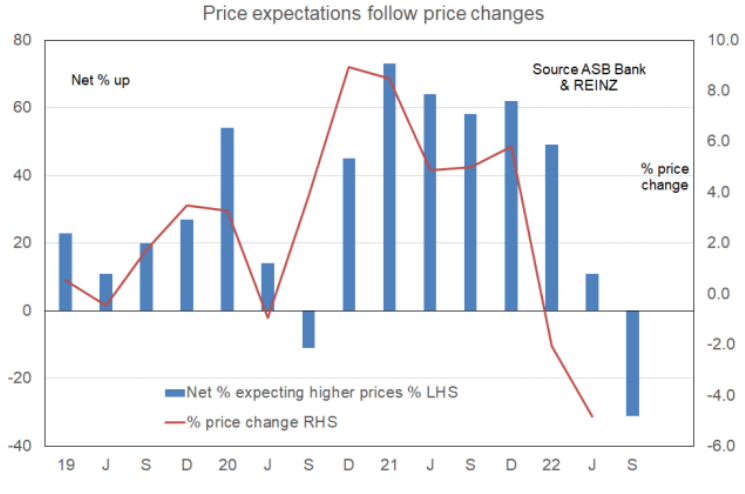
But it is important nonetheless in signalling that people accept the housing market is vastly different from what it was before.
So, what does this mean then if we are in this socalled endgame? A key thing is, don’t expect anyone to be certain about when house prices stop falling on average, when they start rising again as they have done for a couple of centuries, and the speed with which they will rise. The end of the surge last year took a lot longer to happen than I expected because of the listings plunge and FOMO surge.
The main implication is that as each month now goes by it gets riskier to keep holding out for the absolute bottom of the cycle if you are a buyer. Yes, prices are highly likely to fall another 5% or so (meaning I don’t really have a clue but 5% seems an acceptable number to most people most of the time for most things).
For buyers the environment is one in which vendors become the most compliant and willing to negotiate that they have been for many years. Sales can actually pick up because of that just as prices fall further.
To repeat, the way I look at things does not tell me when prices rise and by how much. Instead, the approach I am taking and the stuff I am looking at encourages me to strengthen the message I am already delivering to first home buyers.
Stop trying to pick the bottom of the house price cycle and focus on what you really want – a house to raise your family in for the next one to two decades.
