
CoreLogic’s daily dwelling values index, which measures value changes across the five major capital cities, fell another 0.23% in the week ended 8 September – the 18th consecutive weekly decline:
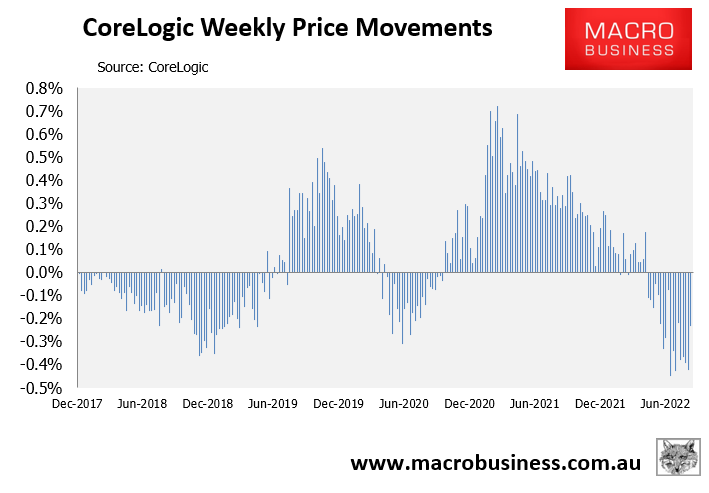
18th consecutive weekly price decline.
The weekly decline in values was driven by the three biggest markets of Sydney (-0.32%), Brisbane (-0.29%) and Melbourne (-0.22%), whereas Adelaide (+0.12%) and Perth (+0.09%) posted rebounds:
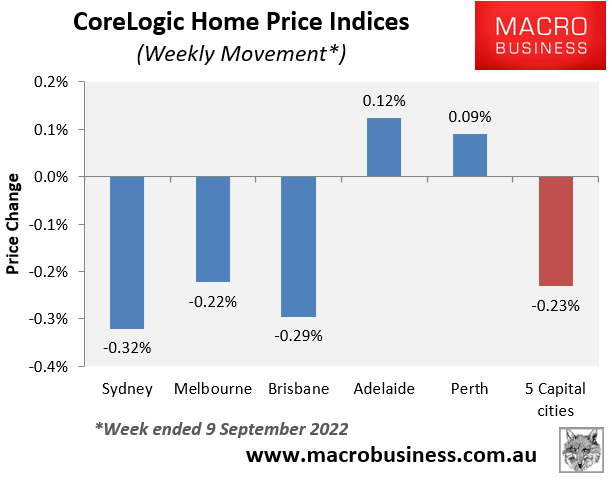
Three biggest capitals drive dwelling value falls.
The next chart plots quarterly dwelling value growth across the three biggest capitals and the 5-City aggregate level:
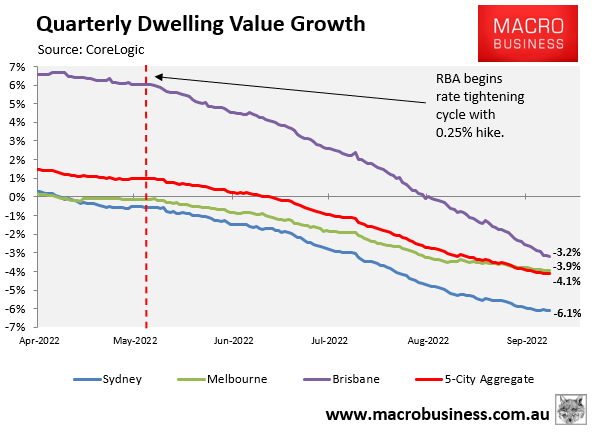
Quarterly dwelling values tumble.
Dwelling values are falling at their fastest quarterly pace since 1983 across Sydney (-6.1%) and at the 5-City aggregate level (-4.1%), whereas Melbourne’s quarterly decline (-3.9%) is its fastest since February 2019 and Brisbane’s (-3.2%) since 2008.
At the 5-City aggregate level, dwelling values are now tracking 4.6% below their April peak, with Sydney’s down 7.8% from peak, Melbourne’s down 4.9%, and Brisbane’s down 3.3%:
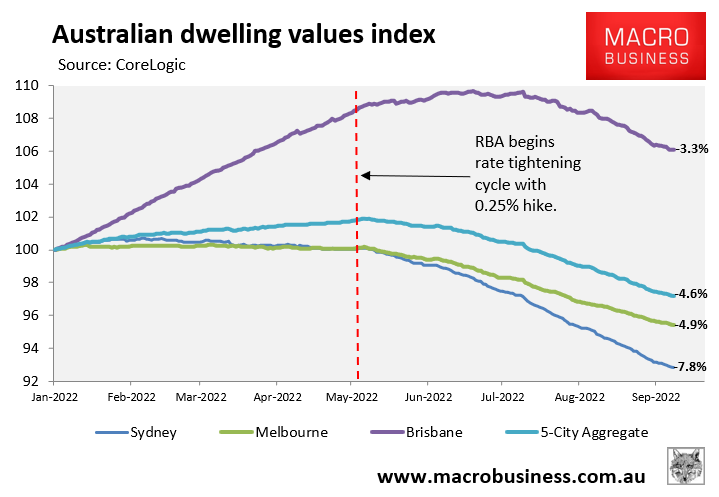
East Coast house prices fall from peak.
Ultimately, how far house prices fall will depend on how aggressively the Reserve Bank of Australia (RBA) hikes interest rates, given higher mortgage rates lowers borrowing capacity and reduces housing demand.
In the RBA’s monetary policy statement accompanying Tuesday’s rate hike, governor Phil Lowe noted that “inflation in Australia is the highest it has been since the early 1990s and is expected to increase further over the months ahead”. As such, “the Board expects to increase interest rates further over the months ahead”.
Therefore, mortgage rates will continue to rise, which will further lower borrowing capacity and reduce home buyer demand. This will inevitably push house prices lower.
