
By Gareth Aird, head of Australian economics at CBA:
Key Points
- RBA Governor Lowe yesterday provided a clear hint that the pace of rate hikes could be about to slow.
- The Governor re-iterated his comments from Tuesday’s Statement accompanying the Board decision that there are lags in the operation of monetary policy. But he added today that rates have risen very quickly and the case for a slower pace of increase in interest rates becomes stronger as the level of the cash rate rises.
- We maintain our view that the cash rate will increase by 25bp at the October Board meeting to 2.60%. From there our central scenario now has one further 25bp rate hike in November which would take the cash rate to 2.85%.
- We continue to look for RBA rate cuts in H2 2023 and have 50bps of easing pencilled in.
The RBA Governor today delivered a speech on Inflation and the Monetary Policy Framework to the Anika Foundation. It was the first speech by the Governor in almost two months. The Governor’s remarks come two days after the RBA once again raised the cash rate by 50bp to 2.35%.
The Governor’s speech had something in it for everyone. Indeed, it was the archetypal two-handed economist speech. That in and of itself is important. Some global central bankers have been far more one-handed over recent months. More specifically, ‘crush inflation as priority number one’ has been the dominant theme for some central bankers. In contrast, Governor Lowe has not taken that approach. And today’s speech was a case in point.
To be clear, Governor Lowe stated today that, “the Board is committed to doing what is necessary to ensure that inflation returns to target over time.” And for the first time today he stated that, “high inflation is a scourge” – colourful language for a central banker! But that does not necessarily provide a clue to the policy outlook. Rather this descriptive language can be used contextualise the RBA’s aggressive tightening to date. And justify the case for further policy tightening.
On that score, the Governor’s concluding paragraph in the speech today was the most important one. He stated, “the Board expects that further increases in interest rates will be required over the months ahead. The Board is not on a pre-set path…. we are conscious that there are lags in the operation of monetary policy and that interest rates have increased very quickly. And we recognise that, all else equal, the case for a slower pace of increase in interest rates becomes stronger as the level of the cash rate rises. But how high interest rates need to go and how quickly we get there will be guided by the incoming data and the evolving outlook for inflation and the labour market.” (our emphasis in bold).
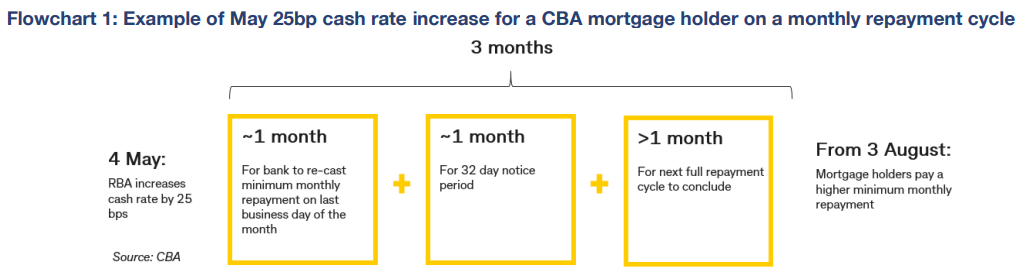
We wrote about the lags in the operation of monetary policy earlier this week (see here). There is on average a three month lag between an RBA rate hike and when CBA borrowers on variable rate mortgages experience an increase in their home loan repayments. The lag largely explains why the official spending data has remained strong but consumer sentiment sits at levels associated with a recession or major negative economic shock.
The flowchart below illustrates the delay in pass-through from the RBA’s first 25bp rate hike in May to a CBA borrower on a standard variable rate with a monthly repayment schedule (~75% of people).
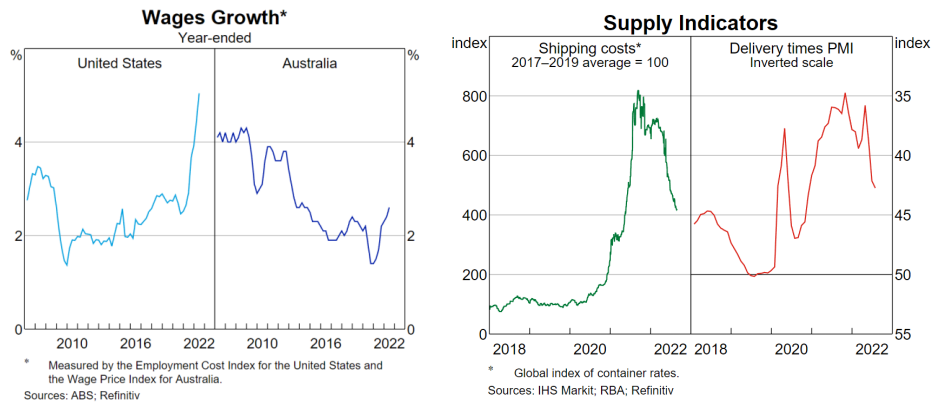
The Governor also in his speech today pointed out the contrast between wages outcomes in the US and Australia. Specifically he stated that, “wages growth has picked up, but not nearly to the same extent as in the United States. This is an important difference. While there are some areas where wages are rising very quickly in Australia, aggregate growth in wages has not responded materially to the higher inflation and is not inconsistent with inflation returning to target over time.” The Governor also noted that inflation expectations in Australia remain consistent with the inflation target, albeit they are watching the ‘inflation psychology’ carefully. And he stated that, “the supply side of the global economy is gradually improving and the demand for goods is stabilising”.
Governor Lowe continues to maintain the Board is seeking to return inflation to target in a way that “keeps the economy on an even keel”. In contrast, some offshore central banks have clearly articulated that their need to contain inflation will involve some pain.
The RBA Governor’s recognition of the lags coupled with his comment today that the case for a slower pace of increase in interest rates becomes stronger as the level of the cash rate rises supports our call that the next move in the cash rate will be a ‘business as usual’ 25bp hike at the October Board meeting. Such a move would take the cash rate to 2.60%. From there our central scenario sees the RBA deliver one final 25bp rate hike at the November Board meeting which would take the cash rate to 2.85% (this previously was the risk to our base case and today we have incorporated that risk into our central scenario).
We continue to look for RBA rate cuts in H2 2023 and have 50bps of easing pencilled in
