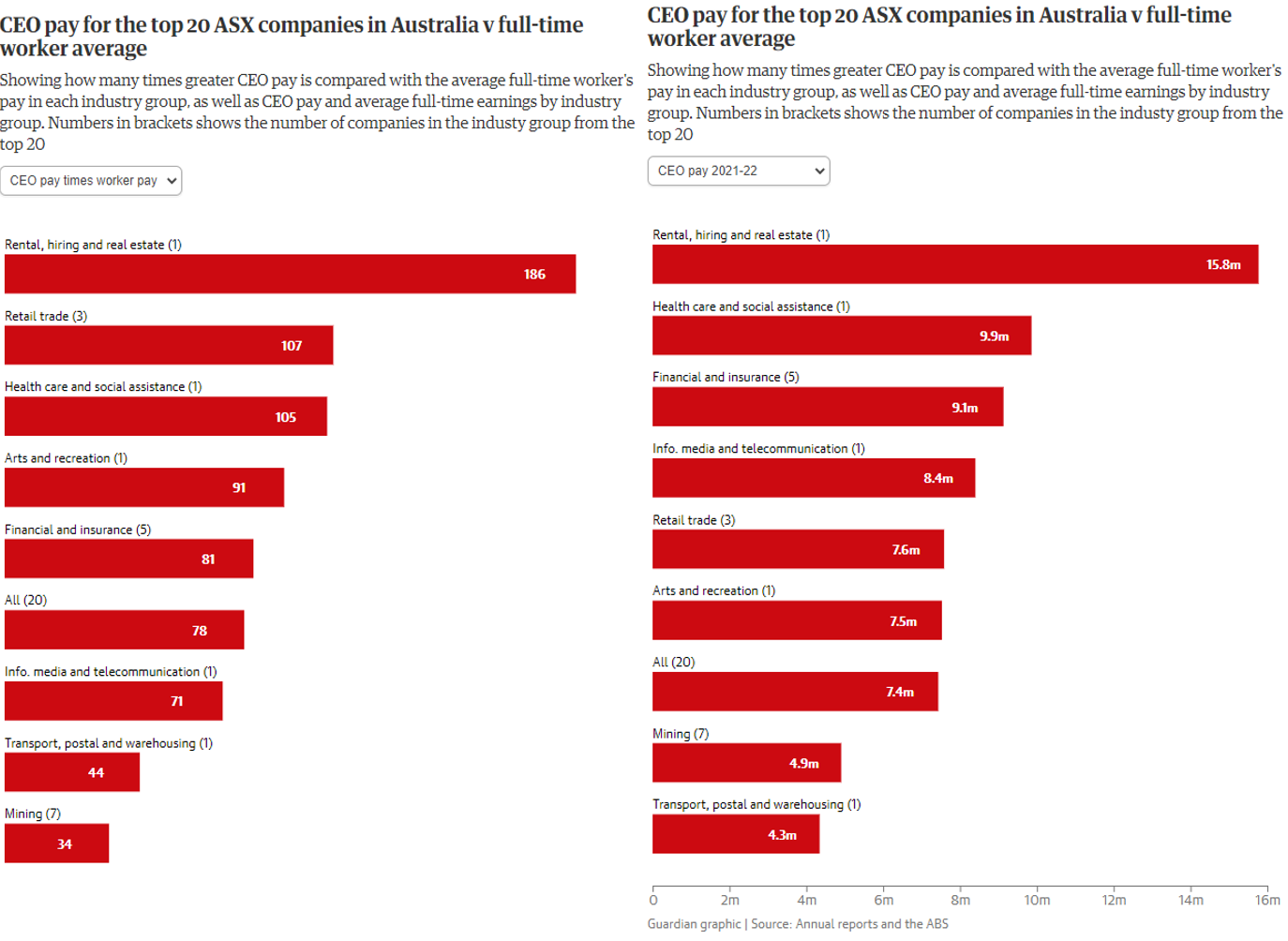
The Australia Institute’s executive director Richard Dennis argues people with annual earnings of more than $1 million should be subject to an income tax rate of 60%.
This follows the release of data showing that the CEOs of Australia’s top 20 listed companies received an average pay rise of 17.2% in 2021-22. In contrast, average earnings for full-time workers rose by just 1.9% in the year to May, which represents a pay cut in real terms given the rise in the inflation rate over the period:
“If the companies want to hand away shareholders’ money so freely, I can’t see any economic or democratic reason why we shouldn’t collect some of that back in the form of a new income tax threshold,” [Richard Dennis] said…
“Did CEOs work 17% smarter this year?” Dennis said. “Did they work 17% harder this year, and when they sat down with their boards, did they prove that they were 17% more productive?
“That is really important, because how does a librarian prove that they’re more productive this year? How does the childcare worker prove that they’re more productive this year?
“Of course it’s impossibly difficult and their employers know that. But their employers, the CEOs, don’t apply the same rules to their own remuneration. It’s no accident.”
He said that the reason CEO pay rose was because it was largely linked to company profits.
Across the top 20, profits after tax surged by an average 53% in the most recent reporting period, excluding companies that swung back into profit after making a loss, Guardian Australia data shows.
“So when the wage and salary earners work harder, and work smarter and get real wage reductions, then of course profits go up,” Denniss said.
“And of course, the CEO salary goes up, but the CEO doesn’t have to prove what they did. They’ve got a slice in the performance of the business – a slice that their employees are entitled to.”
It’s hard to disagree with anything Richard Denniss has said.
Advertisement
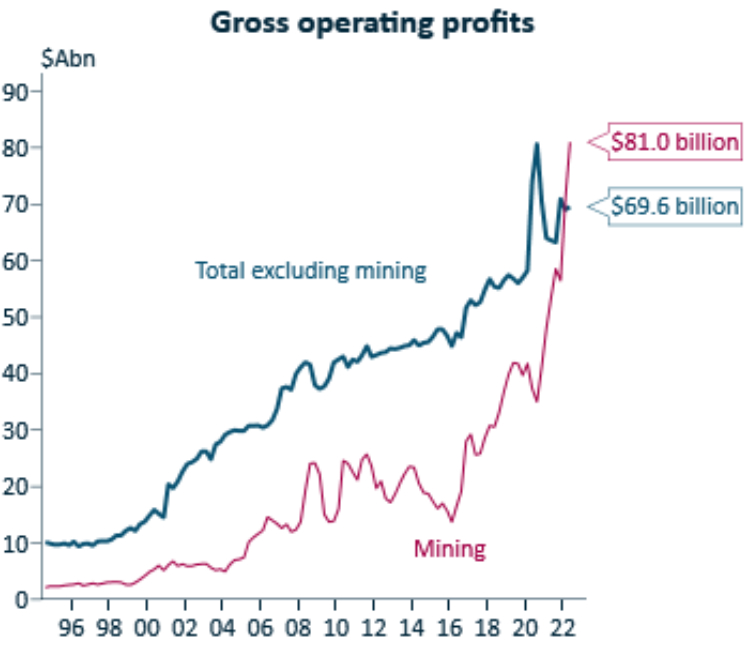
Really, Australia should implement both ‘super profits’ taxes on the mining sector:
Alongside ‘super income’ taxes on uber high income earners, as outlined above.
Advertisement
Both would raise many billions of dollars in additional tax revenue for the federal government, reducing the budget deficit and enabling more spending on public programs and social security.
Sadly, the chance of either happening is buckley’s and none.
Leith van Onselen is Chief Economist at the MB Fund and MB Super. He is also a co-founder of MacroBusiness.
Leith has previously worked at the Australian Treasury, Victorian Treasury and Goldman Sachs.