
As expected, China is being forced to stimulate MOAR as the triple shock of zero-COVD, property market crash and trade shock metastasises. Goldman describes the latest efforts.
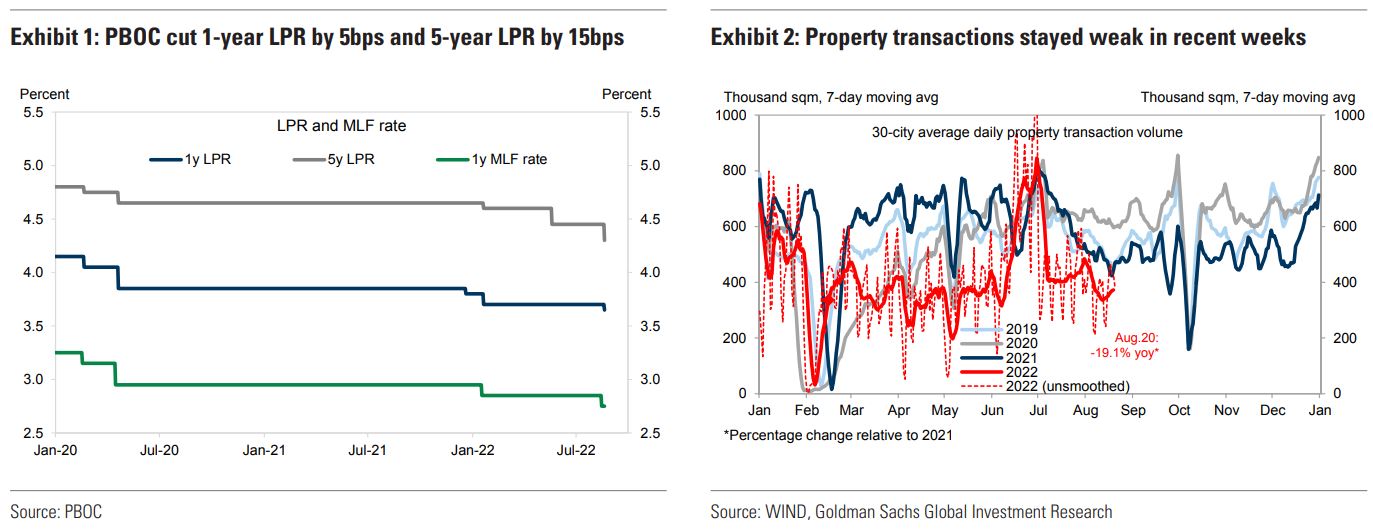
Following the 10bp cut to key policy interest rates last week, the PBOC announced cuts to the LPR this morning (August 22nd). Specifically, the 1-year LPR will be lowered by 5bp to 3.65%, and the 5-year LPR will be lowered by 15bp to 4.30%. LPR cuts were widely expected (Bloomberg consensus suggests the market expected 10bp cuts to both the 1-year and 5-year LPR) after the PBOC lowered key policy interest rates last week. We think the asymmetric cuts (smaller than expected cut to 1-year and bigger than expected cut to 5-year) aim to support long-term borrowing and in particular mortgages, as overall credit supply remains ample while credit demand is sluggish. The property downturn has been one major drag to overall activity growth, and property indicators have deteriorated further in recent weeks. In addition to LPR cuts, in recent days, policymakers have announced a series of supportive measures to the property sector, including policy banks’ credit support to property projects that faced delayed deliveries, and guarantees to onshore new bond issuance for selected private property developers.
1. Following the 10bp cut to key policy interest rates last week, the PBOC announced cuts to the Loan Prime Rate (LPR) this morning (August 22nd). Specifically, the 1-year LPR will be lowered by 5bp to 3.65%, and the 5-year LPR will be lowered by 15bp to 4.30%.
2. The smaller than expected cut to the 1-year LPR might reflect the fact that overall credit supply remains ample and front-end market rates have been very low. July loan data showed strong bill financing growth but weak medium to long term loan growth, and policymakers have continued to urge commercial banks to accelerate loan extensions. Weak credit demand (in particular amid the property sector downturn) is thus the key constraint for overall credit growth in our view.
3. The asymmetric and slightly bigger than expected cut to the 5-year LPR aims to support long-term borrowing and in particular mortgages in our view. Nationwide first-home mortgage rate floor would be lowered further to 4.10% after today’s cut from 4.25% previously. According to Beike, effective mortgage rates for first-home buyers in 100+ cities was 4.35% in July, around 1.4pp lower than the level in September last year, the recent peak of effective mortgage rates. Effective mortgages rates for new homes might be lowered further after today’s cut, which could help with property demand on the margin. The bigger than expected cut to the 5-year LPR came under the backdrop of further deterioration in property indicators. The recent mortgage boycott worsened property developers’ funding conditions and further dampened sentiment in the overall property market. Property transactions in top cities declined by 16% yoy last week (August 19th), and growth in new home starts and completions remained deeply negative in July, at -45.4% yoy and -36.0% yoy, respectively.
4. Policymakers announced more property easing measures in recent days. Apart from today’s LPR cut, the Ministry of Finance, PBOC and Ministry of Housing and Urban-Rural Development recently announced that policy banks would extend targeted lending to property projects that faced delayed deliveries to protect homebuyers’ rights. Policymakers would also help provide guarantees to onshore bond financing of selected private property developers, to ease liquidity stress of private property developers after recent locally-based mortgage boycott, and also to help restore confidence in private property developers. Having said that, in the official statement, policymakers reiterated “housing is for living in, not for speculation”.
5. Interest rate cuts and funding support to private property developers and property projects could help the property sector on the margin, but whether these measures would be sufficient remains to be seen as policymakers stick to the broad guideline that “housing is for living in, not for speculation”. In light of overall weak activity growth, uncertainties around the property sector outlook, and households’ low willingness to buy properties, the property sector downturn might remain an unsolved problem for the overall economy, and more policy easing is still needed to support overall economic growth in coming months. We do expect more local government bond issuance beyond this year’s budget in the next few months to further boost infrastructure investment, while on monetary policy, due to rising food prices and potential spillover effects from developed markets’ monetary policy tightening, the PBOC might not be in a rush to deliver more interest rate cuts in our view.
What will this achieve? Sweet FA. Pantheon has more.
More support has been announced for China’s property sector, but it won’t provide an immediate fix. The one- and five-year loan prime rates were cut by 5bp and 15bp respectively on Monday, following the 10 bp cut to the MLF rate last week. The five-year
rate is the benchmark used for mortgage lending, though existing loans won’t be repriced until 2023.
But regardless of timing, we see rate cuts as almost impotent, at this juncture.
The key obstacle to buying a home is not the cost or availability of financing for prospective borrowers, both of which have been steadily lowered over the last twelve months to little effect. Instead, it is the uncertainty that developers will be able to deliver, which makes buying a home on a pre-sale basis a very risky endeavour, particularly using debt. Firsttime buyers are also squeezed by a shaky labour market, with youth unemployment hitting new records every month.
Policymakers are slowly moving to tackle this problem. A joint announcement on Friday unveiled a RMB 200B fund aimed at completing stalled housing projects. The fund had previously been rumoured but without confirmation of its size, which we discussed here. We are still sceptical that the fund is large enough to provide a full fix.
Zhengzhou’s government, for example, is spending RMB 20B to acquire 50,000 units as part of a local bailout, which suggests the RMB 200B announced on Friday might cover half a million properties; roughly equivalent to the outstanding presale units of just Evergrande in late 2021. Rather than a systemic fix, therefore, we think the funds are aimed at calming the mortgage boycott, which has spread to 100 cities so far. Consequently, the fund will not herald a turning point for China’s real estate sector. But we are encouraged that the central government is—at last—deploying its balance sheet.
I will go further and say that so long as Bejing maintains that “houses are for living in, not speculation”, then there is no reason to ever buy another investment property again in China.
And without houses, Chinese growth is fooked.
