
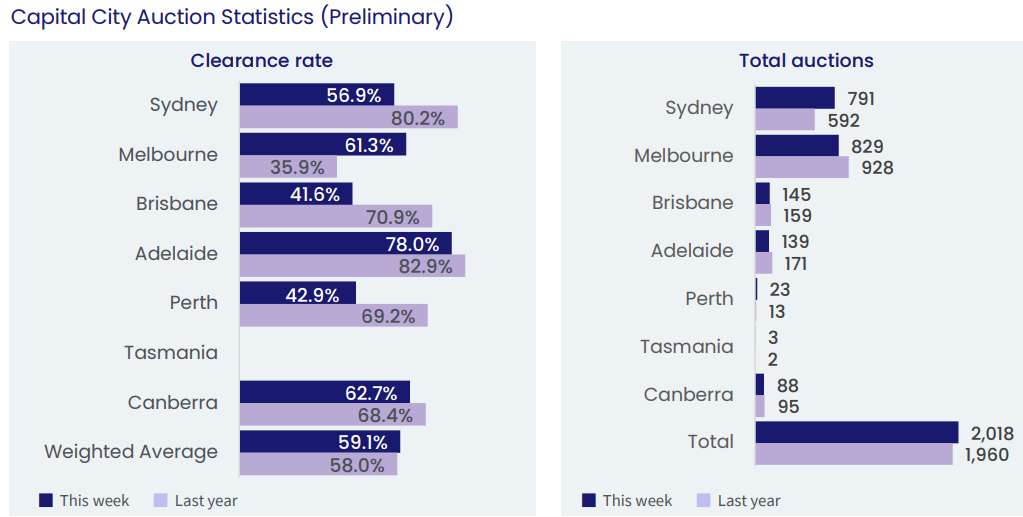
The nascent rebound in Australia’s auction market stalled over the weekend, with CoreLogic’s preliminary auction clearance rate falling below 60% for the first time in three weeks.
Nationally, 59.1% of Auctions returned a successful result, down 3.5% from last week’s preliminary rate (62.6%, revised down to 58.8% at final figures).
Sydney recorded its lowest clearance rate in three weeks (56.9%), and highest withdrawal rate in eight weeks (25.4%). Whereas Melbourne’s preliminary clearance rate fell 3.7% this week to 61.3%.
Auction market still weak.
After only four of his eleven properties sold, leading Sydney auctioneer and Real Estate Influencer, Tom Panos, still declared that “we’re very close to the bottom” because “this won’t be a super Spring of stock”:
“I think we’re going to get more listings like we seasonally do… But we are not going to get a lot more. The reason why is there is no evidence of distressed selling. And because there is no evidence of distressed selling, you’ve got vendors that are saying ‘I’m not going to come onto the market. At the moment I don’t like the clearance rate. And because I don’t like the clearance rate, my property is not going to sell. So because I don’t have to sell, I’m not going on the market’.
“What that does, it creates this domino effect of less stock being on the market, which I think is probably going to protect any further major price reductions”.
“I still think we are going to get some kind of negative price reduction… And most likely that’s going to happen in September when there’s a little more stock. But we are not going to have this glut of oversupplied listings just sitting there not being sold, which will probably create a barrier to price drops”…
“We’ve got more buyers looking than we have had for many, many months when you are looking at Sydney and Melbourne… But of course, the big question we’ve got coming is we’ve got a big interest rate rise”…
My counter to Panos’ argument is that Sydney house prices (-5.8%) are already falling at their fastest quarterly pace since 1983, whereas Melbourne’s (-3.7%) are falling at their fastest quarterly pace since early 2019:
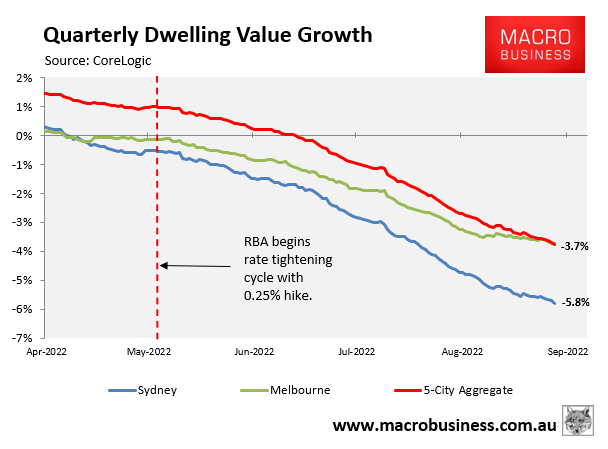
Sydney and Melbourne house prices plummeting.
These sharp price falls have occurred without a ballooning in listings or distressed sales. Rather, they have been driven by the Reserve Bank of Australia’s (RBA) aggressive interest rate tightening, which has severely limited borrowing capacity and ergo buyer demand.
Ultimately, how far Australian house prices will fall depends most on what the RBA does with interest rates, with the volume of listings over Spring playing second fiddle.
If the RBA continues to hike aggressively, as predicted by the more bullish economists and the futures market, then prices will fall heavily.
But if the RBA stops hiking, then prices will stabilise. The housing market’s destiny is in the hands of the RBA.
Regardless, I cannot see Aussie house prices rebounding until after the RBA begins cutting rates, which probably won’t occur until at least mid-2023.
