Gareth Aird at CBA is the bank economist to watch these days.
——————————————————————
The S&P Flash Australia Composite PMI today will likely cause policymakers some angst. The headline index printed just below 50 which indicates a contraction in business activity over August.
The RBA August Board Minutes noted that, “the Board expects to take further steps in the process of normalising monetary conditions over the months ahead, but it is not on a pre‑set path. It is seeking to do this in a way that keeps the economy on an even keel. The path to achieve this balance is a narrow one and subject to considerable uncertainty.”
The PMIs today highlight just how narrow that path is. And they signal that if the RBA continues to tighten policy aggressively the private economy will likely go backwards. That is not what the RBA is trying to achieve.
The Composite PMI last printed below 50 in January 2022. But that was when the Omicron wave coupled with more people than usual on leave from work caused a sharp slowdown in private activity. The January 2022 result was bookended by strong outcomes in December 2021 (54.9) and February 2022 (56.6). So the January data was noise and not signal.
Today’s result is different. The Composite PMI has softened for the past four months. The move into contractionary territory over August was simply an extension of the recent trend (the Composite PMI was 51.1 in July and 52.6 in June).
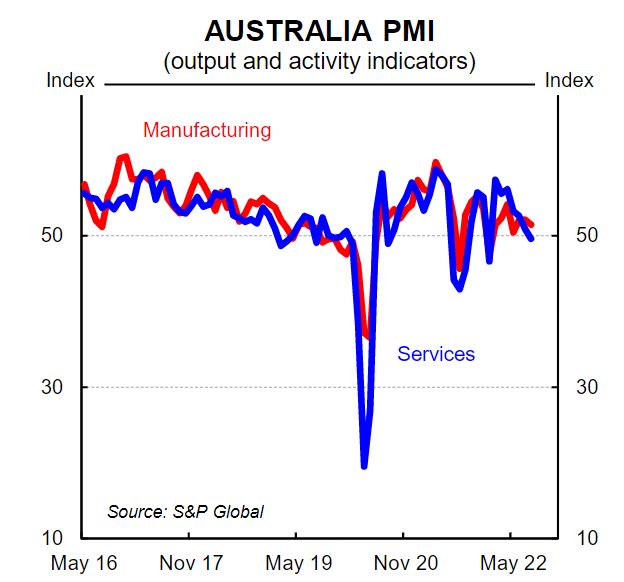
Australia’s services sector is where demand went backwards over August, although weaker growth in activity in the manufacturing sector was also posted. The Australian services sector dwarfs the manufacturing sector in size which means activity in the services sector largely drives the Composite PMI.
According to S&P on the services side, “inflationary pressures and recent interest rate hikes reportedly contributed to the renewed decline in business activity. Panellists also linked deteriorating consumer confidence and uncertainty to the contraction”.
The August MI/WBC consumer sentiment data (very weak) sat at odds with the NAB July Business survey (reasonably strong – see here). But the August PMIs, which are a timelier read on the private economy, narrows the disparity between the consumer and business survey data. Indeed S&P noted today that business confidence slumped to its lowest level since April 2020 as optimism at both manufacturers and service providers weakened.
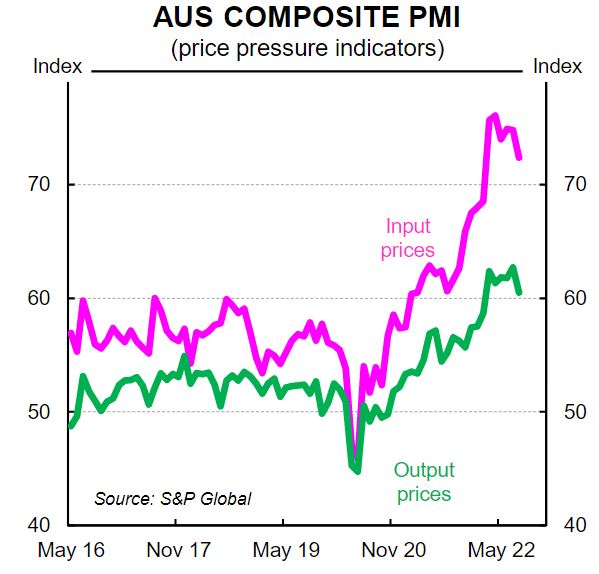
The inflation gauges in the survey indicate that price pressures remain substantial. That said, they have eased from recent peaks. We expect inflation pressures to remain firm over the rest of 2022 and the annual rate of inflation will continue to lift.
But inflation is a lagging indicator and monetary policy works with a lag, particularly with respect to inflation. There are tentative signs that the inflationary pulse is easing a little. This is a bright spot in today’s release.
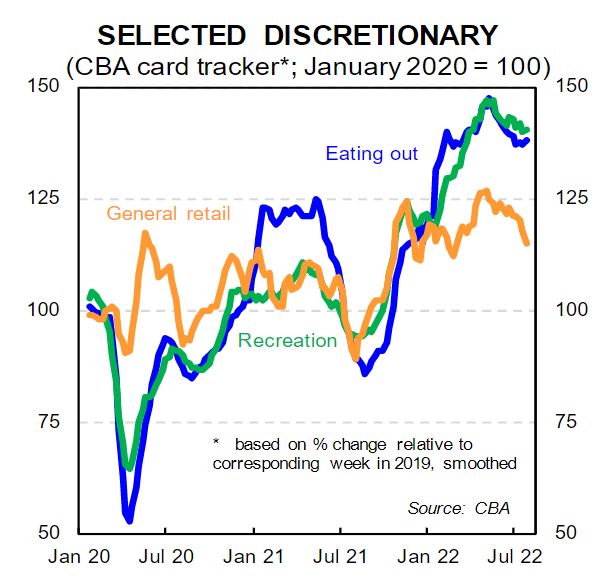
Regular readers will recall that we have written a lot about the significant dichotomy that is in the domestic economic data presently. The crosscurrents in the data will remain with us over the rest of the year. Backward looking labour market data will be robust, wages growth will accelerate and inflation will remain elevated. But forward looking data has deteriorated and further weakness is expected (this includes consumer sentiment, home prices, housing lending, building approvals and the PMIs). Our latest internal data on consumer spending, which is a coincident indicator, has also showed spending growth is moderating (see here).
The PMI data today supports our RBA call. We see the cash rate target peaking at 2.60% in late 2022 (a level which we consider to be contractionary). And we have two 25bp rate cuts pencilled in for H2 23. We think that provided the RBA pause in their tightening cycle when the cash rate is ~2.60% (close to the 2.5% level the RBA have nominated as their estimate of neutral, which is ~100bp above our assessment of neutral) the data will indicate that there is no need to continue to take the policy rate higher. Indeed taking the cash rate higher would likely generate a hard landing in the economy.
As a reminder, the RBA has put through an incredible amount of tightening already in a very short space of time (175bp over four meetings; i.e. three months). And there is a lag between changes in the cash rate and the impact it has on monthly cash flow for borrowers on a floating rate mortgage. At CBA, for example, by December the impact of already announced rate rises on monthly cash flow for mortgage holders will be a four‑fold increase compared to July.