Coolabah Capital’s Chris Joye gave another dissertation on Australia’s housing market, which he says is headed for a “record collapse” that is “only likely to get worse” as the Reserve Bank of Australia’s (RBA) aggressive rate hikes bite:
The entire east coast of Australia, which accounts for the vast majority of the population, is experiencing a record housing collapse that is only likely to get worse given most borrowers have yet to feel much in the way of mortgage repayment pain.
The big news in August is that the Brisbane and Gold Coast housing markets have given up the ghost after defying gravity for a few months. Adelaide is not far behind…
Sydney remains the epicentre of the housing crash… They have been falling at a 19 per cent annualised rate since the RBA’s first rate increase at the start of May.
I know these facts are uncomfortable for property spruikers to hear, but there is little point denying that Aussie housing is likely to weather its largest correction since records began in the early 1980s…
If you are half-smart, you will focus on the fact that borrowers have only experienced one to two of the Reserve Bank of Australia’s four interest rate increases since May due to delays in the banks’ operational implementation of changes to borrowers’ actual repayments…
While borrowers know that the wolf is at their door, they have yet to have their cash flows materially impacted.
CoreLogic’s daily dwelling values index certainly backs up Joye’s claim.
While dwelling values across the five major capital cities have only fallen by 3.8%, led by Sydney (-6.7%) and Melbourne (-4.2%):
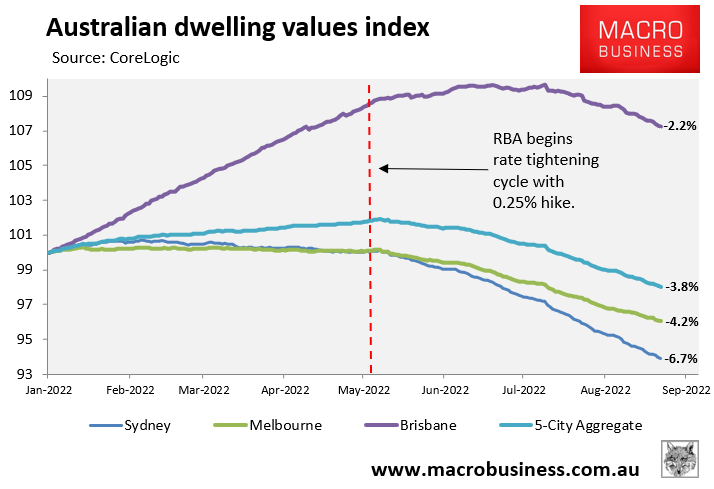
Sydney leads national house price decline.
The pace of price decline is stunning. As illustrated in the next chart, quarterly losses at the 5-City aggregate level are running at 3.5% – the fastest pace of decline since 1983:
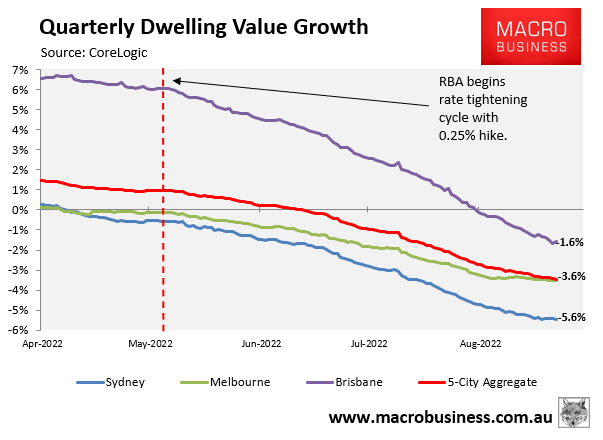
Australia’s major capitals are declining at the fastest pace since 1983.
Sydney’s quarterly decline (-5.6%) is also the sharpest since 1983, whereas Melbourne quarterly values (-3.6%) are falling at their fastest pace since February 2019.
How deep Australia’s housing bust goes will obviously depend on whether the RBA continues to hike rates aggressively.
If the futures market gets its way, and the official cash rate is lifted to 3.6% by mid 2023 (implying an average discount variable mortgage rate of around 7%), then Australia is facing its biggest house price crash in living memory.
The Australian economy would also risk a recession via the negative transmission to household consumption, which is easily the biggest driver of growth, alongside dwelling construction.
For these reasons alone, the RBA needs to tread carefully with rate rises.