
Westpac’s Bill Evans with the index. It’s difficult to see how the economy could bounce in the face of aggressive interest rate hikes from the RBA and crashing house prices.
Household consumption drives the economy and should fall as both rising mortgage repayments and the negative wealth effect from falling house prices bite.
____________________________________________________________________________________________
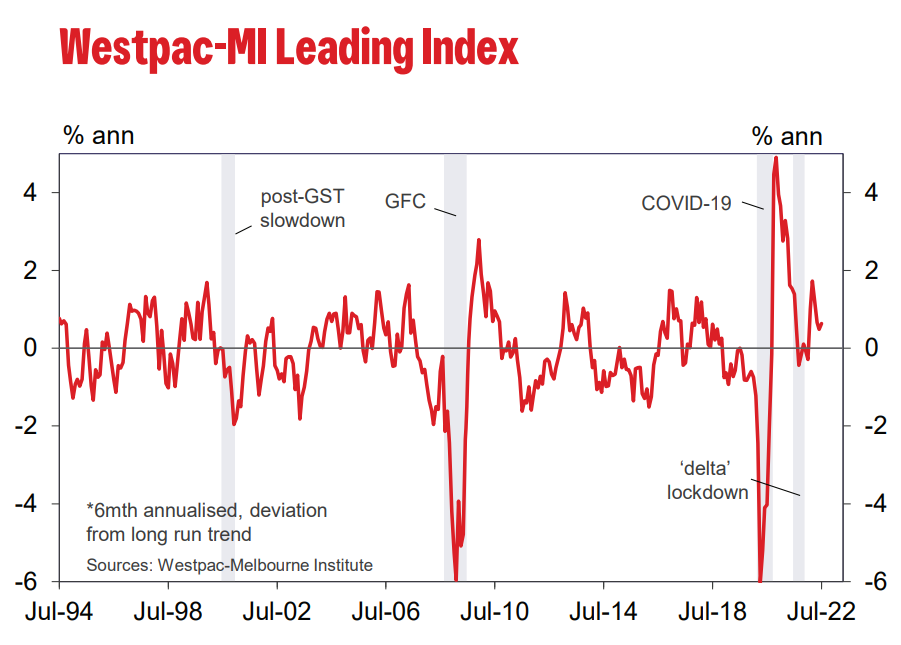
- Growth rate nudges up from 0.48% from 0.63%.
- Still pointing to above trend growth in 2022 H2.
- Strong labour market offsetting weak confidence and rising rates.
The six-month annualised growth rate in the Westpac-Melbourne Institute Leading Index, which indicates the likely pace of economic activity relative to trend three to nine months into the future, increased to 0.63% in July from 0.48% in June.
The Index growth rate has held broadly steady over the last three months after an abrupt slowdown earlier in the year from a strongly above trend starting point. Latest reads are consistent with momentum continuing to track slightly above trend heading into year-end.
While overall momentum in the economy remains above trend we expect that as we near the final quarter of the year growth in spending will slow under the weight of rising interest rates and high inflation which are already sapping confidence.
However, these negative forces are, for now, being compensated by a very strong labour market and solid household balance sheets.
Components of the Index are consistent with that story.
The gradual easing in the growth rate of the Index is consistent with the expected slowdown in the economy by year’s end.
The moderation in the Leading Index growth rate over the last six months – from 1.01% in February to the current 0.63% – has been driven by three main factors: interest rates, commodity prices and sentiment. The RBA’s rapid re-tightening has seen a sharp narrowing in the yield spread, taking –0.51ppts
off the Index growth rate. A pull-back in commodity prices, down 10.3% since May in AUD terms, has taken off a further –0.2ppts; compounded by weakening consumer sentiment – the combined effect of sharp falls in the Westpac-MI Consumer Expectations Index and less bullish reads on the Westpac-MI
Unemployment Expectations Index taking a further –0.36ppts off the Index growth rate.
These drags were partially offset by better reads on aggregate monthly hours worked (adding +0.31ppts); stabilising dwelling approvals (+0.28ppts); and a rally in equity markets (+0.12ppts).
The Reserve Bank Board next meets on September 6.
While the Minutes of the August Board meeting confirm that policy is not on a ‘pre-set path’ we expect that the Board will decide to increase the cash rate by a further 50bps from 1.85% to 2.35%, extending the series of 50bp increments to four consecutive meetings.
That would lift the policy stance into what we believe is the Board’s assessment of the neutral zone.
The level of rates thereafter will be in the contractionary zone and a slower pace of increases to 25bp increments can be adopted.
With inflation pressures continuing to intensify it is important that the Board continue to raise the cash rate at every meeting for the remainder of 2022 and into 2023 when we expect the final increase at the February Board meeting.
