
Aussie home builders hurtle off insolvency cliff
Just 953 companies in Australia’s construction sector were declared insolvent during 2020-21, due in large part to government support measures in response to the pandemic. This compares with 1,447 insolvencies in 2019-20.
However, the number of number of construction firms entering external administration rose to 1,282 in 2021-22, after government relief measures were withdrawn. Construction industry groups have also warned of a looming increase in insolvencies across the sector, amid the rising cost of materials. They have, therefore, demanded the government implement bankruptcy protections for the industry:
A confluence of factors including soaring material costs, global competition for workers and supply-chain problems has sparked warnings from peak bodies that the building industry is “marching towards a cliff”…
A coalition of peak associations and unions have joined to call on the federal government to better protect businesses from bankruptcy, urging the commonwealth to crack down on “unfair” contractual terms that often underpin the sector’s high rates of failures…
The group – including National Electrical and Communications Association, Master Electricians Australia, Electrical Trade Unions – has written to Ms Collins, Employment Minister Tony Burke, Industry Minister Ed Husic and Assistant Minister for Competition Andrew Leigh with its list of demands…
“During the pandemic the numbers dropped off significantly off the back of the government measures, including when the government introduced changes to allow businesses to trade while insolvent, but they have bounced back up,” Mr Judd said.
The irony here is that Australia’s home builders are busier than ever. As shown in the next chart from the RBA’s latest Statement on Monetary Policy, the pipeline of houses under construction has swelled to an all-time high:

Pipeline of houses under construction at an all-time high.
Despite this, building insolvencies are marching higher, with literally dozens of major companies folding this year alone. This has left hundreds of Australians out-of-pocket with unfinished homes.
IBISWorld recently forecast that thousands of builders will collapse in 2022-23, with the number of firms “contracting for the first time in a decade”:
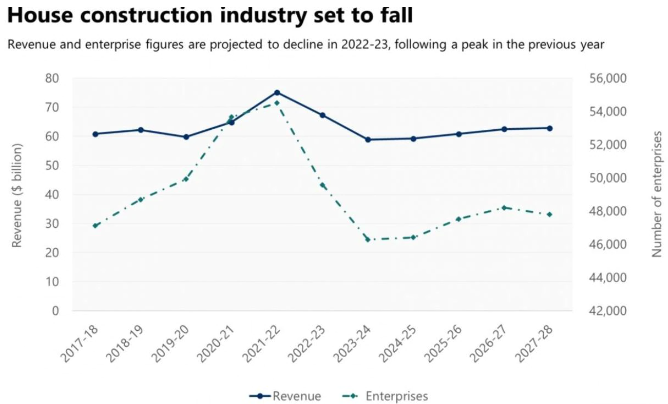
Thousands of Aussie home builders to fail.
The key problem is that ultra-low interest rates and the Morrison Government’s HomeBuilder stimulus led to thousands of building contracts being signed at fixed prices. Then the cost of key building materials, such as steel and timber, soared by more than 40% in just one year on the back of global supply constraints. As a result, builder margins turned negative.
The below chart from the ABS’ June quarter CPI release highlights this cost inflation, with new dwelling prices soaring by a record 20% in the 2021-22 financial year:
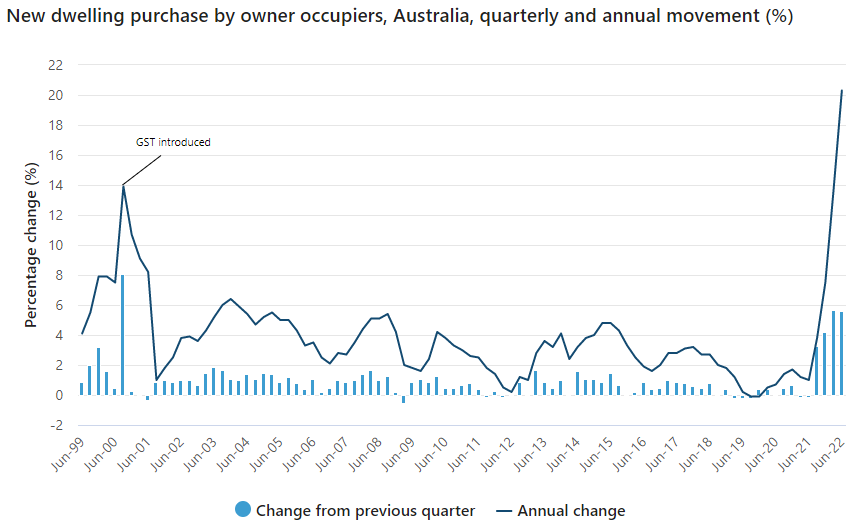
Extreme cost inflation drives new dwelling prices higher.
The end result is that builders are hard at work bleeding money at an alarming rate, pushing many into insolvency. It is, therefore, a “loss-making” boom for the industry.
The longer-term implications are worrying given it could leave Australia with a reduced building capacity at the same time as the Albanese Government ramps-up immigration (housing demand) to record levels.
It’s a disaster in the making.
