
As if zero-COVID and the property were not enough for China to cope with. Now it is drought. More CNY falls ahead. Mizuho on other consequences.
In August, China was hit by an unprecedent heat wave, with a severe drought along the Yangtze= River, which led to power rationing for commercial buildings and industrial plants as well as restrained outdoor activity in those regions.
Affected by those factors, China is likely to see another month of sluggish growth in August. That said, the impact is expected to be short-lived as the weather cools in early September. Meanwhile, we are more concerned about a material cut to China’s Autumn harvest caused by the drought. If that is the case, China may see elevated food inflation over a much longer period, leaving less room for further monetary easing while also eroding household purchasing power.
• China saw an unprecedent heat wave in August. A red alert (temperature ≥ 40°C) was issued by the Meteorological Bureau at the national level for the first time on record and lasted for 12 days. Following the heatwave, a severe drought hit a wide range of areas along the Yangtze River, including Chongqing and Sichuan. Note that the Yangtze River is seeing its water level fall to a record low at this time of the year.
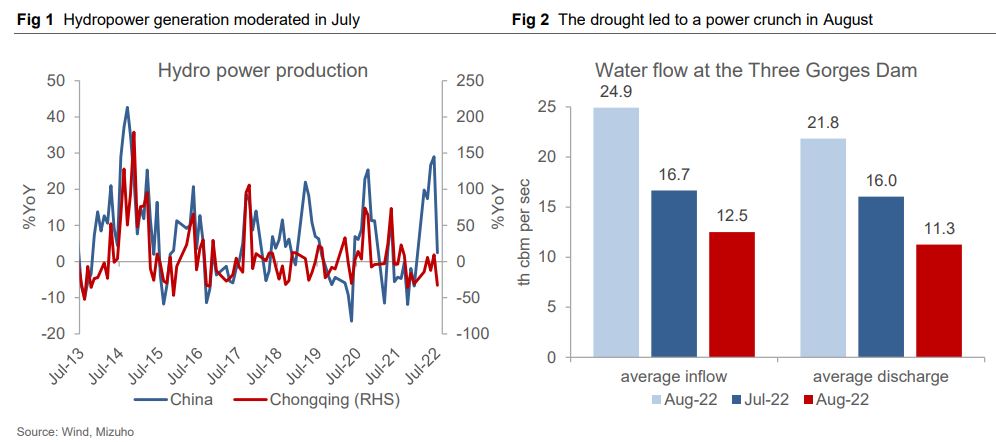
• As a result, China is suffering from a power shortage amid slumping hydropower production. Just before this heat wave, national hydropower production rose 2.4% YoY in July, notably slowing from June’s 29% increase, while Chongqing, a megacity sitting on the Yangtze River, saw its hydropower production slump 32.9% YoY in July (Fig 1).
• Although August’s power data is not out yet, the situation is expected to be much worse. Month-to-date, water discharged from the Three Gorges Dam, the world’s biggest power plant, fell 29% MoM or 42% YoY on average (Fig 2). Note that hydropower contributes about 19% of total power production in China in August.
• In our view, the widespread heat wave and the drought in the southwest may weigh on the economy through:
o Power rationing. As the heat wave greatly spurred the use of air conditioning among households and pushed the peak load demand above the maximum capacity of local power supply in places like Shanghai, Jiangsu and Zhejiang, those local governments had to ration power use by commercial buildings and industrial plants. The power shortage would be worse for places that rely more on hydropower, such as Chongqing.
o Restrained outdoor activity. For those areas hit by the heat wave, outdoor work, especially on construction sites, was suspended during daytime. That said, subway ridership in those major cities held up well in August.
o Threats to the autumn harvest. The severe drought is expected to affect China’s autumn harvest, especially for corn and rice. Note that regions along the Yangtze River and Sichuan basin contributes almost half of the country’s rice production.
• In this sense, it is almost certain that August would be a month of weaker growth and higher food inflation for China. That said, the impact from power rationing and restrained outdoor activity is expected to greatly ease as the weather cools in early September, and another power crunch similar to the one seen last Autumn is very unlikely.
• Meanwhile, if the drought causes a material reduction to Autumn’s agricultural output, China may see elevated food inflation over a much longer period, leaving less room for further monetary easing and also eroding household purchasing power. Note that food comprises 20% of China’s CPI basket.
