
CoreLogic’s daily dwelling values index, which tracks price changes across the five major capital city markets, fell another 0.39% in the week ended 25 August. This was the 16th consecutive weekly decline:
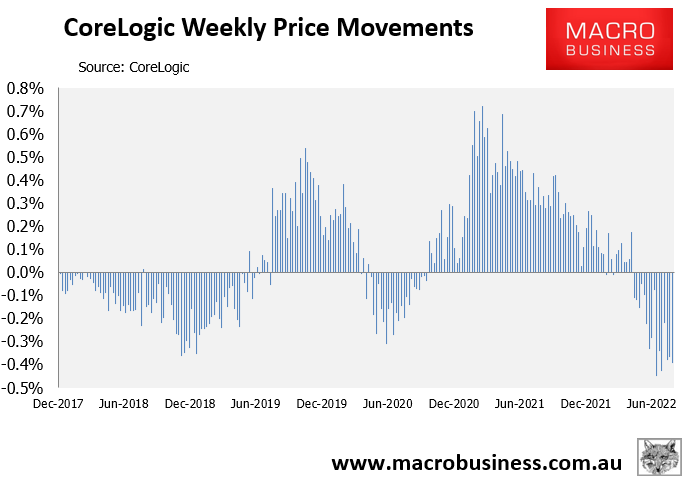
16th consecutive weekly fall.
Every major capital city market recorded falling values over the week, with Brisbane (-0.58%) and Sydney (-0.51%) leading decline:
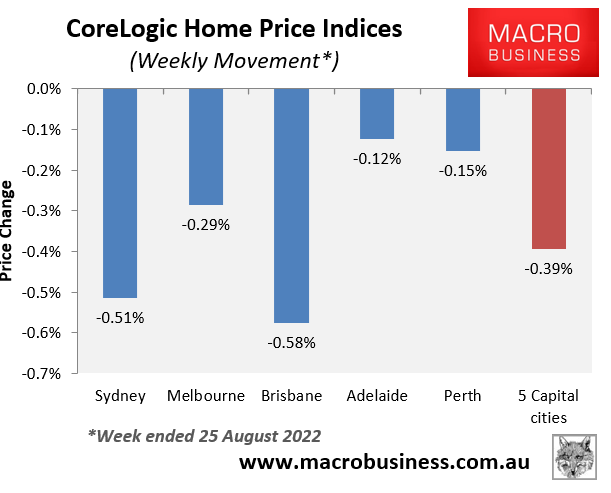
Coast-to-coast house price falls.
So far in August, dwelling values have fallen 1.21% at the 5-City aggregate level, driven by heavy losses across the three biggest markets:
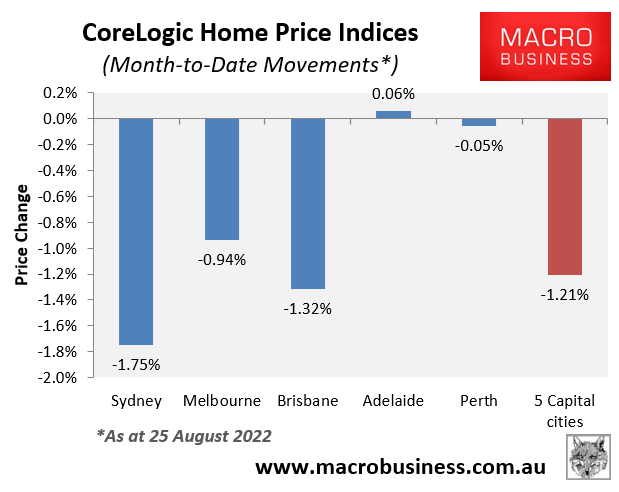
Sydney, Melbourne and Brisbane drive house price declines.
The next chart shows the cumulative decline-from-peak across the five major Australian capitals:
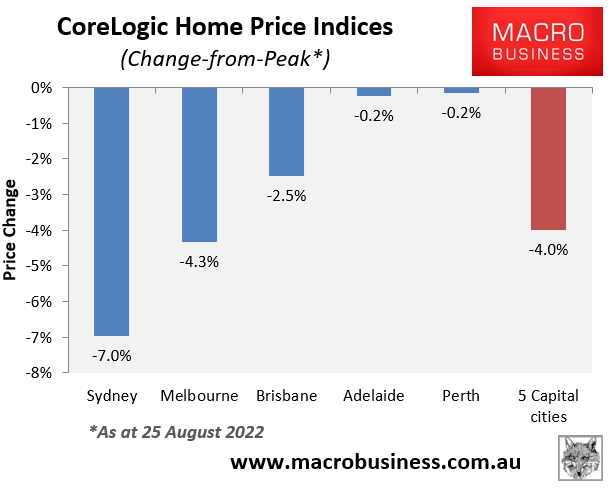
Values down across every major capital.
Sydney (-7.0%) and Melbourne (-4.3%) continue to lead the correction, with Brisbane (-2.5%) catching-up. Interestingly, both Adelaide and Perth have belatedly joined the bust, with values down 0.20% respectively from their recent peaks.
The next chart shows that quarterly growth is negative across Sydney (-5.6%), Melbourne (-3.6%) and Brisbane (-1.9%), with Brisbane’s pace of decline steepening:
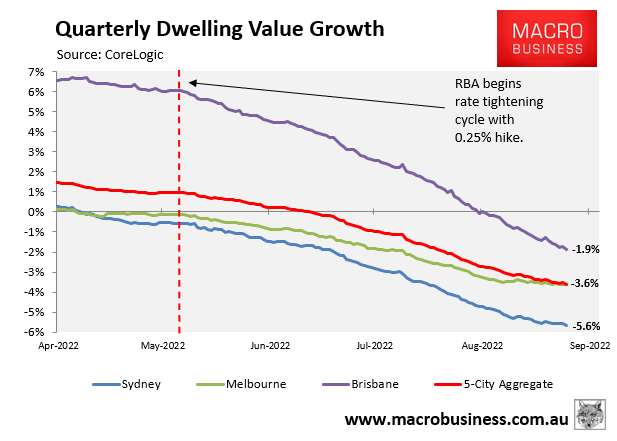
Quarterly values decline across Sydney, Melbourne and Brisbane.
While quarterly growth remains positive across Adelaide (+2.1%) and Perth (+0.4%), the rate of growth has slowed significantly. This reflects the recent declines in response to the Reserve Bank of Australia’s (RBA) aggressive rate hikes:
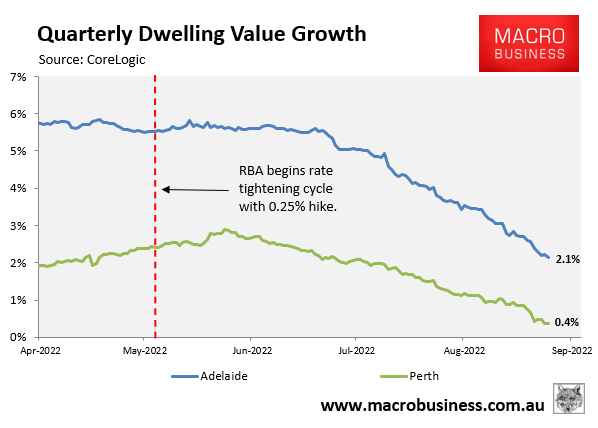 With the RBA expected to continue lifting rates through the remainder of this year, heavy price falls will continue across Sydney, Melbourne and Brisbane, with accelerating falls also likely across the remaining capital cities and the regions.
The bigger worry is that the economy could be pushed into recession via lower household consumption, which is the biggest driver of growth, alongside falling dwelling construction.
For these reasons, the RBA needs to tread cautiously with further rate hikes.
